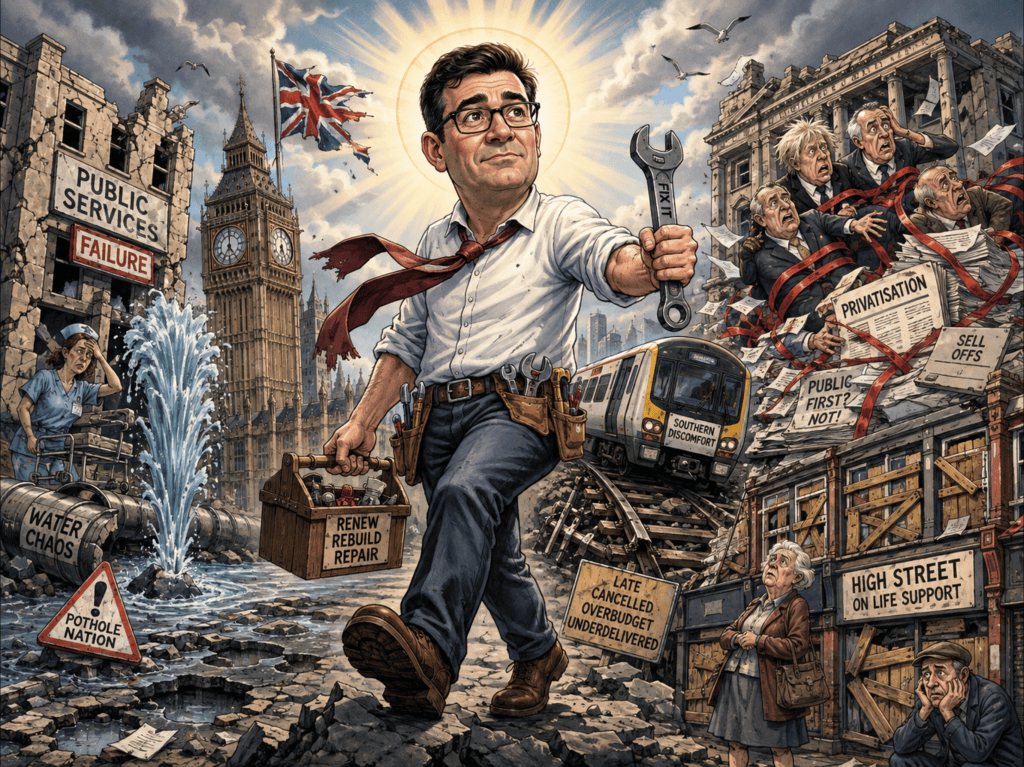
🧛♂️🇬🇧Andy Burnham has finally arrived at the dispatch box, surveyed the smouldering remains of modern Britain and delivered the kind of diagnosis usually associated with a mechanic who has just looked under your bonnet and quietly removed his hat.
The economy is tired. Public services are wheezing. Housing is broken. Infrastructure is held together with cones, temporary traffic lights and the enduring optimism of local councils. Westminster is too centralised, welfare dependency is too high, energy is too expensive, immigration is politically radioactive and the country has somehow managed to borrow enormous sums of money while still giving everyone the impression that nothing works.
In other words, Britain needs fixing.
Thank heavens somebody noticed.
🧛♂️ Dr Burnham Will See the Patient Now
Burnham’s central argument appears to be that Britain has spent several decades making one disastrous decision after another, beginning somewhere around Margaret Thatcher and continuing through almost every administration since.
Privatisation did too much. Austerity did too much. Centralisation did too much. Deindustrialisation did too much. Brexit did too much damage. Governments did too little. Markets did too much. Whitehall interfered too much while simultaneously failing to intervene enough.
It is a wonderfully British political diagnosis because everyone is guilty, everything is broken and the treatment involves reorganising the filing cabinets.
Burnham now wants more public involvement in water, energy, transport and investment while also pushing power away from Westminster.
This sounds contradictory only if you are the sort of narrow-minded person who expects political programmes to make immediate sense.
The vision is apparently that central government should take control of more important things while surrendering control of other important things to regional authorities, who will presumably then spend several years demanding more money from central government so they can exercise their exciting new independence.
To symbolise this glorious decentralised future, Burnham has reportedly embraced the idea of “No 10 North”, which is an inspired concept because nothing says power to the regions quite like opening another Downing Street.
One imagines a future in which every major British city has its own Number 10.
No 10 Manchester.
No 10 Birmingham.
No 10 Newcastle.
Eventually there will be more Downing Streets than Greggs, and true regional equality will finally have been achieved.
Then came welfare.
Burnham says it is indefensible that so many young people are economically inactive or dependent on benefits, which sounds refreshingly straightforward until British politics begins doing what British politics does best: discovering seventeen structural explanations before anybody is allowed to suggest personal responsibility might occasionally have wandered into the room.
Education failed them. Employers failed them. Healthcare failed them. Mental-health provision failed them. The labour market failed them. The economy failed them.
At this rate, Tuesday itself will shortly be accused of creating barriers to employment.
Burnham may well be right that welfare dependency cannot be separated from deeper failures in education, health and opportunity. The awkward part is that fixing those problems requires rebuilding half the country before breakfast.
This makes welfare reform less a policy and more a box set.
Season One: Fix the NHS.
Season Two: Reform Education.
Season Three: Rebuild Regional Economies.
Season Four: Discover Nobody Budgeted for Any of It.
Meanwhile, electoral reform entered the conversation with all the revolutionary energy of a parish council subcommittee.
Burnham did not promise proportional representation. That would have been dangerously specific.
Instead, Britain may one day engage in serious consideration of the possibility that voters could perhaps be consulted about whether they would like to consider changing the voting system.
Robespierre would have been impressed by the restraint.
Immigration produced the usual Westminster miracle whereby a single statistic can apparently have several biological parents.
If small-boat crossings fall, the government deserves credit.
If they rise, international conditions are difficult.
The opposition insists any improvement happened despite the government.
The government insists it happened because of the government.
Somewhere on a beach in northern France, a police officer who has just confiscated an inflatable dinghy is probably wondering why half the House of Commons is claiming his overtime.
Then came defence, where politics returned to one of its most ancient traditions: answering the question that was not asked.
Would Britain increase defence spending to 3% of GDP?
The answer, roughly translated, was that Britain takes defence extremely seriously.
This is the political equivalent of asking a restaurant how much the steak costs and being told the chef has enormous respect for cattle.
There will be spending.
There will be commitments.
There will be reviews.
There will certainly be numbers.
The number you asked for, however, is currently unavailable.
But the line that deserves the greatest scrutiny was Burnham’s claim that “Britain’s defence starts in Ukraine.”
Strategically, there is an argument for that. European security is interconnected, Russia is a genuine military threat and the outcome of the war matters far beyond Ukraine’s borders.
Politically, however, the sentence is striking.
Because governments have spent years insisting Britain is supporting Ukraine without being at war with Russia, while steadily expanding the range of things that apparently do not count as escalation.
Sending weapons is not escalation.
Training troops is not escalation.
Providing intelligence is not escalation.
Supplying longer-range systems is not escalation.
Helping those systems become more effective is not escalation.
At some stage, the average voter may reasonably ask whether the English language has been fitted with an emergency brake.
That does not mean support for Ukraine is wrong. It means governments should be capable of explaining where strategic support ends, what deeper involvement might look like and where the limits actually sit.
Otherwise “Britain’s defence starts in Ukraine” risks becoming another grand phrase whose practical meaning is discovered several spending reviews later.
And that is really the fascination of Burnham’s programme.
He appears to understand that Britain’s problems are not isolated potholes. They are connected cracks running through the whole building.
Housing affects productivity. Infrastructure affects regional growth. Energy prices affect industry. Weak public services affect employment. Immigration pressures affect housing and services. Centralisation distorts decision-making. Low investment drags on productivity. Poor productivity makes everything harder to pay for.
This is the part where the jokes stop being entirely comfortable.
Because Burnham may be broadly correct.
Britain increasingly does feel like a country that has postponed maintenance for thirty years and is now surprised to discover water coming through the ceiling.
The problem is that every politician who identifies a structural crisis eventually reaches the same terrifying stage of the presentation.
The solution.
And Burnham’s solution appears to involve the state doing more, local government doing more, industry doing more, public services doing more, employers doing more and taxpayers somehow remaining calm while everyone does more.
That is ambitious.
It is also expensive.
Britain has heard variations of this speech before.
Every new government enters office declaring that the previous government left behind a dreadful mess. The cupboards are empty. The systems are broken. The infrastructure is crumbling. The finances are worse than expected.
Then, after several years, another government arrives and discovers — astonishingly — that the previous government left behind a dreadful mess.
Britain may not have an economic model anymore, but it has developed a highly efficient recycling industry for political disappointment.
So welcome to the Burnham era.
Andy has entered Downing Street carrying a diagnosis, a reform agenda and, one hopes, an industrial quantity of WD-40.
The patient is on the table.
The lights are flickering.
The Treasury is clutching its wallet.
Whitehall has formed a steering committee.
And somewhere, deep beneath Westminster, the ancient machinery of British government is preparing to respond to demands for radical change by producing a consultation document.
🔥 Challenges: Is Britain Getting Rebuilt — Or Just Rebranded Again?
Burnham may have identified some very real structural problems. The question is whether his government can actually fix them without creating twelve new departments, three commissions, another regional mayor and a five-year review into why nothing has happened.
What do you think? Is Burnham offering the overhaul Britain actually needs, or are we watching Westminster sell another restoration project while the roof continues leaking?
👇 Join the argument in the blog comments, then like and share the post if it made you laugh, swear, nod or throw something soft at the television. 💬🔥
The best comments, sharpest observations and funniest political autopsies will be featured in the magazine. 📰🎯


Leave a Reply