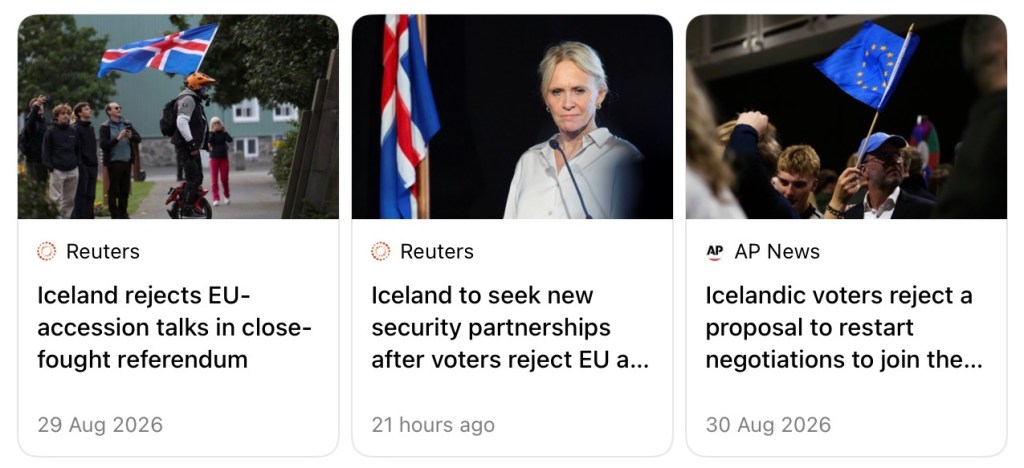
🧊🇮🇸🇪🇺Iceland has looked across the North Atlantic at Brussels, considered restarting talks about joining the European Union, and politely responded with the diplomatic equivalent of: “Nah, we’re good.”
On 29 August, Icelanders weren’t even voting to join the EU. They were voting on whether to reopen negotiations about possibly joining at some unspecified point in the future.
And even that was apparently one European commitment too many.
52.8% said no. 47.2% said yes. Turnout? A whopping 82.5%.
That isn’t voter apathy. That’s practically an entire country putting its coat on just to tell Brussels it won’t be needing a membership form. 🗳️❄️
🐟 Brussels Went Fishing — Iceland Kept the Boat
The great Icelandic problem for Brussels can be summed up in one word:
Fish. 🐟
Lots of them.
And Iceland rather likes deciding for itself who catches them, how many get caught, and what happens to the industry afterwards.
EU membership raises the prospect of eventually negotiating over fisheries policy, quotas and access — which, in a country where fishing remains economically and culturally enormous, is roughly as relaxing a proposition as handing your house keys to a committee and being told they’ll “harmonise the kitchen.”
Iceland already gets many of the benefits of European integration anyway.
It participates in the European Economic Area, enjoys access to the single market, belongs to Schengen, trades heavily with Europe and cooperates extensively with its neighbours.
So from Reykjavík’s point of view, the sales pitch can start sounding suspiciously like:
“Would you like to keep most of what you’ve already got, but with significantly more paperwork and several exciting new opportunities to be outvoted?” 📚🇪🇺
Apparently Icelanders weren’t stampeding towards the brochure rack.
And that’s what makes this awkward.
Iceland isn’t some unstable state peering suspiciously at Europe from the wilderness.
It’s wealthy. Democratic. Highly developed. Deeply European. Already economically intertwined with the continent.
On paper, it looks like the sort of country Brussels ought to be able to recruit before lunch.
Instead, Iceland looked at full membership and effectively said:
“The current arrangement seems fine, thanks.”
That doesn’t mean Iceland has rejected Europe.
It means Iceland has rejected the argument that more EU automatically equals better Europe.
And somewhere inside a Brussels conference room, a PowerPoint presentation titled “The Irresistible Benefits of Ever Closer Union” may just have acquired a rather uncomfortable new slide. 📉🧊
Because if a prosperous European democracy already enjoying enormous integration benefits decides that handing over additional authority isn’t worth the upgrade…
perhaps the problem isn’t Iceland’s reluctance.
Perhaps somebody needs to work on the sales pitch.
🔥Challenges🔥
Here’s the awkward question Brussels probably won’t be putting on a commemorative mug:
If EU membership is such an irresistible prize, why did Iceland refuse even to restart the conversation? 🤔
Is Iceland sensibly protecting its fishing industry and sovereignty?
Has it simply found the perfect European sweet spot — enjoying much of the cooperation without signing up for full political membership?
Or should Brussels be asking why one of Europe’s wealthiest and most stable democracies looked at the membership menu and decided it was already full?
💬 Drop your verdict in the BLOG comments — not just on Facebook. We want the arguments, the jokes, the fury and the fish-related metaphors.
👇 Comment. Like. Share. And send this to someone who still thinks every European country is desperate to get into the EU. 🧊🐟🇪🇺
The best comments will be included in the magazine. 🎯📝


Leave a Reply