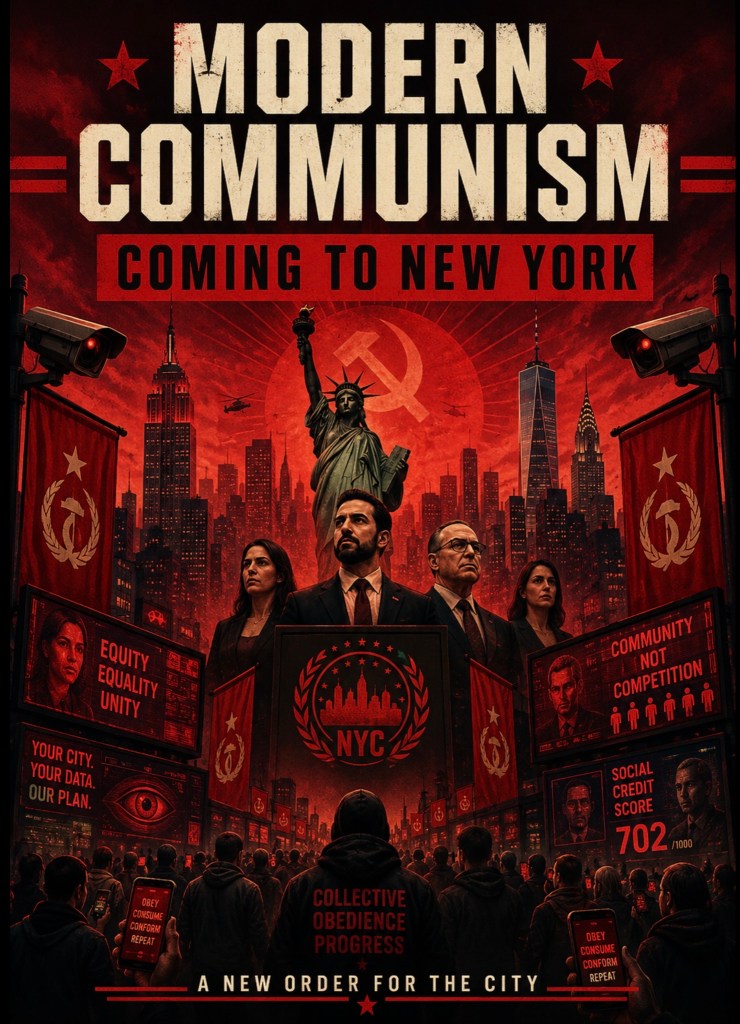
Which apparently means you keep capitalism, keep the millionaires, keep the landlords, keep the private businesses and keep the shops — but gradually allow City Hall to decide what rather more of them should charge, what they should pay, who should subsidise whom and which bits of the economy government might fancy running itself.
So perhaps we need a new expression.
Modern communism.
Not the old-fashioned variety with Lenin, bread queues and somebody arriving at three in the morning to nationalise your toaster.
This is communism with an iPhone.
It comes with excellent branding, social media accounts and an assurance that absolutely nobody is abolishing capitalism.
They are merely improving it until increasingly large parts of it are controlled by somebody else.
Mamdani has already given us perhaps the finest slogan for this new era himself. In his inaugural address he promised to replace the “rugged individualism” of the past with the “warmth of collectivism.”
That is an extraordinary sentence for the mayor of the financial capital of America.
Wall Street must have spilled its coffee.
And Mamdani is not merely talking about philosophy.
New York has now frozen rents on rent-stabilised leases. He wants buses to become free. Universal childcare is being expanded. Wealthier New Yorkers are expected to contribute more towards the bill. And City Hall is preparing to create five municipal grocery stores — one in every borough. (New York City Government)
Yes.
The government is going into the supermarket business.
By July, Mamdani’s administration was promising that a basket of groceries at these municipal stores would be about 30% cheaper, with the city owning the sites, subsidising some of the costs and private operators actually running the shops. (New York City Government)
Which is where Modern Communism becomes rather clever.
You don’t seize the supermarket.
You build another supermarket beside it using public money and announce that capitalism is now invited to compete with the government.
Mamdani himself essentially said precisely that: let the most affordable grocery store win. (New York City Government)
And perhaps it will.
That is the interesting part.
Some of these policies may genuinely prove popular. Free childcare sounds wonderful when you’re paying for childcare. Free buses sound wonderful when you’re paying bus fares. Frozen rent sounds magnificent when you’re the tenant whose rent has just been frozen.
Modern Communism therefore doesn’t arrive carrying a red flag.
It arrives carrying things people quite understandably want.
The awkward question arrives later.
Who pays?
Because the bus isn’t free.
The driver still gets paid.
The childcare isn’t free.
The nursery still has staff, buildings, heating and electricity.
And the groceries aren’t magically 30% cheaper because City Hall discovered a previously unknown species of socialist chicken laying subsidised eggs beneath Manhattan.
Someone somewhere absorbs the cost.
And increasingly Mamdani’s answer is that those with more should pay more.
Again, that isn’t communism by itself. Progressive taxation exists throughout capitalist democracies.
But Mamdani’s political philosophy becomes more interesting when you put all the pieces together.
Freeze the price of one essential.
Subsidise another.
Make another free.
Create a government competitor in another.
Tax wealth more heavily to finance some of it.
Then describe the philosophical destination as greater collectivism.
None of that makes New York the Soviet Union.
But neither is it unreasonable to notice which direction the steering wheel has been turned.
The great political experiment taking place in New York may therefore be something much subtler than communism.
It is an attempt to discover how much of capitalism government can progressively manage, regulate, subsidise or replace while still confidently insisting that capitalism remains completely intact.
And perhaps that is what Modern Communism looks like.
Nobody takes your business.
They just regulate your prices.
Nobody abolishes the supermarket.
The government opens one across the road.
Nobody abolishes private landlords.
They just decide whether the rent can increase.
Nobody abolishes wealthy people.
They merely receive increasingly enthusiastic invitations to finance everybody else.
And absolutely nobody is coming for capitalism.
Not yet, anyway.
They’re just giving it a little more of that famous “warmth of collectivism.”


Leave a Reply