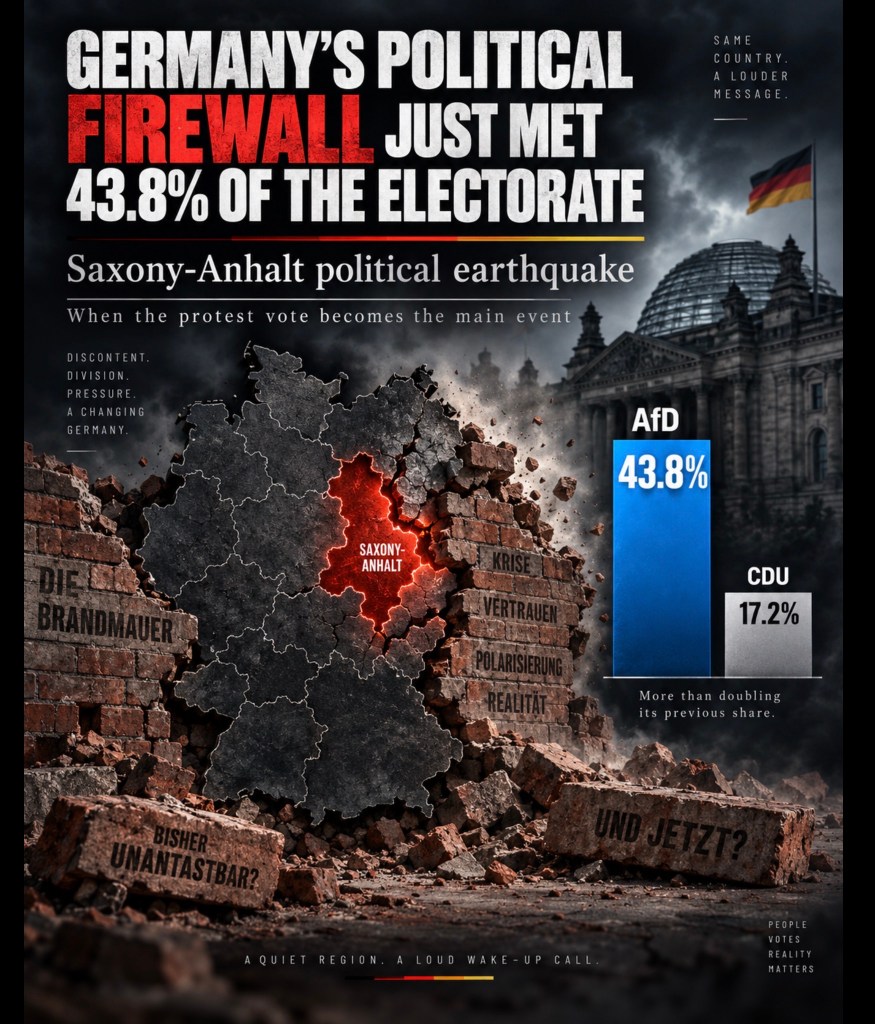
🇩🇪🔥Germany woke up to a political earthquake in Saxony-Anhalt. The AfD took 43.8% of the vote, more than doubling its previous share, while the governing CDU collapsed to 17.2%.
At that point, calling this a little protest vote is rather like describing an elephant in your kitchen as “a minor storage issue.” 🐘
Something much bigger is happening.
And while it would be simplistic to claim that “the left created the AfD,” it would be equally absurd for Germany’s political establishment to stare at a result like this and conclude that the principal problem is that voters have somehow failed to understand the approved instructions.
🚨 When the Protest Vote Becomes the Main Event
For years, Germany’s political class has had a wonderfully convenient answer to uncomfortable electoral developments: build a firewall, condemn the outsiders and carry on discussing amongst themselves why everybody ought to be voting differently.
There is just one snag.
The voters keep turning up.
Migration. Integration. Energy prices. Economic stagnation. Ukraine. Cultural change. Wages. Housing. A lingering sense in parts of eastern Germany that Berlin notices them mainly when election posters need somewhere to be hung.
These issues do not magically disappear because politicians dislike the party benefiting from them.
And this is where establishment politics repeatedly makes the same spectacularly expensive mistake: confusing condemnation with persuasion.
You can refuse to cooperate with the AfD.
You can denounce the AfD.
You can investigate the AfD.
You can construct a political firewall around the AfD high enough to require oxygen masks at the top. 🧱
But none of those things answers the question:
Why did 43.8% of voters choose them?
That question is considerably harder because it requires something politicians traditionally find rather awkward — examining themselves.
If millions of people repeatedly say they are worried about immigration, economic insecurity, energy policy or rapid social change, responding as though the primary problem is the moral deficiency of the voter is not exactly an electoral masterclass.
It is practically an advertising campaign for the opposition. 📣
“Your concerns are unacceptable.”
Fine.
“Your preferred party is unacceptable.”
Fine.
“You must vote for us instead.”
And there, apparently, the sales pitch ends.
No wonder insurgent parties flourish.
The AfD has positioned itself in political territory that substantial numbers of voters believe mainstream parties abandoned. Whether one likes the AfD, loathes it, fears it or wants it launched into the North Sea aboard an inflatable Bundestag, that political fact cannot simply be wished away. 🌊
A democracy cannot function indefinitely on the principle that voters are magnificent whenever they produce the correct answer and dangerous whenever they don’t.
The firewall may isolate a party institutionally.
It cannot quarantine dissatisfaction.
And if the mainstream parties genuinely want to reduce support for the AfD, perhaps the revolutionary new strategy should be this:
Find out why people are voting for it — and address those problems better.
Radical stuff. Someone alert Berlin. 📞🇩🇪
🔥 Challenges: Can Germany Listen Without Reaching for the Lecture?
Here is the question nobody can dodge after Saxony-Anhalt:
Can you realistically dismiss a political movement supported by more than four voters in ten without asking what drove them there?
Maybe some voted because of migration.
Maybe others because of the economy.
Maybe Ukraine, energy policy, distrust of Berlin or frustration with mainstream parties played a part.
Probably, for many, it was a mixture.
But simply declaring the electorate morally defective is unlikely to persuade anybody back.
So what do you think?
Has Germany’s political “firewall” protected democracy — or helped the AfD present itself as the only party outside the establishment club?
And at what percentage does ignoring dissatisfied voters stop being a strategy and start becoming political self-harm? 🤔🔥
👇 Comment on the blog, like the post and share it with someone who thinks Germany’s political establishment has some serious questions to answer.
💬 The best comments, arguments and spectacular political takedowns will be featured in the next issue of the magazine.


Leave a Reply