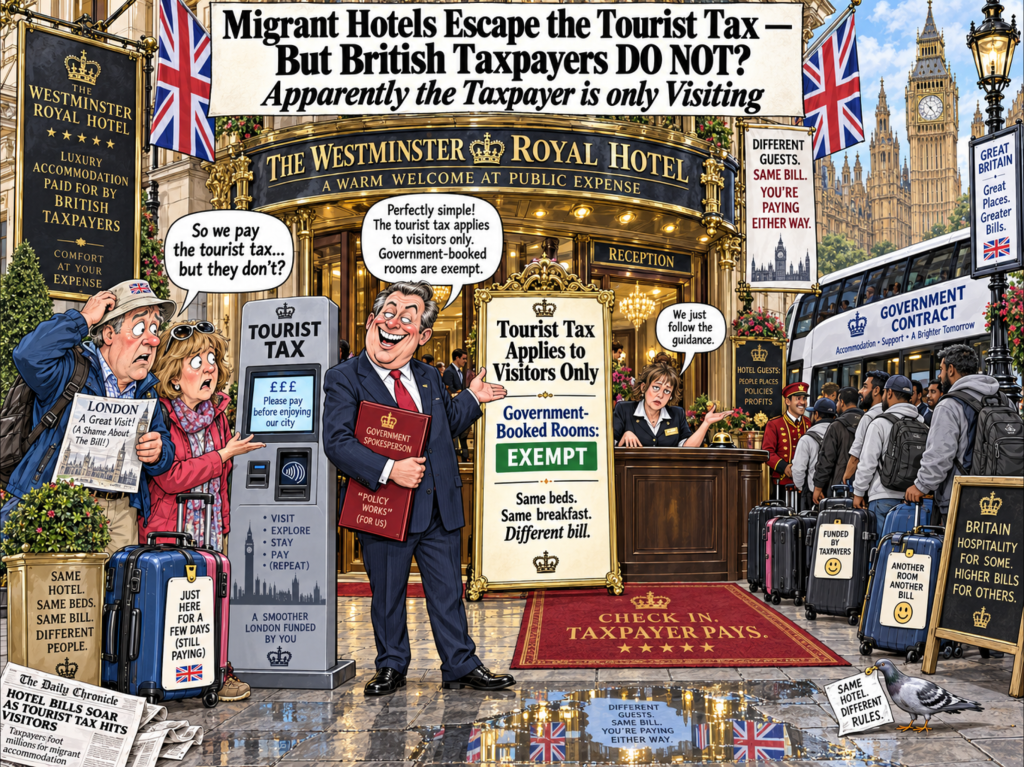
Britain may soon acquire another ingenious tax: an overnight visitor levy on people who commit the financially reckless act of staying in a hotel. Families taking a weekend break, workers travelling on business and couples spending a few days away could all find an extra charge added to the bill.
But hotels being used as asylum accommodation are expected to sit outside the scheme because the people staying there are not legally regarded as ordinary visitors.
So the British taxpayer gets the privilege of helping fund the accommodation — and, if they book a hotel themselves, potentially paying the tourist tax as well.
That is efficiency.
Apparently You’re Only a Visitor If You’re Paying for the Privilege
The idea behind a tourist levy is simple enough. People stay overnight, use local infrastructure and services, and contribute a small amount towards the area hosting them.
Fine.
But the moment exemptions begin appearing, the simplicity disappears.
Asylum seekers housed in hotels are not tourists in the normal sense. They are being accommodated under government arrangements rather than choosing a weekend break in Manchester or a sightseeing trip to York.
That distinction makes administrative sense.
It also creates a political absurdity that practically writes its own headline.
A British couple booking a hotel with their own money may be charged because they are regarded as visitors.
Meanwhile, accommodation paid for through public funds can fall outside the same levy because the people occupying those rooms are not technically tourists.
In other words, the taxpayer can help pay for the room, help fund the wider asylum system and then pay an additional charge when they book a room for themselves.
There are loyalty schemes with fewer benefits.
The obvious response from government will be that these are completely different categories of accommodation.
And technically, they are.
But taxpayers do not experience government spending as a collection of beautifully separated accounting categories.
They experience it as money leaving their pocket.
That is the part Whitehall frequently struggles to understand.
Nobody sensible is suggesting asylum seekers with little or no income should personally be presented with a tourist-tax bill at reception.
That would be pointless.
But if the justification for an overnight levy is that hotel accommodation places pressure on local services, then the obvious question remains:
Why should the contribution disappear simply because the government is paying for the room?
If the occupant cannot pay, government could.
Instead, we risk creating the usual British masterpiece: a system where one arm of government pays for accommodation, another creates a tax on accommodation, and then a third explains why the first category of accommodation does not count.
Eventually a consultation will probably be required to establish whether somebody sleeping in a hotel is technically staying in a hotel.
Britain excels at this sort of thing.
The Government can take something straightforward, add definitions, exemptions, grants, reimbursement arrangements and statutory categories, then emerge six months later with a 70-page document confirming that common sense was regrettably outside the scope of the review.
And then what actually changes?
Tourists pay more.
Hotels alter their billing systems.
Councils administer the levy.
Accountants reconcile it.
Officials publish guidance.
Hospitality businesses complain.
And publicly funded hotel accommodation carries on largely as before.
That is the real issue.
The sums involved in any individual tourist levy may be modest, but the symbolism is dreadful.
A government asking ordinary people to accept another charge must be able to explain why comparable accommodation funded by the state is treated differently.
Saying, “Ah, but technically they aren’t tourists,” may be legally correct.
It is not especially persuasive to the person paying both sets of bills.
The cleaner solution is obvious.
If overnight hotel accommodation creates measurable costs for local communities, attach the contribution to the accommodation rather than the personal circumstances of whoever happens to be sleeping in the bed.
Where an individual reasonably cannot pay, the organisation funding the accommodation pays instead.
Simple.
Equal treatment.
Far less political theatre.
But simplicity has always faced one major obstacle in Britain.
It leaves far too little work for committees.
So we will probably continue with the more traditional arrangement: taxpayers fund the system, taxpayers pay the levy, taxpayers fund the administration required to distinguish who pays the levy, and then taxpayers are assured that everything has been designed with fairness in mind.
You really could not make it up.
Unfortunately, somebody already has.
🔥 Challenges: If British taxpayers can be charged a tourist levy when they stay in a hotel, should publicly funded hotel accommodation also generate the same contribution — paid by government where necessary? Or is the exemption justified? Tell us what you think on the Chameleon News blog.
🔥 Comment, like and share — especially if you think paying for the room and then paying the tax on your own room is quite enough generosity for one taxpayer.
🏆 The best comments will be included in the magazine.


Leave a Reply