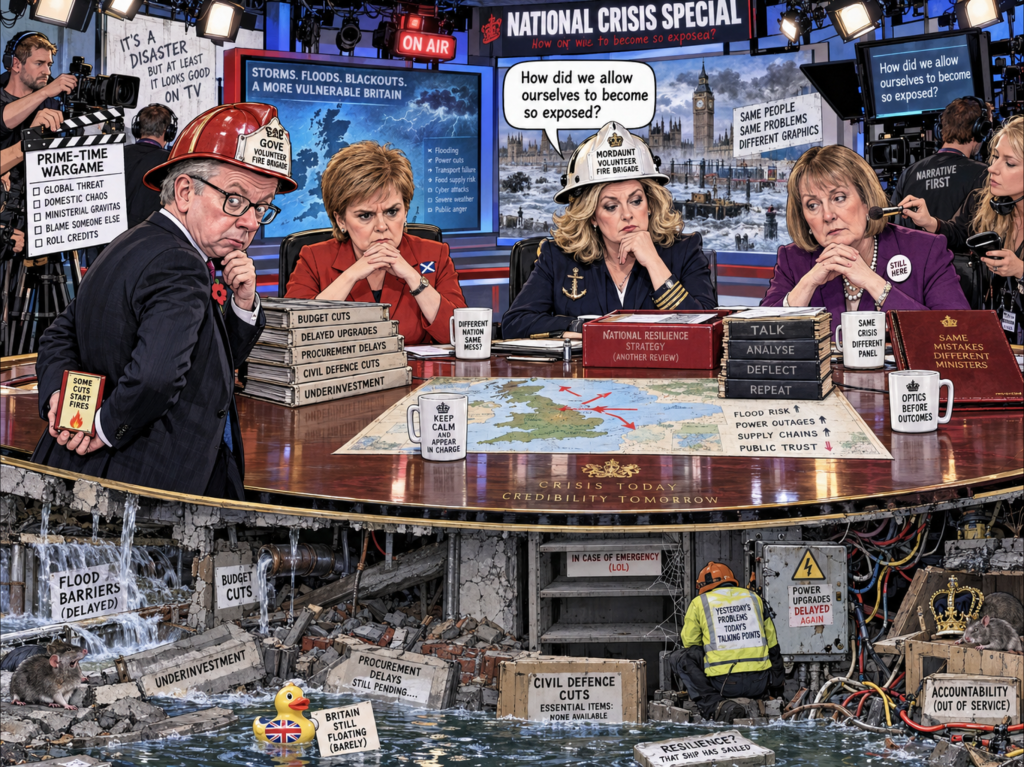
🎭🚨Britain has apparently discovered the perfect format for examining decades of national-security headaches: put former political heavyweights in a fake crisis room, switch on the cameras and ask them what on earth has happened to the country.
Sky’s The Wargame, launching on 21 September, puts Michael Gove in the simulated prime-ministerial chair, Nicola Sturgeon beside him as deputy, with Penny Mordaunt, Harriet Harman and other former senior political figures confronting a fictional Russian attack on Britain. (Sky Group)
And somewhere, satire quietly packs up its desk.
Because Britain’s problems with defence procurement and preparedness did not materialise during the opening credits. Parliamentary committees have documented persistent delays, cost pressures and troubled equipment programmes stretching across successive governments; the Commons Library describes major procurement difficulties as a long-running problem that administrations of different political colours have repeatedly tried to reform. (House of Commons Library)
🎬 From the Cabinet Table to the Director’s Chair: Britain Auditions for Its Own Inquiry
There is something magnificently British about this arrangement.
First comes the Governance Phase:
Spend years navigating Treasury settlements, departmental compromises, procurement programmes, strategic reviews and that ancient Whitehall ritual known as “we’ll revisit this in the next spending round.”
Then comes the Television Phase:
Dim the lights. Roll the emergency bulletin. Place the former political class around a polished table and unleash the gravest facial expressions available outside a prestige Netflix drama.
“Good God. Our resilience appears to have weaknesses.”
Yes.
That does seem to be the plot.
The delicious irony is not that any single participant personally created Britain’s present vulnerabilities. They plainly did not. Defence procurement programmes commonly span governments, ministers and decades, while parliamentary investigations have repeatedly described structural problems inside the system itself. (House of Commons Library)
The irony is that Britain has reached the point where people who spent substantial portions of their careers inside the machinery of government can now re-enter a replica of that machinery as participants in a television stress test.
It is less Yes, Minister and more Yes, Minister: The Reunion Special. 📺
Former ministers confronting inherited institutional weaknesses on television may genuinely illuminate how difficult emergency decision-making is. That is the serious argument for the programme.
But the satirical alternative is irresistible:
Westminster has invented retroactive management training.
Twenty years of governments wrestling with capability gaps, procurement delays and competing spending priorities — followed by a programme in which political veterans discover that running Britain during a national emergency is, apparently, rather difficult.
Parliament’s Public Accounts Committee was still warning in June 2026 that delays to defence planning were hindering modernisation and creating additional cost pressures. So the underlying debate The Wargame dramatises is hardly fictional, even though its Russian-attack scenario is. (UK Parliament Committees)
You could hardly design a more perfect piece of administrative performance art.
The political equivalent of watching former restaurant managers compete on Kitchen Nightmares while somebody quietly points toward the freezer they ordered in 2014.
🔥 Challenges: Stress Test the Stress Test🔥
Here’s the question worth arguing about:
When former leaders take part in exercises exposing weaknesses in the state, is that valuable public service — or does television risk transforming political accountability into entertainment?
And when institutional failures stretch across parties, departments and successive governments, where should responsibility actually sit: with individual ministers, the permanent machinery of Whitehall, Treasury priorities, Parliament — or the political incentives that keep long-term resilience permanently behind whatever crisis is happening this afternoon?
💬 Don’t just shout at the television. Put your argument in the blog comments.
👇 Comment. Like. Share. Challenge the premise, defend the participants, roast the absurdity — but bring an argument.
The sharpest comments will be included in the magazine. 🎯📝


Leave a comment