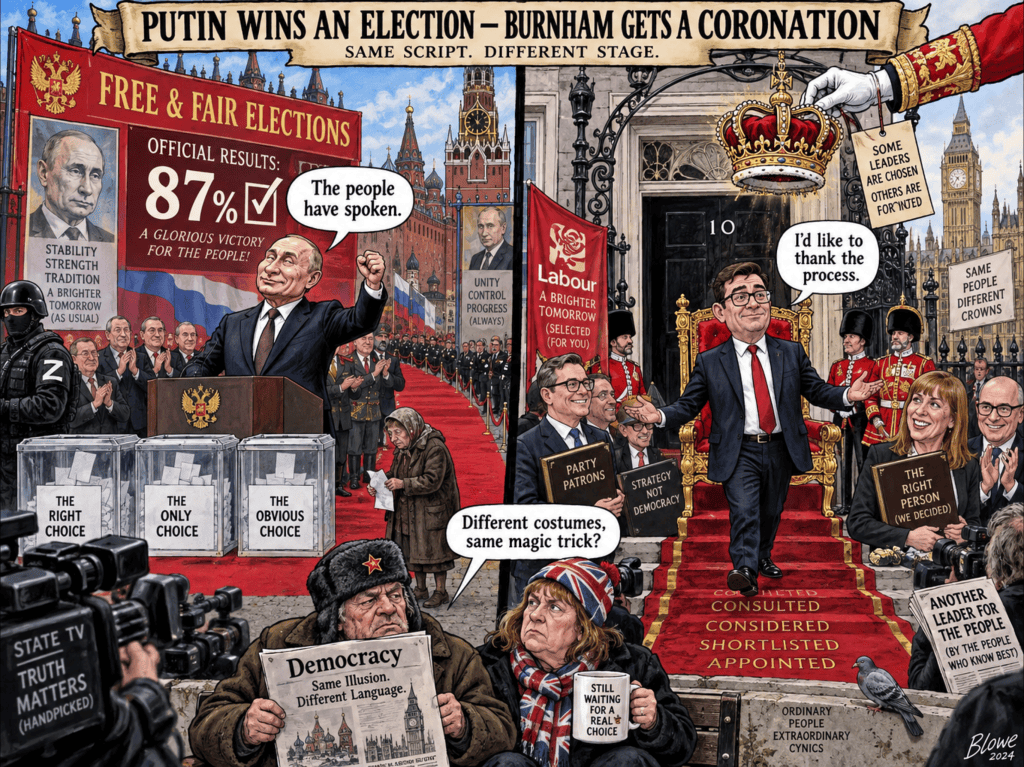
Britain spends a great deal of time lecturing Russia about elections, democratic legitimacy and the sacred principle that ordinary citizens should get a meaningful choice over who governs them. Fair enough. Vladimir Putin’s 2024 presidential election was condemned by the British government as neither free nor fair, amid repression, excluded opposition candidates and the absence of independent OSCE observers. Putin nevertheless emerged with an officially reported 87% of the vote.
Fast-forward to Britain in 2026 and Andy Burnham has become Prime Minister without the British electorate voting for him as Prime Minister at all. After Keir Starmer resigned, Burnham secured overwhelming backing from Labour MPs and affiliated organisations, faced no rival in the final leadership contest, was confirmed Labour leader at a special conference on 17 July and entered Downing Street three days later.
Different systems. Very different political conditions. But from a distance, the optics are comedy gold.
🇬🇧 Please Do Not Call It a Coronation — His Majesty Is Already Involved
Nobody should pretend Russia’s political system and Britain’s parliamentary democracy are equivalent. They aren’t. Russia’s elections have faced serious international criticism over repression, lack of genuine competition and restrictions on opposition activity. The Kremlin rejects allegations that its elections are illegitimate and has defended their integrity.
Britain’s peculiar contribution to democratic theory is rather different: we simply don’t directly elect prime ministers in the first place.
At a general election, voters choose their local MP. The Prime Minister is formally appointed by the monarch and, under constitutional convention, must be the person capable of commanding the confidence of the House of Commons. When a governing party changes leader between elections, that party can therefore produce a new Prime Minister without asking the country to hold another general election.
Perfectly constitutional.
Perfectly legal.
And absolutely magnificent material for anyone who remembers Britain explaining democratic legitimacy to the rest of the planet.
Putin at least had ballot boxes with his name on them. Burnham’s route involved Labour MPs, affiliate nominations, a special conference and ultimately a meeting with the King. On 20 July, Charles III invited him to form a government.
That isn’t evidence Britain is somehow less democratic than Russia. It is evidence that British democracy remains a magnificent antique contraption assembled from elections, conventions, party rulebooks and ceremonial monarchy — the constitutional equivalent of a grandfather clock that somehow also runs the nuclear deterrent.
The crucial point is that Burnham inherited the premiership because Labour already possessed the parliamentary mandate won at the previous general election. A British government survives only while it commands the confidence of the Commons. That is the democratic chain: voters elect MPs, MPs determine who can sustain a government, and the monarch performs the formal appointment.
But try explaining that in one sentence without sounding like Jacob Rees-Mogg has trapped you in a library.
“Why didn’t you vote for your Prime Minister?”
“Well, technically we voted for several hundred individual legislators, whose collective distribution determines the governing party, whose internal mechanisms determine its leader, whom the hereditary monarch then appoints subject to parliamentary confidence.”
Right.
And we’re sending other countries leaflets about simplifying democracy.
The particularly awkward feature of Burnham’s elevation is that Labour originally published a leadership timetable containing provision for a membership ballot. But Burnham amassed such overwhelming parliamentary and affiliate backing that he emerged unopposed. Labour says he had the support of 379 Labour MPs and 23 affiliate organisations.
So the British public watched their national leader change without a national election, while even the governing party’s wider membership never reached the competitive-ballot stage.
Constitutionally normal. Politically fascinating.
Democracy apparently comes with several subscription packages.
Russia offers the giant presidential ballot with a result critics say lacked genuine competition. Britain offers competitive general elections but permits the winning parliamentary party to swap the person occupying Downing Street between those elections.
Choose your constitutional meal deal.
And then what?
Nothing automatically happens.
Burnham does not require an immediate general election merely because he replaced Starmer. Unless political circumstances force the issue, the parliamentary mandate continues with the government. That arrangement has produced several mid-term changes of Prime Minister in modern Britain and is built into the system rather than being an emergency loophole.
That is where the satire becomes more useful than pretending Moscow and Westminster are identical.
Britain can reasonably criticise repression, barriers to opposition and disputed electoral practices abroad while simultaneously admitting something rather less flattering about itself: our own citizens do not directly choose their Prime Minister.
Perhaps the solution isn’t another constitutional commission accompanied by seventeen professors, four former judges and a £6 million website explaining “stakeholder engagement”.
Perhaps it is simply clarity.
If Britain believes its parliamentary system remains the better democratic model, defend it openly. Explain why MPs rather than presidential ballots ultimately determine who governs. Debate whether a new Prime Minister taking office mid-term should eventually face some additional democratic test. And stop behaving as though our own arrangements descended from Mount Sinai engraved onto a ceremonial dispatch box.
Because Britain’s constitutional system may well be democratic.
But when the “King of the North” reaches Downing Street unopposed and is formally installed after an audience with the actual King, perhaps we should retire the phrase “coronation” very carefully indeed.
🔥
Challenges: If Britain Demands Democratic Choice Abroad, Should Voters Get More Say When Their Own Prime Minister Changes?
Russia’s system and Britain’s are plainly not the same — but does Britain’s ability to change Prime Minister without a general election strengthen parliamentary democracy or expose a democratic gap we’ve simply grown accustomed to? Put the slogans aside and tell us where you think the line should be. Join the argument in the Chameleon News blog comments.
👇 Comment, like and share — and tell us whether Britain’s system is sensible parliamentary democracy, const


Leave a comment