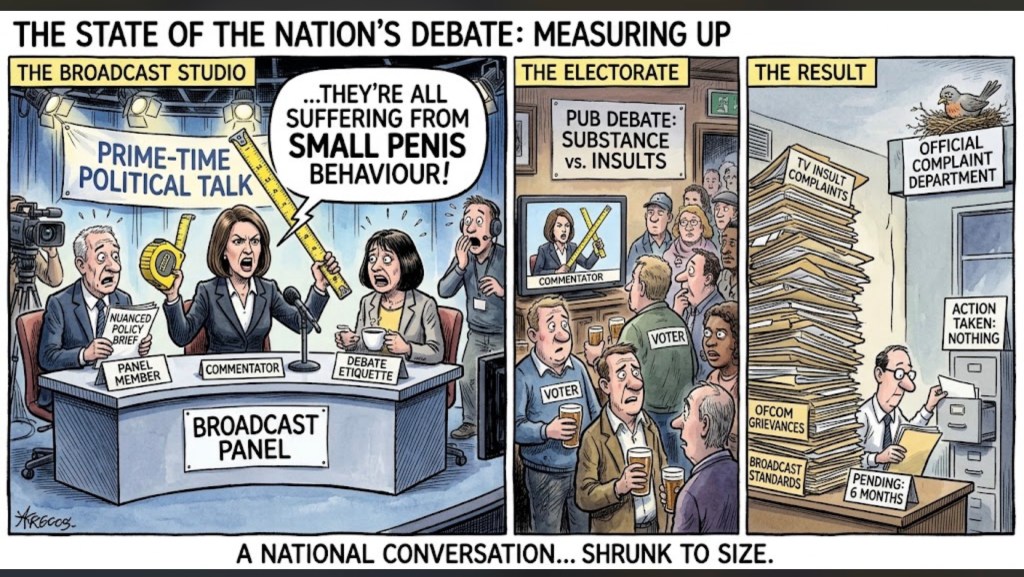
Modern political commentary used to require nuance, historical context, and an understanding of economic trade-offs. Today, however, the pinnacle of broadcast debate appears to have shifted to playground anatomical diagnoses delivered live on the BBC. When panellist Ash Sarkar branded anti-immigration agitators as displaying “small penis behaviour” on Question Time, it marked a remarkable milestone in prime-time political discourse. Rather than dismantling complex policy arguments on border control or civil unrest, national television was treated to a clinical assessment of the British electorate’s lower half. It turns out that decades of parliamentary tradition were simply waiting for someone to reduce the entire state of the nation to a schoolyard insult.
The High Art of Institutional Outrage
The immediate aftermath followed the standard British theatrical script. Social media lit up with predictable fury, Ofcom inboxes braced for impact, and op-ed columnists mobilized to debate whether the national broadcaster had finally lost its mind. Editors drafted urgent headlines, commentators traded accusations of hypocrisy, and panel shows spent hours analyzing the precise boundaries of acceptable insult terminology. For twenty-four hours, the political universe revolved around a single, crude anatomical reference as though the future of constitutional governance depended on it.
And what actually changes as a result of all this outrage? Absolutely nothing.
Once the initial shock wears off, the broadcaster will issue a carefully worded statement reminding everyone of its commitment to balance, a few formal complaints will sit in a regulatory queue for six months, and the circus will move on to the next broadcast spat. The actual underlying issues—border management, public safety, and the collapse of meaningful civic debate—remain completely untouched while everyone argues over the etiquette of name-calling on television.
The practical alternative isn’t particularly complicated: if broadcast media wants to host serious national debates, it should insist on arguments built on policy and substance rather than childish taunts, while viewers would benefit from demanding higher standards from commentators regardless of which side of the political spectrum they occupy.
After days of screaming headlines, viral clips, and solemn commentary on the decline of public standards, we arrive at the grand conclusion of modern political debate: a system where serious national problems are ignored, and the height of political intellect is measuring your opponent’s manhood on live television.
🔥 Challenges: Has political commentary on major broadcasters descended into childish name-calling, or are viewers overreacting to harsh language in national debates?
Tell us what you think in the comments on Chameleon News! Don’t forget to like, share, and join the conversation on the blog.


Leave a comment