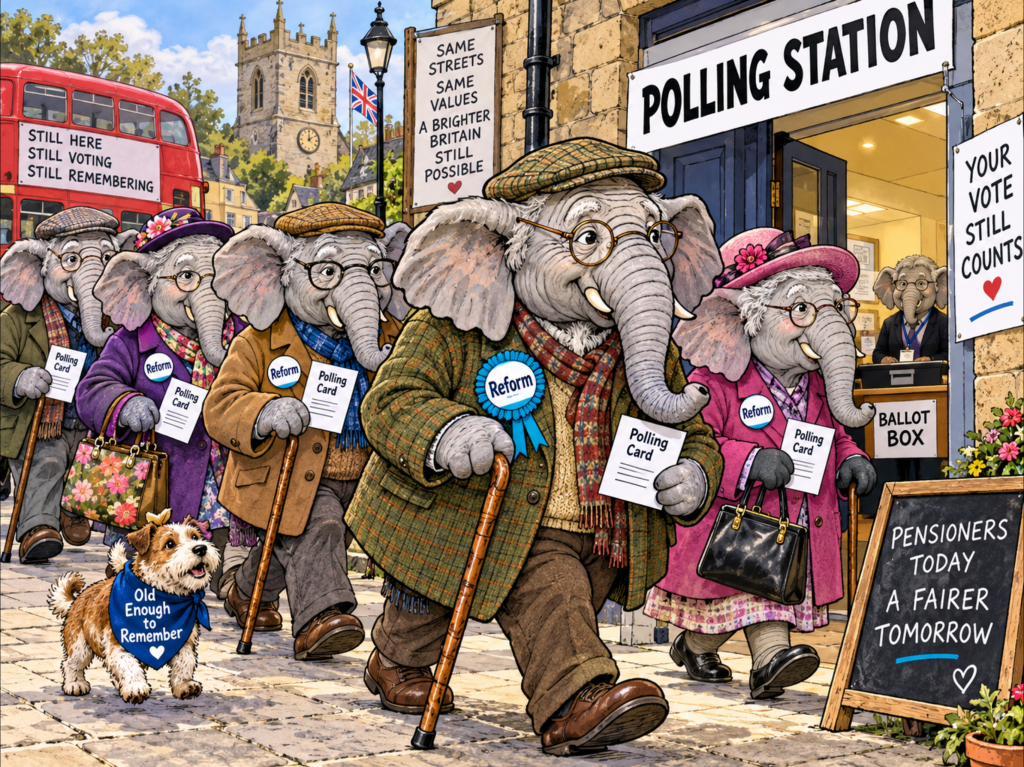
Andy Burnham has been Prime Minister only since July, yet one of the biggest political fights of his premiership is already taking shape around the state pension.
Burnham did not become Prime Minister following a general election fought with him as Labour leader. He took over after Keir Starmer resigned, returned to Parliament as MP for Makerfield and became Labour leader after emerging as the only candidate able to clear Labour’s nomination threshold. He was then appointed Prime Minister on 20 July 2026. (House of Commons Library)
Now comes the politically explosive bit: the Government says the existing pension triple lock will stay until April 2030 — but Burnham wants Parliament to legislate for its replacement before the next general election. (GOV.UK)
🗳️ Nothing Says “Trust the Voters” Like Doing the Paperwork Before They Arrive
Welcome to Westminster, where apparently you can change the chef, rewrite tomorrow’s menu and start setting the tables before the customers have even been asked whether they fancy the restaurant. 🍽️
Burnham’s defence is straightforward: Labour promised to maintain the existing triple lock throughout this Parliament, and he says that promise will be kept. From April 2030, the Government proposes a different guarantee under which the state pension would rise by at least inflation or 2.5%, while maintaining a longer-term link with average earnings. The Government says the resulting savings would contribute towards a new National Care Service. (GOV.UK)
That may be the policy argument.
The political argument is something entirely different.
If the new arrangement does not begin until 2030, why legislate for it before voters have had the opportunity to judge Burnham and his programme in a general election?
That is the question opponents are already circling like pensioners around the final reduced-price Victoria sponge in Marks & Spencer. 🍰👀
And anyone assuming older voters have collectively misplaced their political memories alongside the reading glasses might want to reconsider.
Pensions have a remarkable ability to turn seemingly technical Treasury calculations into extremely personal kitchen-table arithmetic.
A percentage here. An earnings link there. A reassuring minister explaining that everything will be perfectly fine sometime around 2037.
Meanwhile, millions of pensioners are doing the calculation that matters to them:
“What will be in my pocket?”
Burnham himself has acknowledged there may be a political price for changing the system. The proposal has also drawn criticism from political opponents and unions, while the Government argues that pensioners would gain from the proposed National Care Service and continued protection against inflation. (Labour Party)
So perhaps the real danger is not that pensioners have long memories.
It is that Westminster occasionally has a remarkably short one.
Keir Starmer discovered how quickly political authority can disappear. Burnham inherited Downing Street without first leading Labour through a general election, and his pension reforms could now become one of the defining tests of whether the public accepts the direction in which he wants to take the government.
That isn’t a prediction about what voters will do.
It’s a reminder that eventually they get to answer. 🗳️
🔥 Challenges 🔥
Here’s the question worth arguing about:
Should a Prime Minister who took office between general elections legislate now for a major pension change that would take effect after the next election — or is passing the legislation precisely what Parliament is there to do?
And if changing the triple lock helps fund free personal care, does that make the trade-off worthwhile — or should pensions and social care be funded separately?
💬 Don’t just shout at the television. Put your argument in the blog comments.
👇 Comment, like and share — and tell us which part of the pension deal you think deserves the closest scrutiny.
The best comments will be included in the next issue of the magazine. 🎯📝


Leave a comment