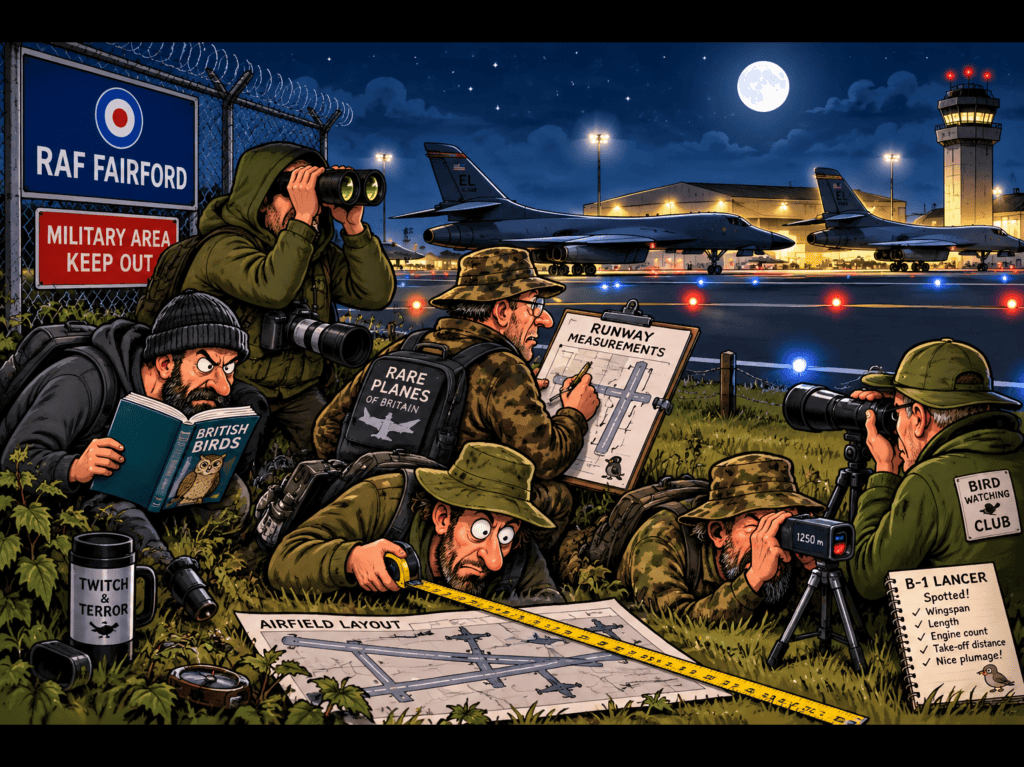
✈️🦆🚨President Donald Trump says the United States pulled its bombers from RAF Fairford because of “some threats,” which is about as specific as a smoke alarm shouting “something smells spicy somewhere near a toaster.” Around 12 B-1 Lancer bombers reportedly left the Gloucestershire base after suspicious vehicles were spotted nearby, six people were arrested on suspicion of preparing terrorist acts, then bailed — and now Britain is left squinting through binoculars, wondering whether this was a national security incident, political theatre, or a bunch of overenthusiastic birdwatchers trying to photograph something with feathers and accidentally triggering the Pentagon. 🕵️♂️🪶💥
🦅 The Great Bomber Shuffle: When Twitchers Meet Trigger Warnings
So let’s get this straight: mysterious vehicles appear near RAF Fairford in the early hours, suspects are arrested, suspects are bailed, bombers vanish, and Trump wanders up to the microphones with the calming precision of a man reading military intelligence off the back of a cereal box.
“We know the people that made the threat,” he says — which is helpful, unless the “people” in question were six blokes in waterproof trousers whispering, “Is that a kestrel?” while pointing a zoom lens at the perimeter fence. 🦉📸
Because let’s be honest: in rural Britain, a group of parked cars, thermos flasks, long lenses, and men standing silently in hedges could mean two things. Either it is a sinister terror plot, or someone has heard there is a rare warbler within three postcodes and absolutely nobody is leaving until Derek from Swindon gets a clean shot for the birding forum.
This is modern security communication at its finest: half warning, half cliffhanger, all fog machine. The public gets just enough information to develop anxiety, but not enough to do anything useful with it. Like being told there is a shark in the swimming pool, but not which swimming pool, whether it is still there, or if the shark has now been bailed pending further enquiries and advised not to approach any military ducks.
And RAF Fairford, once again, finds itself starring in the international drama nobody asked to stream. One minute it is a quiet military base in Gloucestershire, the next it is the backdrop for bombers, terror arrests, suspicious vehicles, and what may yet turn out to be the most expensive misunderstanding since someone mistook a heron for a drone. 🚁🪿
Trump’s “capture the enemy and beat the enemy” line lands with all the subtlety of a tank reversing through a greenhouse. It is the sort of phrase designed to sound decisive while explaining absolutely nothing. Who is the enemy? Where are they? Are they in custody? Were they armed with maps, binoculars, and a flask of lukewarm tea? Nobody knows.
But if these really were birdwatchers, then congratulations: Britain has achieved peak 2026. We have reached the point where pensioners in cagoules can allegedly scatter strategic bombers simply by parking near a fence and looking too interested in the sky. Somewhere, a robin is sitting on a branch thinking, “I did this.” 🐦🔥
The whole thing feels less like counter-terrorism and more like a deleted scene from Hot Fuzz: NATO Edition. Six suspects bailed. Bombers relocated. Trump declaring victory over “the enemy.” And in the middle of it all, possibly some poor twitcher named Malcolm, still trying to explain that he only came because someone on Facebook said there was a hoopoe near the runway.
🔥Challenges🔥
Was this a real threat, a communication circus, or just birdwatching with unfortunate parking choices? Either way, the public has been handed a mystery wrapped in military fog and served with a side of “trust us, we know things.” Drop your theories, your sarcasm, and your finest bird puns in the blog comments. 🦆💬
👇 Hit comment, hit like, hit share. Tell us whether RAF Fairford faced an international incident — or the most misunderstood twitching expedition in Gloucestershire history.
The best comments, burns, and feather-ruffling theories will be featured in the next issue of the magazine. 🎯📝


Leave a comment