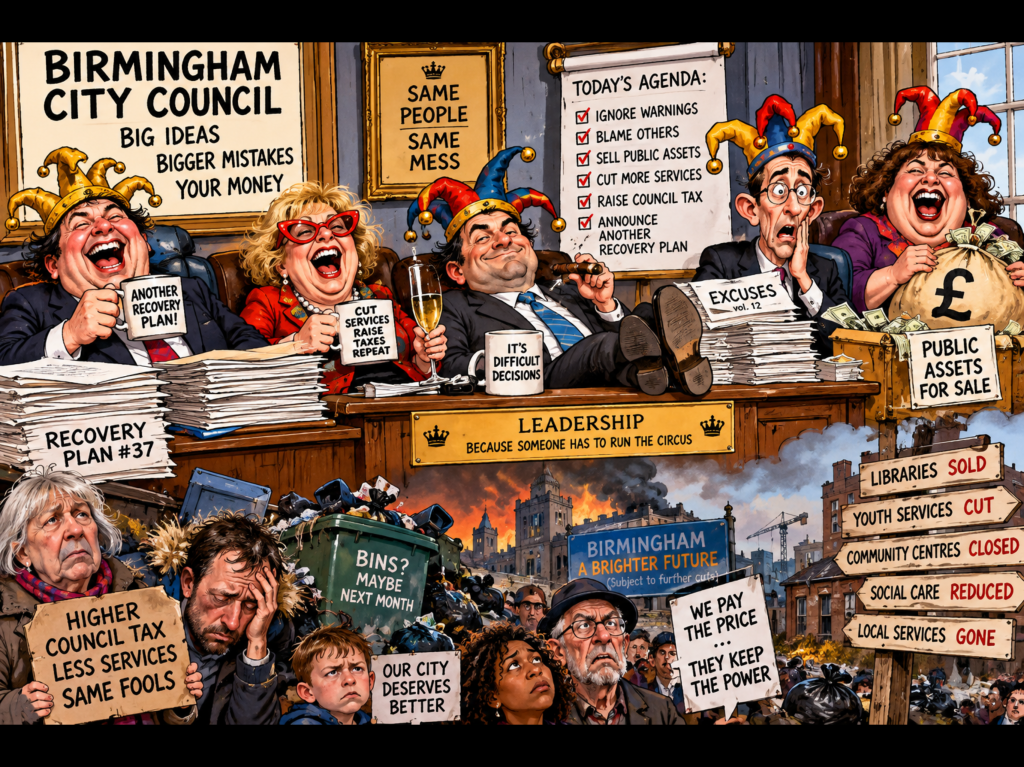
🏛️🔥When a business collapses, investors take the hit, managers get shown the door, and creditors start circling like seagulls over a dropped pasty. But when Birmingham City Council swan-dives into financial calamity, the residents are handed a very special civic gift: the bill. Services shrink, assets go up for sale, council tax climbs, and somehow the people least responsible are invited to fund the clean-up operation. Compulsory participation, naturally. Democracy with a direct debit. 💸
Welcome to the No-Refund Municipality
🧾🚫Imagine signing up for a company where the board fumbles the finances, the product gets worse, the fees go up, and your only cancellation option is “move house.” That’s not a business model. That’s a hostage note with recycling bins.
Birmingham’s crisis has produced government-appointed commissioners, which is a polite way of saying the grown-ups have arrived after the kitchen is already on fire, the dog is holding a spreadsheet, and someone has sold the smoke alarm to balance next quarter’s budget. 🔥📊
Of course, councils are not private equity firms. Councillors are elected officials, not middle managers who can be marched out with a cardboard box and a security escort. Accountability runs through elections, party discipline, resignations, inquiries, and legal processes where actual wrongdoing must be proven. Fair enough. We do still pretend to enjoy rules.
But explanation is not exoneration.
Residents are not asking for a medieval stocks-and-rotten-tomatoes situation—although, given the state of local services, it might be the only public amenity still available. They are asking something painfully reasonable:
If your judgement helped drive the bus into the ditch, why are you still holding the steering wheel for the recovery convoy? 🚌💥
Because in the private sector, failure has consequences. In local government, failure often comes with a new strategy document, a consultation period, and a sentence beginning, “We understand residents’ concerns.” Translation: your library may become luxury flats, your bins may develop a fortnightly sense of mystery, and your council tax will now be doing weightlifting.
No one should pretend every current councillor personally built this bonfire. Birmingham’s mess has layers: historic decisions, structural pressures, budget gaps, political choices, legal liabilities, and the timeless British tradition of noticing the roof is missing only after it rains indoors. ☔
But the public deserves names, timelines, decisions, warnings ignored, risks taken, and consequences faced. Not another laminated recovery plan presented with the emotional warmth of a broken parking meter.
Because residents did not approve the gamble. They did not sign off the risk. They did not vote to become unpaid investors in a collapsing civic portfolio. Yet they are the ones losing services, footing bills, and being told this is “difficult decision-making.”
Difficult for whom?
For the families who rely on youth services? For the disabled residents waiting on support? For the elderly watching community provision disappear? For the ordinary taxpayer being asked to pay more for less while the people responsible explain that lessons have definitely been learned this time, probably, subject to review? 🫠
Birmingham does not need another recovery slogan. It needs accountability with a spine. It needs transparency sharper than a committee biscuit. And it needs officials brave enough to explain not just how the city gets out of the hole—but who helped dig it, who ignored the warning signs, and why residents are once again being asked to bring the shovel. 🕳️
🔥 Challenges🔥
Here’s the question Birmingham residents should be hurling into every meeting, inbox, and blog comment section: who made the decisions, who challenged them, who stayed silent, and who is still collecting authority after the bill landed on the public’s doorstep?
Drop your take in the blog comments—furious, funny, forensic, or all three. Birmingham deserves more than “lessons learned” confetti and another glossy recovery plan. 💬⚡
👇 Comment, like, and share if you think public failure should come with public answers—not just public bills.
The best comments will be included in the magazine. 🎯📝


Leave a comment