📊🐝The BBC’s latest pay figures have served up the sort of plot twist that makes middle managers clutch their lanyards: white staff are reportedly paid less on average than ethnic minority colleagues in every pay band bar one. In both the lowest and top pay bands, Black, Asian, mixed and other ethnic minority employees received higher median pay than white workers — and somewhere in Broadcasting House, a spreadsheet has just become more controversial than a cancelled Christmas advert. 🎄💷
Payday at the BBC: Where Everyone Suddenly Becomes an Equality Expert
📺🔥You can almost hear the panic in the payroll department. One minute it’s all “inclusive values” and “transparent structures,” the next minute Barry from Compliance is staring at the median wage chart like it just insulted his nan.
This is what happens when a public broadcaster builds a pay system so tangled it needs subtitles, a glossary, and possibly David Attenborough whispering, “Here we see the senior executive entering its natural habitat: the expenses portal.” 🦁📑
Naturally, the culture-war circus has arrived with a megaphone and a folding chair. The same people who usually insist pay gaps are just “hard work and choices” have suddenly discovered statistical injustice now that the numbers appear to be pointing the other way. Funny how fast “stop whining” turns into “launch an inquiry” when the boot is on the other spreadsheet. 👞📊
But the real comedy is not ordinary staff arguing over the crumbs. It’s the BBC somehow managing to turn payroll into a national identity crisis. Forget impartiality scandals, licence fee rows, and presenters earning more than small island economies — now we’re all expected to decode who is being underpaid, overpaid, misclassified, banded, re-banded, spiritually banded, or quietly promoted into a job title that sounds like a mindfulness app.
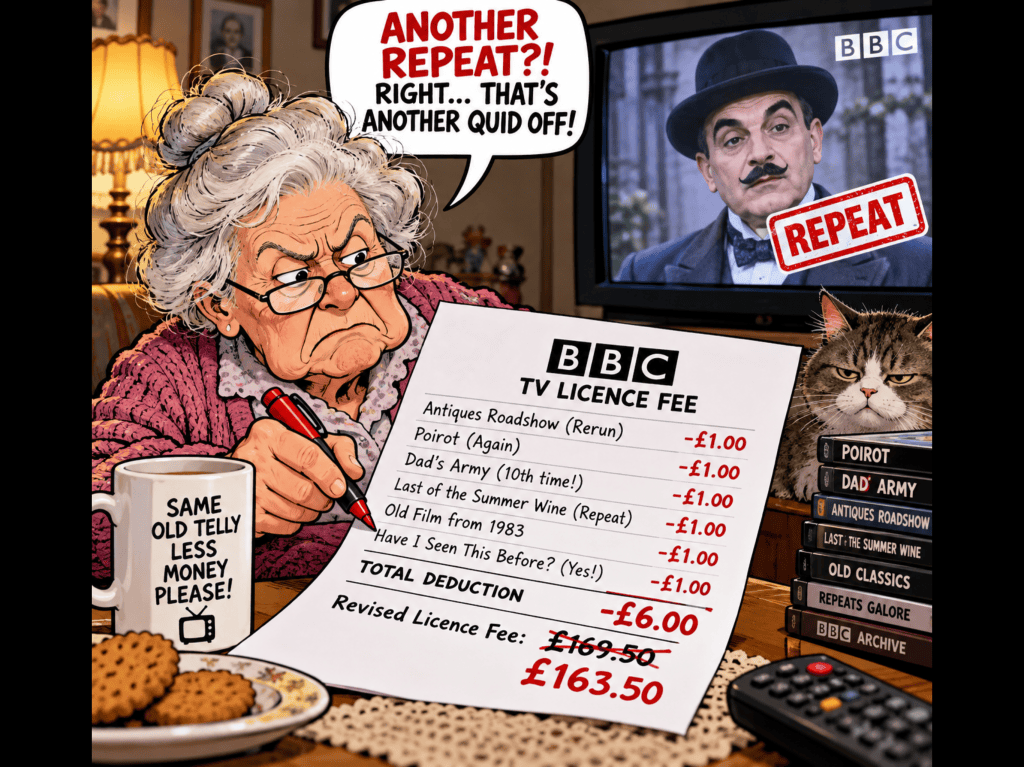
And while they’re busy slicing and dicing pay bands like a confused accountant at a diversity buffet, perhaps licence fee payers should get in on the action too. If the BBC can calculate fairness down to the decimal point, maybe viewers should start adjusting their payments based on what they actually receive. Watching a repeat from 2009? That’ll be a vintage discount. Old film from the archive? Knock a few quid off. Another “classic episode” dragged out like a sofa from a skip? Lovely — charge us 1997 prices. 📼💷
Because if the programme has been paid for, broadcast, repeated, recycled, repackaged, and served again with a new continuity announcement, why should viewers keep paying showroom prices for second-hand telly? At this rate, the licence fee should come with a mileage counter: one careful owner, slightly faded credits, still somehow costing full whack. 🚗📺
Because nothing says “fair and balanced” quite like a wage structure that makes everyone furious for completely different reasons — and a TV schedule where yesterday’s leftovers are billed like tomorrow’s innovation. 🎭💸
🔥 Challenges🔥
So what is this — genuine progress, bureaucratic chaos, or the BBC accidentally dropping a live grenade into the national comments section? 💣💬
And while we’re here, should licence fee payers get a rebate every time the BBC serves up another repeat, dusty archive film, or “festive favourite” older than the remote control?
Drop your take in the blog comments — not just on Facebook. Is this a victory for fairness, a statistical boomerang, or another publicly funded circus with better stationery?
👇 Comment, like, and share — because if the BBC can turn payday into a culture war and repeats into prime-time value, the least we can do is bring popcorn and an invoice. 🍿🧾🔥
The best comments will be included in the next issue of the magazine. 📝🏆


Leave a comment