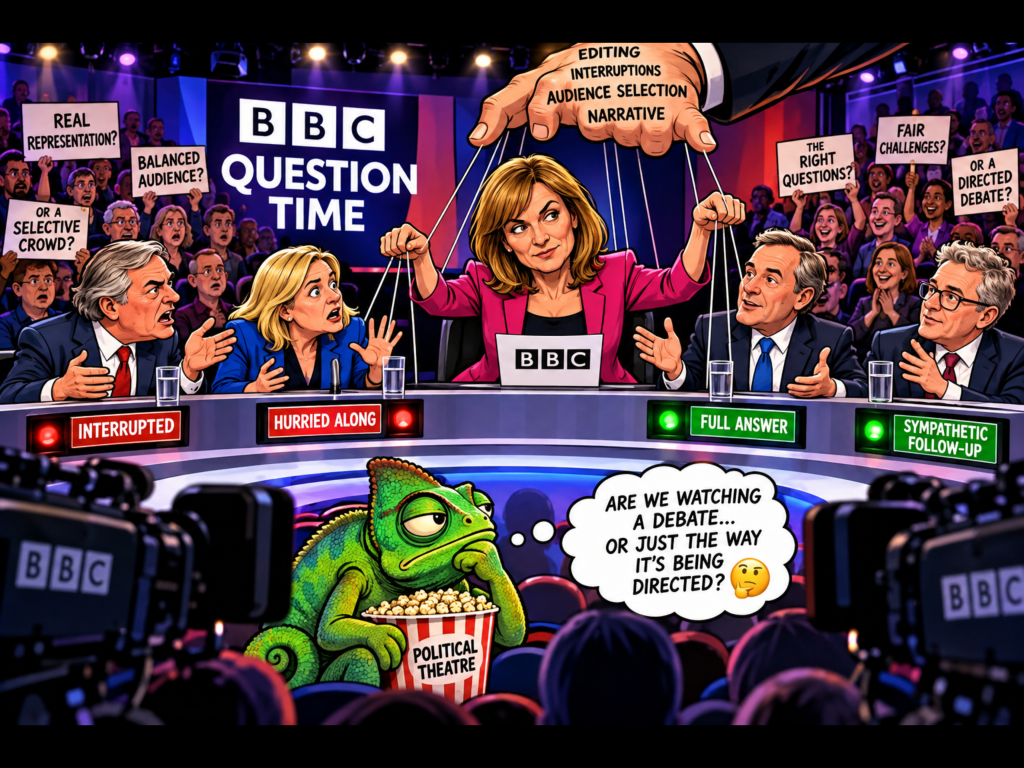
Every Thursday, the BBC presents Question Time as democracy in action. Politicians clash, audiences challenge, and Fiona Bruce attempts to prevent the whole thing becoming a televised shouting match.
But here’s the question: are viewers witnessing an open debate, or can the way it’s managed subtly influence their conclusions? 🤔
Reform UK has accused the programme of political bias, including allegations about audience selection. The BBC disputes these claims, while reported private remarks attributed to Fiona Bruce remain unsubstantiated.
But the bigger issue goes beyond one political party.
How would we recognise subtle bias if nobody openly admitted it existed?
🎪 The Microphone Monopoly: Who Gets Heard — and Who Gets Hurried Along?
Imagine a debate where everyone can technically speak, but one panellist gets interrupted while another enjoys an uninterrupted explanation.
One receives a sharp challenge. Another gets a sympathetic follow-up. One audience member is encouraged to elaborate; another is politely silenced.
Nobody needs to tell viewers what to think. The management of a conversation can shape which arguments appear strongest.
Of course, presenters must maintain order. Without moderation, Question Time could resemble a pub argument with better lighting and a BBC licence fee. 🍺
But there’s a difference between managing a debate and influencing the impression it leaves.
Are interruptions fair? Are controversial claims challenged consistently? Does every political viewpoint face comparable scrutiny?
These aren’t allegations of deliberate wrongdoing. They’re reasonable questions about editorial fairness.
Sometimes the most influential person isn’t making the argument.
It’s the person controlling the microphone. 🎤
📊 The Audience Puzzle: Where Have All the Supporters Gone?
When a political party attracts substantial public support, viewers might expect to hear a meaningful range of sympathetic and critical opinions.
Yet some viewers believe particular political perspectives receive disproportionately hostile reactions.
Does that prove manipulation? Absolutely not.
Studio audiences aren’t miniature general elections. Recruitment methods differ from opinion polling, and supporting a political party doesn’t mean agreeing with everything its representatives say.
Nevertheless, transparency matters.
In August 2026, the BBC explained that electoral results and current polling help determine appropriate political prominence.
So here’s a reasonable question:
How does Question Time ensure genuine political diversity within its audiences, and how can viewers assess that process?
That’s not about defending Reform UK, Labour, the Conservatives or anyone else.
It’s about understanding how the audience is chosen.
🧐 BBC Impartiality: Fairness or Just the Appearance of Fairness?
The BBC must maintain due impartiality, but that doesn’t require equal airtime, applause or criticism for every politician.
Ofcom recognises editorial discretion while requiring significant viewpoints to receive appropriate weight.
In June 2026, the regulator rejected a complaint concerning a candidate’s exclusion from a Question Time election special, while highlighting the importance of changing electoral support.
But here’s the difficulty.
A broadcaster can follow its procedures while leaving viewers unconvinced. Equally, viewers may mistake legitimate scrutiny for political hostility.
Perceived bias isn’t proof of deliberate bias — but genuine concerns shouldn’t automatically be dismissed either.
Trust grows when editorial decisions can be examined, not merely defended.
🔍 The Question Time Test: Stop Shouting, Start Counting!
Here’s a revolutionary proposal for British political television: collect evidence before declaring a conspiracy. 😂
Watch several episodes featuring different political parties.
Count interruptions. Compare follow-up questions. Notice which claims receive challenges and which pass without examination.
Ask whether panellists receive comparable opportunities to explain their arguments.
And consider one uncomfortable possibility: would the same interruption bother you if it happened to a politician you disliked?
Presenters have habits. Audiences have emotions. Viewers have political preferences.
None automatically proves an agenda.
But repeated patterns, properly documented, deserve examination.
Imagine replacing political outrage with measurable evidence.
Westminster might need emergency counselling. 🎭
🎭 The Real Issue: Who Watches the Political Referee?
Debates about BBC impartiality often collapse into two predictable positions.
One side insists the broadcaster is biased. The other dismisses concerned viewers as politically motivated.
Meanwhile, reasonable questions about editorial fairness disappear beneath the shouting.
We shouldn’t have to choose between blind trust and automatic suspicion.
The BBC must challenge politicians. But viewers can reasonably ask whether those challenges are consistently applied.
Audience selection deserves transparency without assuming that every hostile questioner is part of an organised plot.
The real test isn’t whether everyone leaves Question Time happy. It’s whether viewers can trust the process.
And that matters whichever political party is facing the microphone.
🔥 Challenges: Are You Watching the Debate — or the Direction? 🔥
Here’s our challenge.
Next time you watch Question Time, don’t just listen to the arguments. Watch how those arguments are handled.
Who gets interrupted? Who receives extra time? Which claims are challenged? Which audience contributions receive encouragement?
If you spot something questionable, tell us exactly what happened.
Which episode? Which exchange? Was a comparable situation handled differently?
We want observations, evidence and counterarguments — not just accusations.
💬 Do you trust Question Time’s impartiality, question it, or remain undecided?
👇 COMMENT DIRECTLY ON THE CHAMELEON NEWS BLOG! Share your experiences and challenge the arguments.
👍 LIKE if media scrutiny matters.
🔄 SHARE to encourage debate.
💬 COMMENT with evidence, observations and opposing views.
🏆 The best, most insightful and thought-provoking comments will feature in the next issue of Chameleon News Magazine! 🦎📰
Because democracy depends on questioning politicians — and sometimes questioning the people holding the microphones. 🎤


Leave a Reply