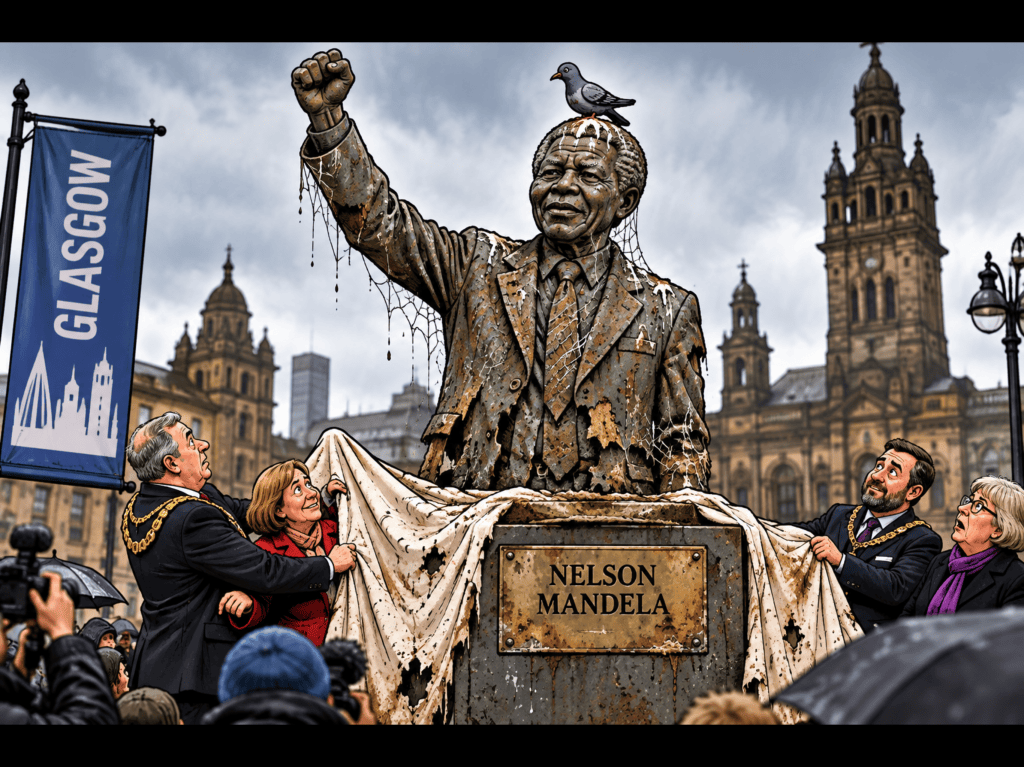
🗿🔥Today, Glasgow raises a statue to Nelson Mandela—a man who helped win freedom for millions and bent history away from one of the ugliest systems humanity ever dressed up as “order.” That deserves honour. That deserves remembrance. That deserves more than a polite round of applause and a council-approved ribbon cutting.
But winning freedom and governing responsibly are two very different achievements. One tears down the prison door. The other has to build the house, fix the roof, keep the lights on, protect the people inside, and make sure the money for the plumbing does not mysteriously vanish into someone’s cousin’s consultancy firm. 🧾💸
The bitter question is how much of that promise South Africa’s political leaders have squandered. Mandela’s legacy deserves more than statues and speeches. It deserves a country whose leadership actually lives up to it.
Freedom Was Won. Responsibility Was Not Optional.
⚖️🇿🇦The failures are substantial—and they make uncomfortable reading beside the speeches celebrating Mandela’s legacy.
South Africa recorded 5,181 murders in January–March 2026—about 58 every day. Murder fell compared with the previous year, and later figures show further improvement, but armed robbery, carjacking, kidnapping, extortion and gang violence remain serious problems. Freedom means less when people cannot live safely. A national anthem is not much comfort when families are listening for footsteps outside the gate. 🚨
Then there is violence against women and children. The August 2026 crime announcement highlighted increases in categories affecting women, children and other vulnerable people. Protecting them remains an urgent, unresolved responsibility. No liberation movement gets to call itself successful while the vulnerable still live like prey.
Mass unemployment remains a brutal indictment. Official unemployment reached 33.6% in April–June 2026, leaving 8.5 million people unemployed. Political freedom has still not delivered the opportunity to earn a living for millions. You cannot feed a family with a slogan, pay rent with a struggle song, or build a future on speeches laminated for conference season. 📉
Corruption and state capture have left wounds that no ceremonial plaque can polish away. The country is still dealing with public institutions exploited for private gain. By June 2026, the presidency reported more than R17 billion recovered through work linked to the State Capture Commission. Recoveries represent progress, yes—but they also reveal the scale of the betrayal. That is not just money stolen from budgets. It is hope siphoned from schools, clinics, communities and futures. 🕳️
Basic infrastructure remains another monument—just not the kind anyone wants photographed. Deteriorating water and sanitation services, unreliable electricity and underperforming freight rail and ports have raised costs and held back investment and jobs. Electricity supply has improved substantially, but repairing years of damage remains unfinished. People do not experience government as ideology. They experience it through taps, toilets, potholes, power cuts, invoices and queues. 🚰⚡
Poverty and extreme inequality still sit at the centre of the national story like an unpaid bill nobody in power wants to open. South Africa remains among the world’s most unequal countries. Poverty has declined on some measures, yet close to 60% of people live below the World Bank’s upper-middle-income poverty line. The promise of shared prosperity remains far from fulfilled. A democracy where millions are politically free but economically trapped has not completed the journey. It has merely changed the scenery around the cage.
Weak growth and poor local government deepen the failure. Economic growth remains insufficient to create enough jobs. Municipal financial management, service delivery and deteriorating local infrastructure remain major problems—failures residents experience through their taps, streets and bills. It is hard to celebrate “progress” when the road outside your house looks like it was shelled by a committee. 🕳️🚗
Glasgow can honour the man who helped win freedom. South Africa’s leaders must answer for how much of its promise remains undelivered. A statue is easier to maintain than a legacy.
Some systems look indefensible from the outside. The demand for change can be powerful, persuasive and morally justified. But removing an unjust system and building a successful replacement are separate responsibilities.
South Africa exposes that uncomfortable distinction. Apartheid was unjust. That does not give the governments that followed it a permanent exemption from scrutiny. Their record must be judged by what happened to the people they promised to serve.
Are people safe? Can they find work? Do public services function? Does public money reach communities, or disappear into connected pockets?
Those questions matter more than the righteousness of a speech.
Do not be fooled by anyone who presents good intentions as proof of good government. A noble cause does not make every policy wise, every leader honest or every outcome acceptable. Nor does failure afterwards prove that the injustice before it was justified.
The real test of change is whether it improves people’s lives. Leaders cannot keep asking to be judged by the evil they opposed while avoiding responsibility for the failures they oversee.
Mandela’s achievement deserves recognition. His successors’ record deserves examination. Reverence for the first must never silence criticism of the second.
You cannot feed a family with a liberation slogan, protect a woman with a commemorative speech or repair a water supply by unveiling another statue.
🔥Challenges🔥
Here is the uncomfortable truth nobody wants printed on the back of the commemorative programme: honouring Mandela properly means asking what became of the freedom he helped win. Not with lazy cynicism. Not with historical amnesia. But with the fierce, necessary question every citizen should demand of power: did you improve people’s lives, or did you simply inherit the microphone? 🎤
So let’s hear it. Is South Africa’s crisis a failure of leadership, policy, corruption, history—or all of the above wrapped in a flag and served with a speech?
👇 Comment on the blog, like, and share if you think legacies should be measured in safer streets, working services and real opportunity—not just bronze statues and polished speeches. 💬🔥
The best comments will be included in the magazine. 🎯📝


Leave a comment