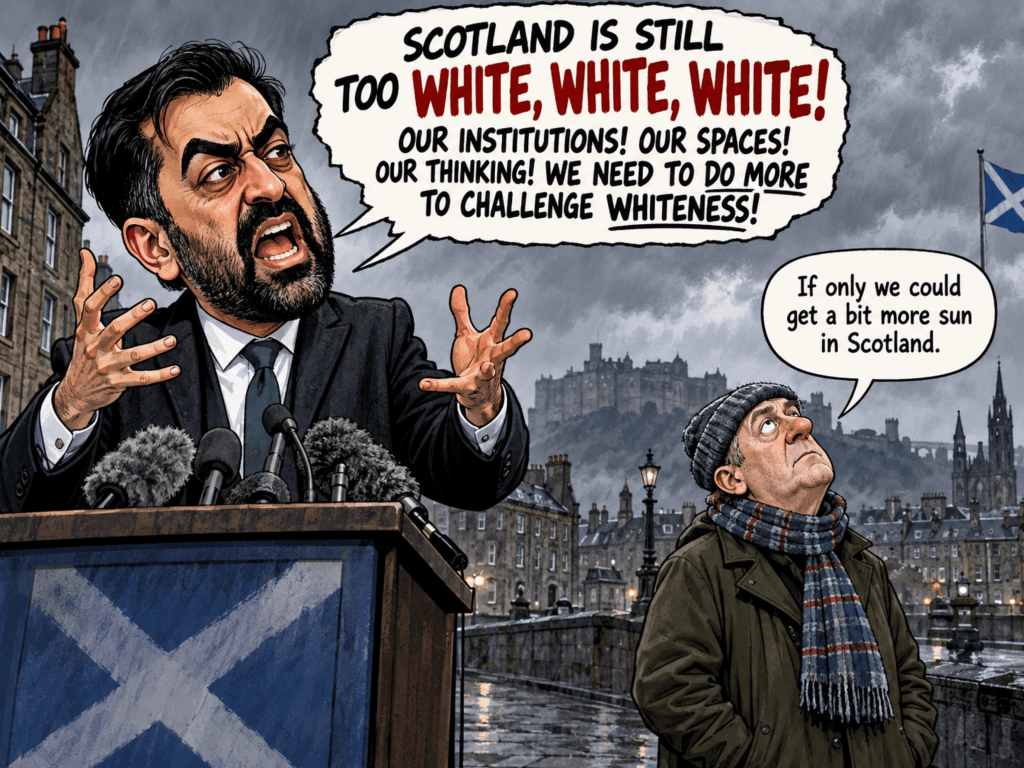
Humza Yousaf appears on Good Morning Britain to discuss racism and his spat with Elon Musk. Yet what about his own infamous “WHITE, WHITE, WHITE” speech in the Scottish Parliament?
Here is a man born in Scotland to immigrant parents, raised and educated in this country, elected by Scottish voters and eventually entrusted with the highest political office in Scotland.
Yet he stood in the Scottish Parliament repeatedly drawing attention to the skin colour of people occupying senior positions of authority.
He argued that he was highlighting inequality and the lack of ethnic minority representation. But that doesn’t mean his choice of language should be beyond criticism.
Scotland is a predominantly white country. Surely it should not be surprising that many of its senior officials are white? That doesn’t mean people from ethnic minorities should be excluded. Quite the opposite. Everyone should have a fair opportunity to succeed.
But shouldn’t the people appointed to positions of power be judged primarily on their ability, qualifications, integrity and suitability rather than the colour of their skin?
And while we’re discussing his public profile, there is another uncomfortable family story.
His brother-in-law, Ramsay El-Nakla, faced serious allegations involving drugs and extortion in a Scottish court. He was subsequently acquitted of all charges after prosecutors accepted his not guilty pleas. However, he later admitted in court that his crack cocaine use had taken over his life and that he had spent as much as £800 in a single day on the drug.
That does not make Humza Yousaf responsible for his brother-in-law’s behaviour. We are all responsible for our own actions.
And in exactly the same way, Scottish people cannot be blamed or made to feel guilty simply for being white. It’s not as though they had a choice in the colour of their skin, any more than Humza Yousaf had a choice in his.
Nobody should be made to feel that their race is something they need to apologise for. If we genuinely believe in equality, that principle must apply to everyone, without exception.
And that is precisely why his parliamentary speech deserves scrutiny. If we accept that people should not be judged by the actions of their relatives, their ancestry or circumstances beyond their control, surely we must also accept that being white is not, in itself, evidence of privilege, wrongdoing or discrimination.
What troubles me is the apparent double standard.
Politicians seem perfectly comfortable scrutinising the words and actions of others while expecting their own controversial statements to receive the most generous possible interpretation.
If we are genuinely interested in tackling racism, there must be one standard for everyone.
It shouldn’t matter whether someone is white, black, Asian, Scottish or from anywhere else. Every individual deserves to be judged fairly, and every politician deserves to be questioned when their language creates controversy.
People in positions of influence should think carefully before opening their mouths. If they expect accountability from others, they must be prepared to accept that same scrutiny themselves.
Racism is too serious an issue for selective outrage. Equality means treating people as individuals, not holding them responsible for the colour of the skin they were born with.


Leave a Reply