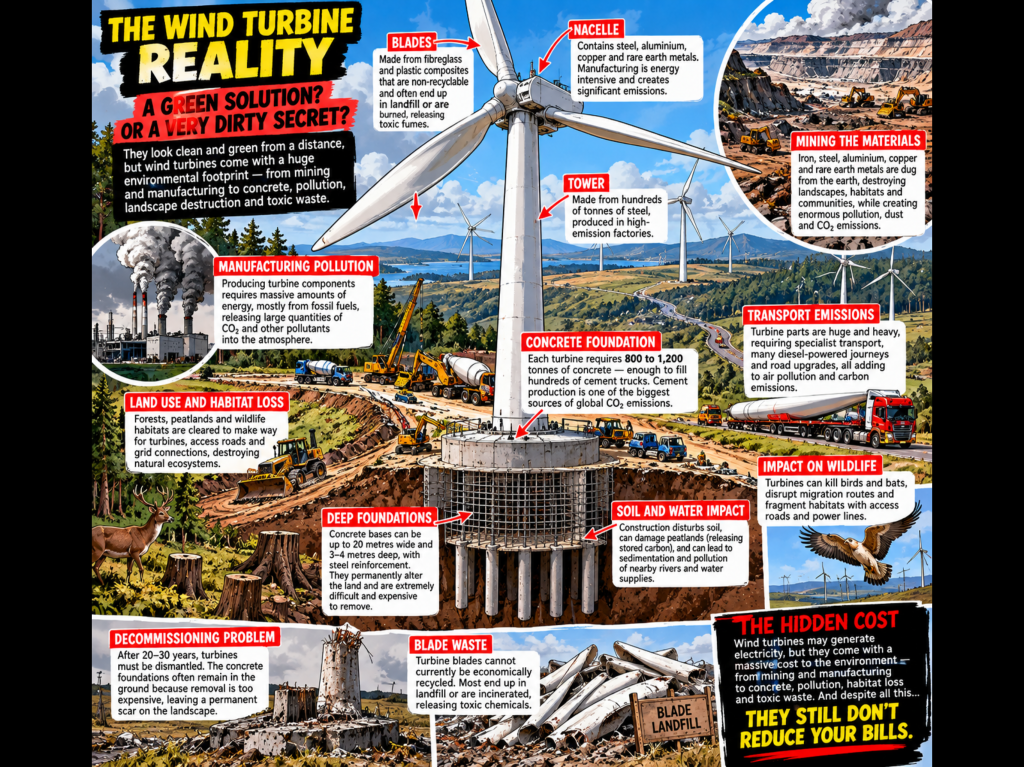
🌬️💸Scotland seems determined to keep planting wind turbines across the landscape as if these towering metal scarecrows are going to roll up their sleeves, hug the planet, lower your electricity bill, and photosynthesise like a patriotic oak tree with a government grant.
But here’s the awkward bit: Scotland already has major onshore wind capacity, and the Scottish Government’s own ambition is to reach at least 20GW of onshore wind by 2030. That is not a few tasteful turbines gently waving on a hill. That is an industrial-scale skyline makeover with blades.
The Trees Don’t Have Shareholders, So Naturally We Chose the Turbines
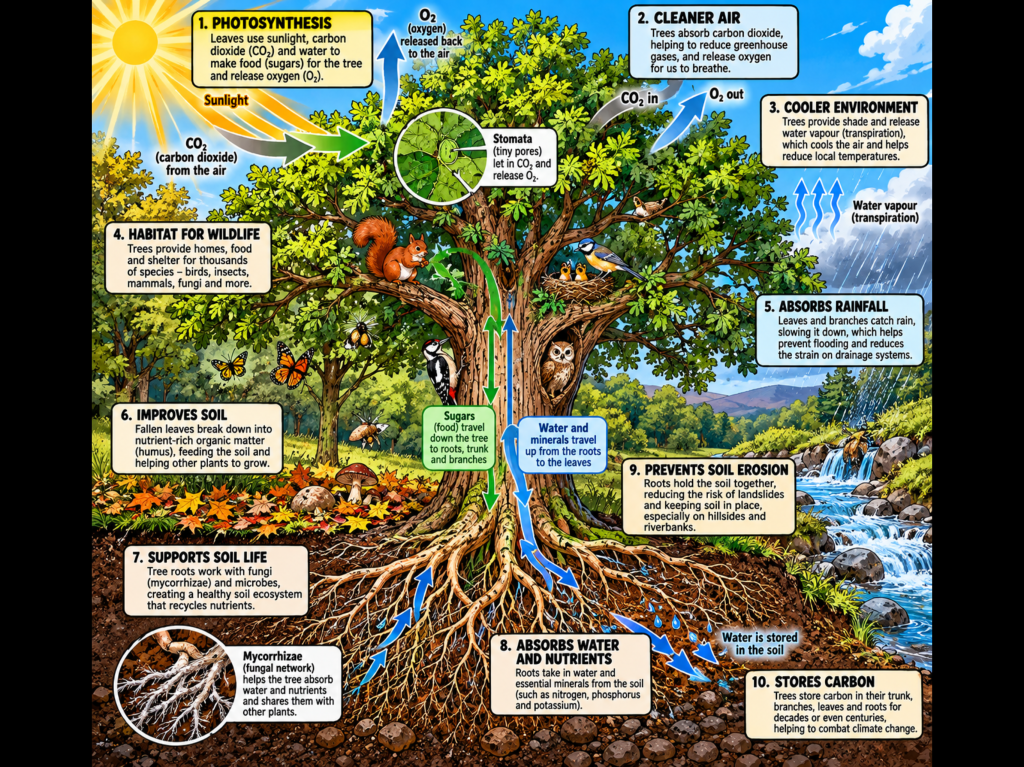
🌳⚙️A tree quietly gets on with the job. It absorbs carbon, shelters wildlife, stabilises soil, improves air, cools the land, asks for no subsidy paperwork, and never once sends an invoice from a head office in another country.
A wind turbine, meanwhile, arrives with access roads, concrete, steel, planning battles, glossy brochures, community “benefit” schemes, and enough corporate language to sedate a Highland cow.
And still, after all this spinning, many people look at their electricity bill and wonder: “At what exact point does the green miracle start feeling miraculous?”
Because ordinary households are not seeing the grand jackpot. The lights still cost a fortune. The standing charges still lurk like legalised mugging. The energy market still performs its little magic trick where Scotland can be rich in wind but people remain poor in affordable power.
That is the punchline nobody wants printed on the side of a turbine: generating energy is not the same as making energy affordable.
The system is the problem. UK electricity prices are still heavily shaped by market rules, network costs, infrastructure problems, and the fact that gas often sets the price even when renewable power is in the mix. So Scotland can be surrounded by wind farms and still have families rationing heat like they are living inside a Victorian cautionary tale.
And let’s not pretend everyone benefits equally. Investigations have found that the financial rewards from Scottish wind farms can flow heavily toward wealthy landowners, investment firms, and private interests, while local communities often receive a far smaller slice of the pie.
So when people object, they are not always “anti-green.” Sometimes they are anti-being-treated-like-scenery while someone else monetises the horizon.
They are not raging because they hate clean energy. They are raging because the hills are being carved up, the views are being industrialised, the profits are floating away, and the bill through the letterbox still looks like it was written by a ransom negotiator.
And yes, wind power has a role. Of course it does. But pretending turbines are magic trees with profit margins is insulting. Trees build ecosystems. Turbines build revenue streams. One gives shade. The other gives shareholders a lovely quarterly glow.
Maybe Scotland does need renewable energy. But perhaps Scotland also needs public ownership, cheaper local power, serious storage, proper grid planning, tougher community benefit rules, and a guarantee that the people living beside these “green monuments” are not just left with the view while someone else pockets the breeze.
🔥 Challenges🔥
Here’s the question blowing across the hills: if Scotland is producing all this wind power, why are ordinary people still being battered by energy bills?
Are wind farms saving the planet, saving corporate balance sheets, or doing both while households are told to be grateful for the privilege?
Drop your take in the blog comments. Are turbines the future, or are they just industrial profit poles dressed up in eco-language? 💬🌬️
👇 Comment, like, and share if you think Scotland deserves clean energy that actually cleans up the bills too.
The best comments will be included in the magazine. 🎯📝


Leave a Reply