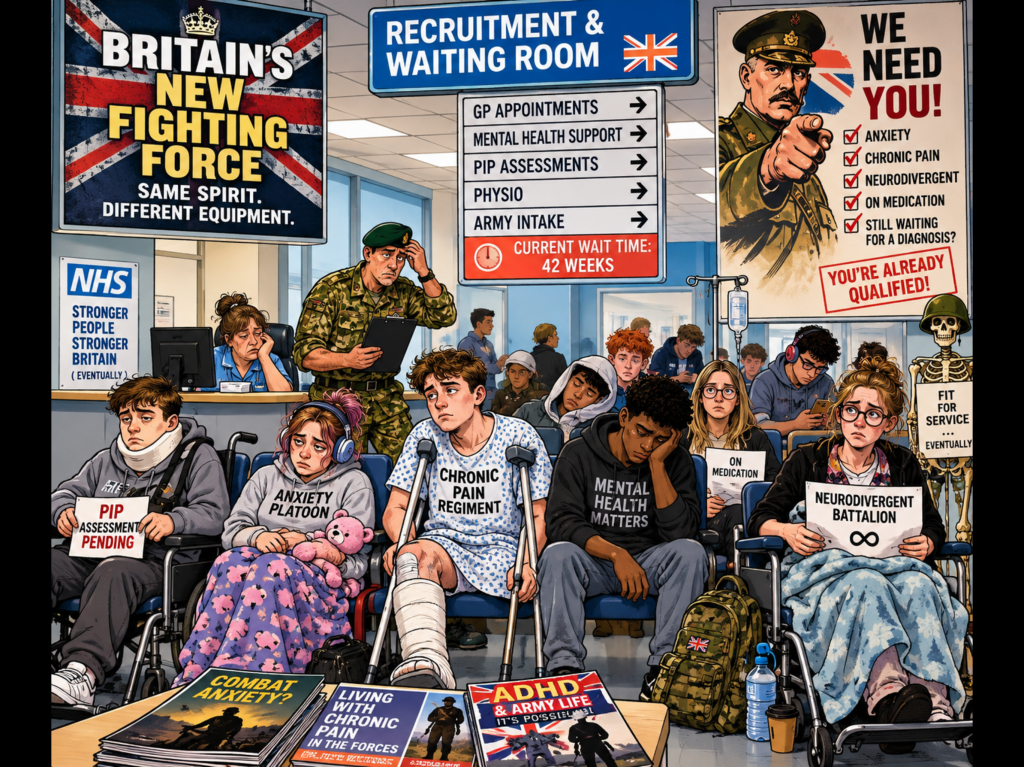
🪖🏥Over 430,000 young people aged 16–24 in England and Wales reportedly receive PIP, while 14,500 people of all ages joined Britain’s regular armed forces in the year ending June 2026. That comparison is not perfect — one is a claimant population, the other is annual recruitment, and PIP can support people who work — but it still points to a national question with teeth: if Britain expects young people to defend the country, why are so many of them already battling illness, disability, anxiety, pain, diagnosis delays, and a support system held together with forms, phone queues, and vibes? Recent reporting has also highlighted pressure around rising youth disability and mental health-related PIP claims, with long waits for assessments and treatment forming part of the wider debate.
🫡 Send in the Troops — Right After Their 42-Week Referral Letter Arrives
So Britain wants a battle-ready generation? Wonderful. Very stirring. Cue the brass band, polish the medals, unfurl the flag — and then immediately pause the whole parade because half the recruits are still waiting for an appointment, a diagnosis, a care plan, or someone in an office to admit that “resilience” is not a substitute for functioning public services. 🇬🇧📋
The government cannot spend years treating young people like administrative problems and then suddenly expect them to transform into disciplined defenders of the realm because a minister has discovered a map and a dramatic tone of voice.
This is not about sneering at people on PIP. That would be lazy, cruel, and about as useful as a chocolate bayonet. PIP exists because real people have real extra costs, real barriers, and real conditions that do not disappear when a newspaper columnist says “national service” three times in a mirror. Plenty of disabled people work, study, care for others, volunteer, and contribute more before breakfast than some professional flag-wavers manage in a fiscal year.
But there is a brutal contradiction here. We are told the country may need strength, readiness, grit, and service — while a huge chunk of young Britain is stuck in the national repair queue. Mental health services overstretched. Neurodiversity assessments delayed. Schools overwhelmed. GP appointments treated like golden tickets. Social care patched with duct tape. Then someone looks at the numbers and acts shocked, as though a generation raised in austerity, lockdown fallout, economic pressure, and collapsing support systems might not emerge as a perfectly polished infantry brochure. 🎺🧠
You cannot cut the roots and then complain the tree looks poorly.
If Britain is serious about defence, it needs to understand that national security does not begin at the barracks. It begins in schools, clinics, homes, youth services, housing, food security, mental health care, disability support, and giving young people a future that does not feel like a punishment with Wi-Fi.
Fix the waiting lists. Fix the support. Fix the poverty traps. Fix the diagnosis delays. Fix the fact that too many young people are being medically, socially, and economically written off before they have even had a proper chance to begin.
Because no nation becomes stronger by shouting “stand up straight” at people it left unsupported on the floor. 🧨
🔥Challenges🔥
Here is the uncomfortable question: are young people failing Britain, or has Britain spent years failing them first?
Should the government focus on recruitment posters and military speeches — or on rebuilding the health, education, and support systems that would make young people stronger in the first place? Drop your take in the blog comments. Bring the facts, bring the fury, bring the sarcasm. 💬⚡
👇 Comment, like, and share — because if Britain wants a stronger generation, it might want to stop treating care like a luxury item.
The best comments will be included in the magazine. 🎯📝


Leave a Reply