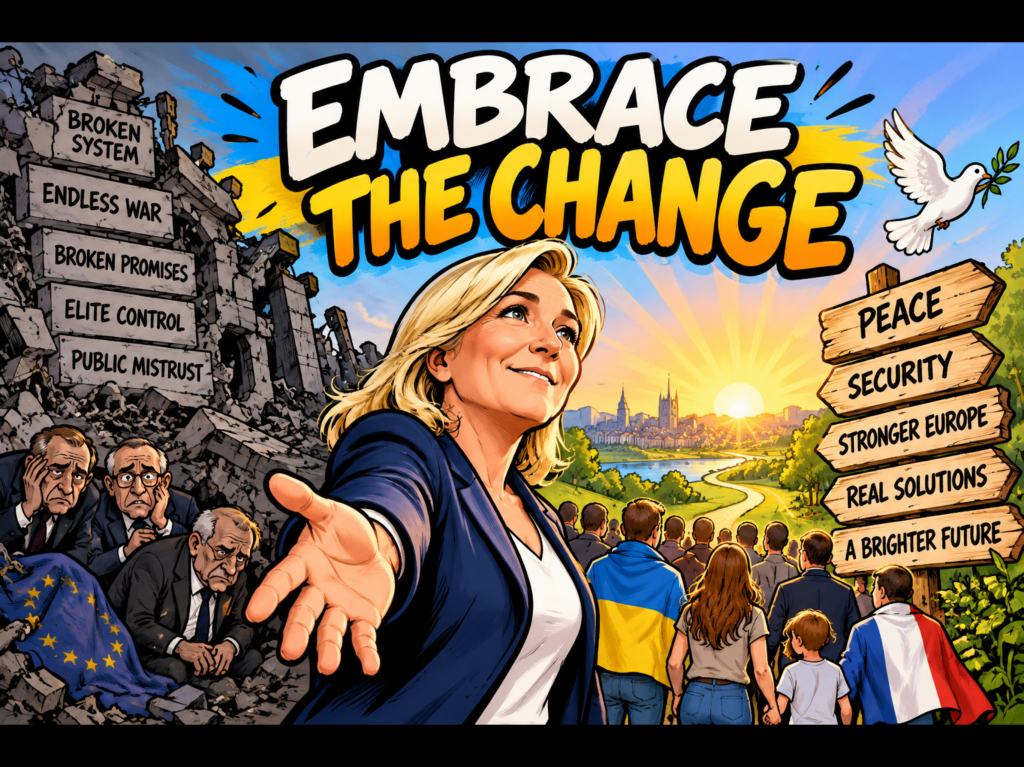
🕊️🇫🇷🇺🇦Europe’s political system is wobbling under the weight of war fatigue, public mistrust, economic strain, and a growing sense that the old answers are no longer working. Marine Le Pen’s rise is not just a French story — it is a warning flare from voters who feel ignored. Her past closeness to Vladimir Putin remains controversial, but it also raises a difficult question: could someone outside the usual diplomatic script help push Europe toward a different kind of peace conversation for Ukraine?
When the Broken Machine Starts Making Strange New Noises
⚙️🕊️Let’s be honest: Europe’s political establishment has not exactly been delivering a masterclass in calm, unity, and public confidence. France is restless. Ukraine is still bleeding. Brussels speaks in statements, summits, and careful phrases polished so smooth they almost say nothing at all.
Into this mess steps Marine Le Pen — a figure many critics distrust, but many voters see as a symbol of change. And that is where the conversation gets uncomfortable.
Her history with Putin is not a footnote. It is a flashing neon sign in the middle of the room. But perhaps the bigger issue is this: the current system has failed to bring peace, failed to reassure ordinary people, and failed to explain what the endgame is. If the established order cannot deliver results, voters will start looking elsewhere — even toward leaders the establishment spent years telling them to fear.
That does not mean Le Pen is a guaranteed peacemaker. Politics is not a fairy tale, and war does not end because someone gives a strong speech under dramatic lighting. But it does mean that a different voice may force a different conversation. Maybe peace in Ukraine will not come from the same old diplomatic furniture being rearranged for the thousandth time. Maybe it will require someone willing to challenge the script, reopen channels, and say the quiet part out loud: endless war is not a strategy. 🕊️
There is risk, of course. A peace deal must never become a reward for invasion, and Ukraine’s sovereignty cannot be treated like loose change in a geopolitical sofa. But there is also risk in pretending the current path is working perfectly while families keep burying sons, cities keep burning, and Europe keeps arguing over who looks toughest on television.
So perhaps Le Pen’s rise is not simply a threat. Perhaps it is a symptom — and maybe, just maybe, a pressure point. A failing system does not need more smug applause from its own architects. It needs disruption, honesty, and a serious conversation about how peace is actually reached.
🌍Challenges🌍
What if the uncomfortable truth is that peace might come from outside the approved political club? What if voters are not rejecting Europe — but rejecting a system that seems unable to protect France, Ukraine, or the future?
Drop your thoughts in the blog comments: could a leader like Marine Le Pen help open the door to peace, or is that hope too risky to trust? Like, share, and join the debate. 💬🕊️
The best comments will be included in the magazine. 📝🎯


Leave a Reply