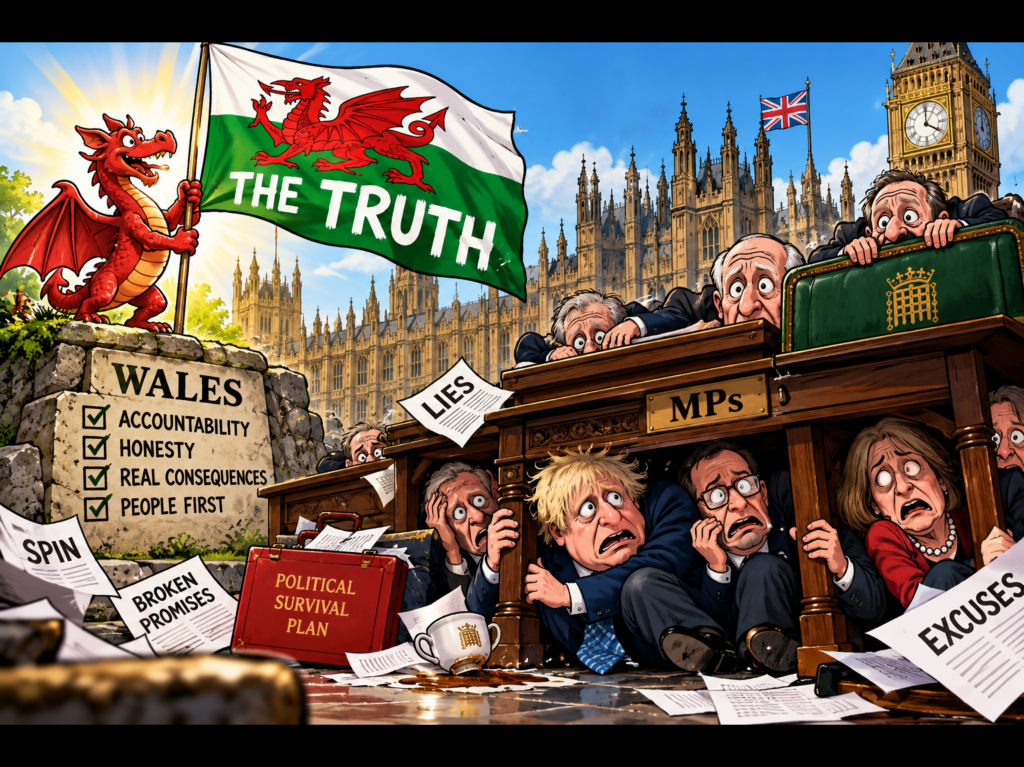
🐉🤥Wales is trying to do something so dangerously radical that political consultants may need smelling salts: make deliberate lying by politicians carry real consequences. Not a slap on the wrist. Not a “lessons have been learned” press release. Not a solemn-faced apology delivered while already planning the comeback tour. Actual consequences. Possibly even removal from office.
The Land of Song Has Found a New Tune: Tell the Truth or Pack Your Bags
🎶📦The proposal is beautifully simple, which is probably why the political class finds it so upsetting. If an elected politician or candidate deliberately misleads the public with a factual claim, and an independent process finds that they knowingly lied, they could face serious punishment—including losing their seat.
Imagine that. A world where “I misspoke” is no longer a magic spell that turns deception into fog. 🌫️
Wales is not saying politicians should be punished for opinions. It is not saying they should be thrown out for bad predictions, clumsy wording, or getting a number wrong during a chaotic interview. Humans make mistakes. Even politicians occasionally qualify.
This is about deliberate deception.
Knowingly false claims. Hidden facts. Invented figures. Statements repeated after the evidence has already been waved in front of their face like a flaming receipt. 🔥🧾
And frankly, this should not be controversial.
If a nurse lies on medical records, there are consequences. If a solicitor misleads a court, there are consequences. If a teacher falsifies safeguarding information, there are consequences. But if a politician lies to millions of people, affects elections, distorts public debate, and damages trust in democracy, we are apparently supposed to sigh and call it “robust politics.”
No. That is not robust politics. That is democracy being sold a dodgy used car with the mileage filed off. 🚗💨
The beauty of the Welsh approach is that it points toward something bigger: politics should not be a truth-free playground where the loudest liar gets the biggest microphone. If you want power, public money, public trust, and the right to shape people’s lives, then the absolute bare minimum should be this:
Do not deliberately lie to the people you serve.
Not exactly Magna Carta, is it?
Yet you can already hear the objections.
“What about free speech?”
Free speech does not mean freedom from consequences when you knowingly deceive the public from a position of power.
“What about honest mistakes?”
Fine. Protect honest mistakes. Build in evidence. Build in fairness. Build in an independent process. Nobody should lose their seat because they used the wrong decimal point or made a prediction that aged like yoghurt in a heatwave.
“What if it becomes political?”
That is exactly why politicians should not be left to mark their own homework. Asking Parliament to investigate itself is like asking a fox to conduct a chicken welfare audit. 🦊🐔
This is why Wales matters. It is showing the rest of the UK that accountability does not have to remain a decorative word printed on manifestos and ignored by lunchtime.
A law against deliberate political lying would not end dishonesty overnight. Of course it would not. Some politicians could find loopholes in a locked room with no windows. But it would change the calculation. It would make lying risky. It would make evidence matter. It would make public truth something more than a polite suggestion.
And perhaps most terrifying of all, it might encourage politicians to say three little words:
“I don’t know.”
Somewhere, a spin doctor has just collapsed into a beanbag. 🫠
This should be made law not because politics needs perfection, but because democracy needs trust. Voters cannot make informed choices if they are being deliberately misled by the very people asking for their vote. Elections become theatre. Accountability becomes pantomime. Public debate becomes a landfill of slogans, denials, and suspiciously polished nonsense.
Wales is not threatening democracy by proposing consequences for deliberate lies.
It is trying to rescue democracy from the people who treat truth like an optional extra. 🐉⚖️
So yes, make it law.
Make it fair. Make it independent. Make it evidence-based. Make it apply across parties, across offices, and across the whole political circus.
Because if a politician cannot survive without deliberately lying to the public, they do not need protection.
They need a different job.
Fiction, perhaps.
At least there, making things up is part of the contract. 📚
🔥Challenges🔥
Should Wales lead the way and force politics to rediscover honesty, or should deliberate lying remain one of Westminster’s most cherished traditions? Drop your take in the blog comments: should politicians who knowingly mislead the public lose their seats, or has lying become so normal we now call it “campaign strategy”? 💬🐉
👇 Comment, like, and share if you believe deliberate political lies should come with real consequences—not just another apology written by a press officer.
The best comments will be included in the magazine. 🎯📝


Leave a Reply