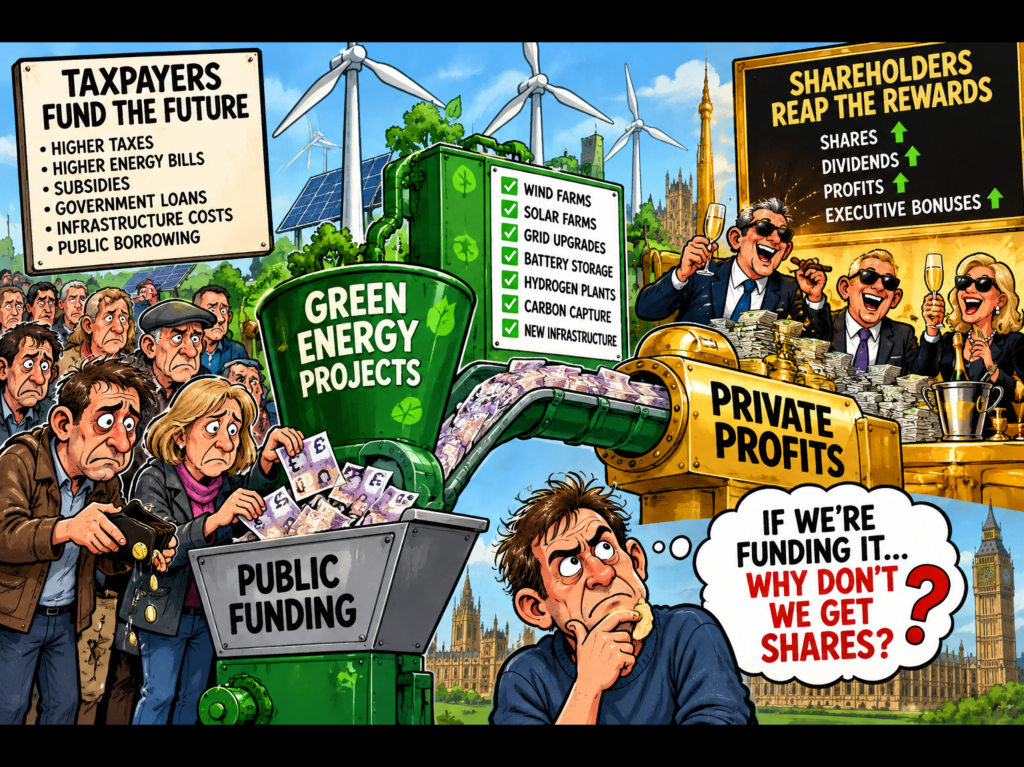
🌱💸Britain is being told to dig deep for the green revolution. Higher taxes, higher bills, public subsidies, government guarantees, infrastructure upgrades, grid expansion, wind farms, battery storage, heat pumps, carbon capture, and enough “net zero investment” language to sedate a charging rhino.
But here’s the awkward little question Westminster keeps stepping over like a pothole outside a council office:
If taxpayers are helping fund the green energy future, why aren’t taxpayers getting shares in the companies profiting from it?
Welcome to People’s Capitalism—Without the People
⚡🏦The government seems to have invented a thrilling new economic model.
It is called: you pay, they profit.
The public is expected to fund the transition through taxes, levies, bills, borrowing, and whatever other fiscal sock drawer the Treasury rummages through when it needs another billion. We are told this is an “investment in the future.” Lovely. Inspiring. Very brochure-friendly. 🌍✨
But when actual investors put money into a company, they usually get something back.
Shares. Dividends. Voting rights. A return. Maybe even a little document confirming they have not simply thrown their wages into a bureaucratic wind tunnel.
Taxpayers, on the other hand, get a colder house, a bigger bill, and a politician in a hard hat pointing at a turbine like he personally invented wind.
Why?
If public money helps build the infrastructure, underwrite the risk, subsidise the technology, guarantee the loans, smooth the planning process, and cushion private companies from failure, then surely the public should own a slice of the upside.
Not a vague promise. Not a slogan. Not a minister saying “long-term benefits” while standing in front of a solar panel with the emotional range of a parking meter.
Actual ownership.
Actual returns.
Actual public benefit. 💷
Because right now, the taxpayer is being treated less like an investor and more like a cash machine with a pulse.
And what makes it even more insulting is that private investors understand this perfectly. They would never pour millions into energy infrastructure out of pure civic affection. They want equity. They want profit. They want protection. They want their reward.
So why is the British public expected to behave like the nation’s unpaid venture capitalist?
If we are funding the green revolution, where are our shares?
Where is our national dividend?
Where is our public wealth fund?
Where is the household bill rebate when these projects start making money?
Where is the clause that says: “Dear taxpayer, because you carried the risk, you now get a share of the reward”?
Instead, we get the usual Westminster pantomime. Public risk is socialised. Private profit is protected. Ministers call it “partnership.” The rest of us call it being mugged with a leaf blower. 🍃🔫
And before anyone starts shouting that this is “anti-green,” it is not. Wanting clean energy does not mean agreeing to be financially rinsed by companies whose business model appears to be “save the planet, invoice the public, reward the shareholders.”
Green energy may be the future.
But if taxpayers are paying for the road to that future, we should not be locked in the boot while someone else drives away with the profits.
🔥Challenges🔥
Here is the question for the government: why are taxpayers good enough to fund the green transition, but not good enough to own part of it?
Should every major publicly funded green energy project come with public shares, bill rebates, or a national wealth fund? Or are we just expected to clap while our money becomes someone else’s dividend?
Drop your take in the blog comments. Should taxpayers get a stake, a refund, a rebate—or just another lecture from a minister in a hi-vis vest? 💬⚡
👇 Comment, like, and share. If we’re paying like investors, we should be rewarded like investors. 💸🌱
The best comments will be included in the magazine. 📝🎯


Leave a Reply