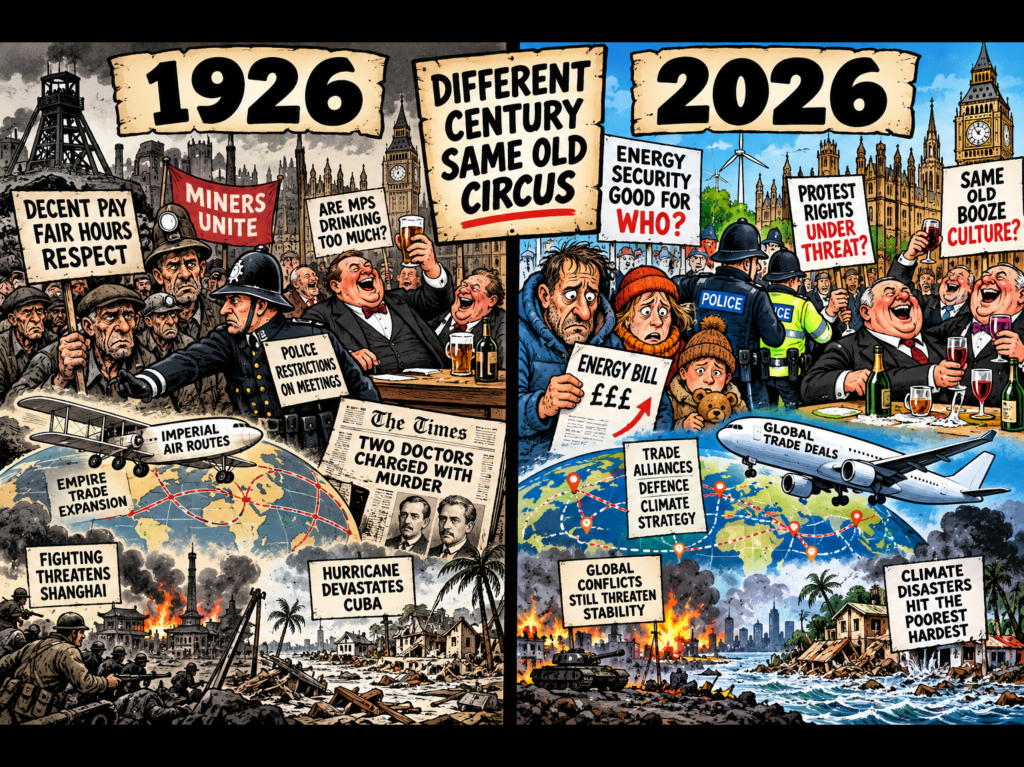
🪨⚡🏛️A century ago, Britain was paralysed by the coal dispute: miners fighting over pay, hours and dignity while government and industry dug themselves into trenches deeper than the pits themselves. Today, the coalfields may be quieter, but the argument has simply changed costume. The fuel is different, the speeches are shinier, and the spreadsheets now have climate targets on them—but the core question remains gloriously, miserably familiar: who pays when Britain’s energy system fails ordinary people?
🔥 The More Things Change, the More They Come With a Ministerial Briefing Pack
In 1926, miners were the human machinery beneath Britain’s industrial power. They wanted decent pay and tolerable hours; mine owners and Stanley Baldwin’s government wanted the books balanced on workers’ backs. Fast-forward to 2026 and Britain is no longer arguing over coal as the national lifeline, but energy is still the political battlefield. Chancellor John Healey’s Budget has promised energy-bill relief, including a £100 payment for millions of households and measures such as removing household gas standing charges, while the government says its broader aim is cheap electricity and energy security.
And yet, just as in 1926, the row is not really about fuel. It is about power—who has it, who profits from it, and who gets told to “be realistic” while their home turns into a walk-in fridge. The Resolution Foundation criticised the Budget’s energy support for not being targeted enough, saying the poorest half of households would receive only slightly more than the richest half. So, congratulations, Britain: a hundred years after miners were told to accept pain for the national good, we have invented a more modern system where everyone gets a tiny plaster and the wound gets a press release. 🩹📉
The freedom of speech row also has a very modern echo. In 1926, police restrictions on meetings addressed by miners’ leaders such as A. J. Cook and Herbert Smith triggered accusations that the authorities were suppressing speech. Today, the debate has shifted to protest powers, public order laws and the policing of dissent. The House of Commons Library notes that the Crime and Policing Act 2026 introduced new offences around face coverings, war memorials and pyrotechnics at protests, while Human Rights Watch has warned that broad police powers risk silencing dissenting voices. The government says peaceful protest remains protected, naturally—the traditional phrase governments use while polishing the handcuffs. 🚔📣
Then there is imperial trade and travel. In 1926, Britain was dreaming of commercial air routes across the Empire, mapping the skies as if the globe were a board game and Westminster had already called dibs on the blue squares. In 2026, the Empire is gone, but the urge to draw grand strategic lines across the world remains. The political language is now about trade resets, defence spending, Ukraine support, carbon markets, EU relations, energy security and industrial strategy. The costume has changed from pith helmet to policy paper, but the old habit remains: when trouble brews at home, look abroad and call it vision. ✈️🌍
Abroad, 1926 newspapers watched China with alarm as fighting threatened Shanghai, while Cuba counted the devastation of a hurricane that destroyed hundreds of homes in Havana’s poorer districts. Today’s headlines still bring the same uncomfortable pairing: geopolitical tension and climate-linked disaster, with Britain trying to budget, posture and moralise its way through an unstable world. The difference is that now we have satellite imagery, rolling live blogs and ministers saying “resilience” with the confidence of someone who has never personally needed any. 🌪️🛰️
And then, beautifully, stupidly, eternally, there is the Commons drinking row. In 1926, Labour MP Dr Alfred Salter’s allegations about drunken MPs caused a parliamentary flap. In 2026, concerns about Westminster’s alcohol culture have not exactly vanished into the mists of reform. A recent Institute of Alcohol Studies survey, reported by The Guardian, described Westminster as an unusually alcohol-centred workplace, with MPs and staff raising concerns about free drinks, long hours, stress and misconduct. A century later, Parliament has achieved the impossible: modernising almost everything except the suspicion that national decisions may occasionally be made by people who have confused democracy with last orders. 🍷🏛️
So what is the comparison? In 1926, Britain was arguing over coal, class, censorship, empire, foreign instability, disaster and drunk legislators. In 2026, Britain is arguing over energy bills, living standards, protest rights, international strategy, global conflict, climate pressure and—yes—whether Westminster has a booze problem.
Different century. Same stage. New props. Same old farce. 🎭
🔥Challenges🔥
Here’s the question worth dragging into the daylight: are we looking at progress, or just a hundred-year rebrand of the same power struggle?
Coal became “energy security.” Suppressed meetings became “public order.” Empire routes became “strategic partnerships.” Parliamentary drunkenness became “workplace culture.” And ordinary people are still being handed the bill with a smiley face stapled to it. 💸⚡
👇 Comment, like, and share if you think 1926 is not history—it’s a warning label Britain keeps peeling off the bottle. Drop your take in the blog comments: what has really changed, and what is just the same old Westminster pantomime in better shoes?
The best comments will be included in the magazine. 🎯📝


Leave a Reply