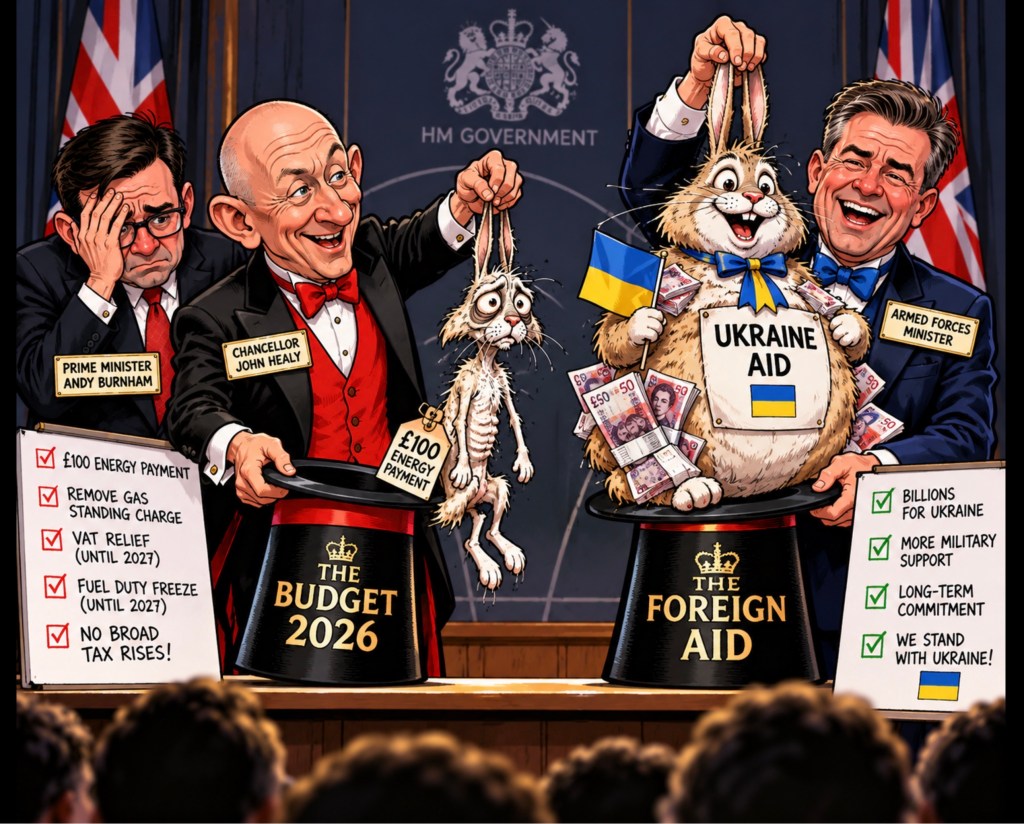
🎩💸Yesterday’s Budget offers households a few useful crumbs from the fiscal biscuit tin: a £100 energy payment, temporary VAT and fuel-duty relief, and the headline-friendly removal of gas standing charges. But behind the confetti cannon sits the less glamorous reality: frozen tax thresholds, temporary fixes, and energy costs that have not vanished so much as been politely relocated to another part of the bill. The government says the £100 Household Energy Payment will go to eligible council-tax band A–D households in England from January 2027, while gas standing-charge costs will be shifted into unit prices rather than abolished from existence.
🧾 The Great Household Houdini Act: Now You See Relief, Now You Don’t
Behold the modern Budget: a theatrical production in which ministers stride onstage with a £100 cheque, a hard hat, and the facial expression of someone who has personally defeated poverty with a calculator. 🎭
Yes, the £100 energy payment will help. Nobody sensible sneers at money landing during a cold winter. But £100 spread across a year is £8.33 a month, which in today’s Britain is roughly enough to heat one room, boil three kettles, and briefly imagine life before every direct debit became a hostage negotiation. 🔥
The problem is not that the payment exists. The problem is that it is doing the political work of a marching band while the real squeeze tiptoes in through the back door wearing socks.
Frozen tax thresholds are the quiet tax rise that never needs to announce itself. Wages and pensions creep up, prices creep up, and suddenly more of your income is taxable—not because you are richer, but because the system has learned to mug you politely. It is less “growth” and more “congratulations, inflation has promoted you into being squeezed harder.” 🧊📉
Then comes the great gas standing-charge vanishing act. The charge is “removed,” except the costs are moved into unit prices. That is not abolition. That is hiding the broccoli under the mashed potato. Low users may benefit, but higher users could pay more—especially people who need more heating because they are ill, disabled, elderly, or trapped in housing that leaks warmth like a colander in a gale. Which? reports that the fixed costs will instead be paid through the unit rate, with 40% potentially seeing higher bills.
And then we reach the temporary relief parade: electricity VAT relief extended until July 2027, fuel duty frozen until July 2027, and everyone expected to celebrate like the cavalry has arrived rather than noticing the cavalry has booked a return ticket. Temporary help is still help—but families cannot build financial security on measures with expiry dates stamped across them like supermarket sandwiches. 🥪⏳
The larger issue is living standards. The Budget may soften the next bill, but it does not convincingly answer the bigger question: when does ordinary life stop feeling like a subscription service nobody remembers signing up for?
The strongest criticism is not that the government did nothing. It is that it did something highly visible, while leaving the quieter pressures humming away in the walls: tax drag, energy insecurity, and public-service spending choices still waiting in the long grass. The Guardian reported OBR warnings of weak living-standard growth and noted IFS concerns that future plans depend on very tight public-service spending.
So yes, take the £100. Take the VAT relief. Take the fuel-duty freeze. But do not mistake a plaster for a cure, especially when the wound is still being taxed by stealth and warmed by a gas bill doing interpretive dance. 🩹🔥
🔥 Challenges🔥
Here’s the question: are we being offered genuine relief, or just a brightly wrapped distraction while the household squeeze keeps chewing through wages, pensions, and patience?
Does £100 feel like meaningful support—or a political fridge magnet stuck over a cracked wall? And if standing charges are simply moved into unit prices, is that reform or just bill-writing with a fake moustache? 🥸
Drop your take in the blog comments. We want your fury, your sarcasm, your receipts, and your best one-line roast of “relief” that expires before the problem does. 💬🔥
👇 Comment, like, and share — especially if your energy bill now requires the emotional support of a financial adviser.
The best comments will be included in the magazine. 🎯📝


Leave a Reply