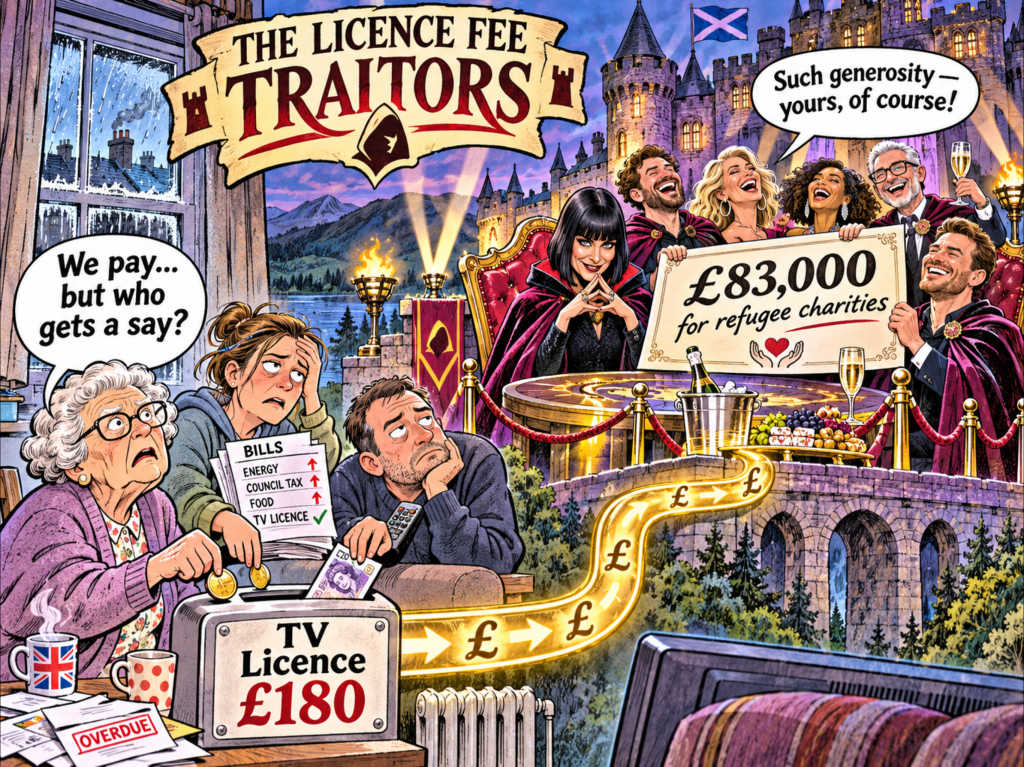
Congratulations to the winners of The Celebrity Traitors! Romesh Ranganathan and Sebastian Croft have walked away from the castle victorious, with £83,000 split between two charities supporting refugees: the Refugee Council and Choose Love. A wonderful result for two organisations doing important humanitarian work.
Meanwhile, millions of British households are doing their own disappearing act — watching £180 vanish from their bank accounts every year for the privilege of having a TV licence. 💸
But here’s a question that might cause more awkward silence than Claudia Winkleman staring across the Round Table.
If the public helps fund the BBC, why doesn’t the public get a say in which charities benefit from its biggest entertainment programmes?
🎭 The Castle of Generosity: Celebrities Choose, Licence Fee Payers Lose Their Vote!
Ah, the BBC. That magnificent institution where celebrities gather in Scottish castles, whisper behind curtains, accuse one another of treachery and eventually hand thousands of pounds to worthy causes.
All very heartwarming. ❤️
Meanwhile, back in the real world, pensioners are checking their heating meters, families are comparing supermarket yellow stickers, and the TV Licensing website is reminding everyone that the annual bill is now £180.
Apparently, the most reliable Faithful in Britain is the person paying by Direct Debit.
And before anyone starts sharpening their pitchforks, let’s make something perfectly clear.
This isn’t an attack on refugees. It’s a question about fairness, accountability and viewer participation.
Helping people fleeing war, persecution and hardship is a worthwhile cause. But so is helping the elderly person down the road who hasn’t had the heating on since September. So is supporting a children’s hospice, a struggling family or a community food bank.
Compassion isn’t supposed to be a competition where one deserving cause must knock another out at the Round Table.
Yet here’s the entertaining twist.
The winning celebrities get to nominate their preferred charities. The licence fee payer gets to nominate which household bill they can afford to pay late.
What a marvellous system! 👏
And what about the people receiving support from the winning charities? Do they even have television licences to watch the programme?
Of course, nobody is suggesting charity beneficiaries should need a television licence to qualify for help. That would be ridiculous.
But in the spirit of BBC generosity, perhaps the next prize could include a complimentary licence — although some might prefer the £180 towards their electricity bill.
Now there’s a plot twist! ⚡
To be fair, programme prize money is part of the BBC’s entertainment spending, not a personal donation collected directly from every household. And under the show’s rules, celebrity contestants choose their charities.
But that doesn’t stop us asking whether licence fee payers should have more involvement.
Imagine a different finale.
Claudia Winkleman dramatically removes her fringe from her eyes, looks directly into the camera and announces:
“Tonight, the celebrities have survived murder, betrayal and banishment. But there’s one final challenge…”
“We’re actually going to ask the viewers where the charity money should go!” 😱
Cue dramatic music.
Somebody faints.
A BBC executive drops their oat-milk cappuccino.
The nation discovers that democracy has made an unexpected guest appearance on Saturday-night television.
Viewers could nominate charities, create a shortlist and vote for causes they would like to support. British hospices, children’s hospitals, refugee charities, disability organisations, pensioner support groups and local community projects could all have their moment in the spotlight.
It wouldn’t diminish the generosity of the celebrities. It would simply give the audience a bigger part in the celebration.
Because surely the real magic of charity television isn’t just watching famous people give money away.
It’s making ordinary people feel that their voices matter too.
And with the BBC already asking households to contribute £180 a year, perhaps allowing viewers to choose a charity wouldn’t be the most outrageous idea ever broadcast.
After all, the public can vote for singers, dancers and reality-show contestants.
Why not let them vote for a good cause? 🗳️
Perhaps next year’s spin-off should be called:
THE LICENCE FEE TRAITORS:
Twenty celebrities. One castle. £83,000 in charity money. And millions of viewers desperately searching for the button marked “Our Say”.
The ultimate mystery isn’t who’s hiding behind the castle curtains.
It’s whether the people funding the entertainment will ever get a seat at the Round Table. 🏰💷


Leave a Reply