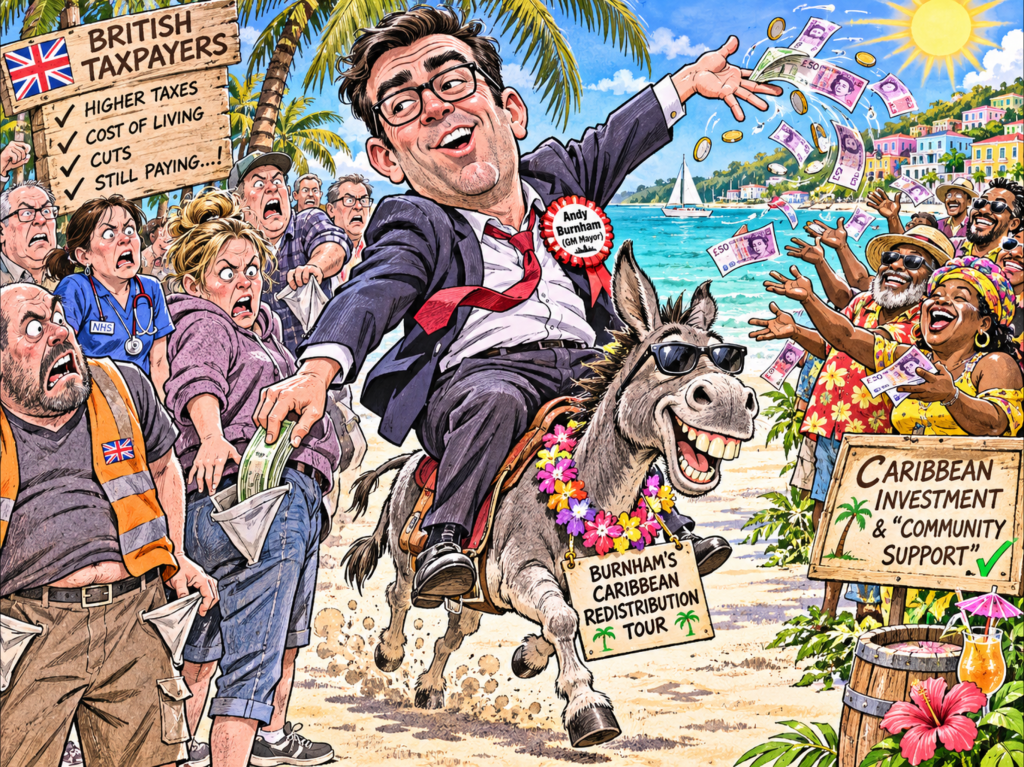
Centuries ago, British monarchs, governments, merchants and wealthy landowners helped build fortunes through the barbaric trade in enslaved human beings. Today, the people who made those decisions are long dead, the royal institution remains, and ordinary British taxpayers are being asked to fund another overseas initiative.
Prime Minister Andy Burnham has announced £40 million over three years for Caribbean infrastructure, including renewable energy projects, from existing aid budgets, while opening discussions about a formal apology for Britain’s involvement in slavery. He insists this is not financial reparations.
But here’s the £40 million question: If this isn’t a guilt payment, why is it being announced alongside discussions about Britain’s historical guilt? 🤔
👑💰 Royal History, Government Guilt and the Modern Taxpayer’s Magic Wallet
What a remarkable arrangement British history has produced!
The powerful make the decisions. The wealthy accumulate the fortunes. Governments write the policies. Centuries pass, administrations change, and somehow the invoice arrives at the doorstep of a pensioner in Preston, a nurse in Newcastle or a struggling family in Glasgow.
Congratulations! You’ve inherited the bill for decisions you never made. 🎩
Nobody should minimise the horrors of slavery. It was a monstrous system of human exploitation, and Britain’s historical participation deserves acknowledgement, education and serious reflection.
But acknowledging historical wrongdoing and accepting unlimited financial responsibility are two very different propositions.
And that’s where things get interesting.
The monarchy is an institution with centuries of history. The British state has existed through generations of governments. Yet when the discussion turns to historical responsibility, it is today’s taxpayer who faces the prospect of footing the bill.
Where is the equivalent conversation about institutional accountability?
Where is the examination of historical wealth, inherited privilege and the institutions that benefited from slavery?
And why does accountability apparently stop at the very institutions that survived long enough to apologise?
It’s rather like your great-great-grandfather crashing a carriage in 1820 and the insurance company sending you the repair bill in 2026. Except you never owned the horse, never rode in the carriage and can’t afford to repair your own car. 🐎💥
💷 The Royal Pension Question: Accountability for Everyone Except the Establishment?
Let’s imagine applying the same historical accountability principle to the institutions themselves.
Would the government consider reviewing royal funding, institutional assets or historical endowments connected to slavery?
Would it examine whether any relevant institutions should contribute voluntarily to educational, cultural or development programmes?
Would it consider whether public officials and public institutions should demonstrate financial restraint before making further overseas commitments?
There is no automatic legal basis for docking today’s royal or parliamentary pensions because of decisions made by predecessors centuries ago. Nor would that be a fair way to determine individual liability.
But there is a legitimate question about why ordinary citizens should be expected to accept collective financial responsibility while historical institutions face comparatively little scrutiny of their own resources.
Britain’s taxpayers are certainly familiar with accountability. Miss a tax payment and HMRC has an impressive memory.
Apparently, when dealing with decisions made by powerful institutions centuries ago, the memory is historical but the payment method is thoroughly modern: direct from the public purse. 💳
🌴⚡ Forty Million Pounds for Caribbean Energy — Is It Aid, Investment or an Apology Wearing a Solar Panel?
The government says the £40 million is intended to support infrastructure investment, including green energy, rather than compensate countries for slavery.
That distinction matters. Aid is not automatically reparations, and the timing of an announcement does not prove a hidden motive.
But taxpayers are entitled to examine the financial arrangements.
If Britain is financing renewable energy facilities, why not consider loans, investment partnerships or joint ventures wherever those arrangements are commercially appropriate?
Why shouldn’t British taxpayers benefit financially when projects generate profits?
Why shouldn’t there be agreements that provide measurable returns through trade, jobs, energy technology exports or diplomatic partnerships?
And crucially, who will actually own the infrastructure once British money has helped finance it?
At present, the public announcements do not establish a clear taxpayer ownership stake or project-by-project financial return. Nor do they provide a complete published breakdown identifying every recipient and ownership arrangement.
Of course, not every worthwhile overseas project will generate a direct financial profit. Some may deliver humanitarian, climate or strategic benefits that make conventional investment unsuitable.
But that is an argument for explaining the benefits and risks honestly — not treating scrutiny as an inconvenience.
Meanwhile, British households face expensive energy, pressure on public services, strained council budgets and infrastructure desperately needing investment.
Imagine the average taxpayer asking for £40 million to repair local roads, schools or hospitals.
They’d probably receive a consultation document, a feasibility study, three budget reviews and a polite explanation that the money simply isn’t available. 🏚️
⚖️ An Apology Is Free. A Financial Commitment Requires Answers.
There is something especially uncomfortable about confusing national responsibility with personal guilt.
Today’s British working population did not establish the transatlantic slave trade. They did not enact the laws that sustained it, and they should not be treated as personally guilty of those crimes.
Indeed, Burnham himself has argued that modern British people should not be held financially liable for historical wrongs in which they played no personal part.
That makes scrutiny of the £40 million commitment all the more important.
The government should demonstrate that it is making an investment in the future rather than simply funding a gesture about the past.
Britain can acknowledge the horrors of slavery without presenting every modern taxpayer with an inherited invoice.
And Britain can support Caribbean development without assuming that unconditional grants are always better than mutually beneficial investment.
That isn’t denying history.
It’s demanding responsible government.


Leave a Reply