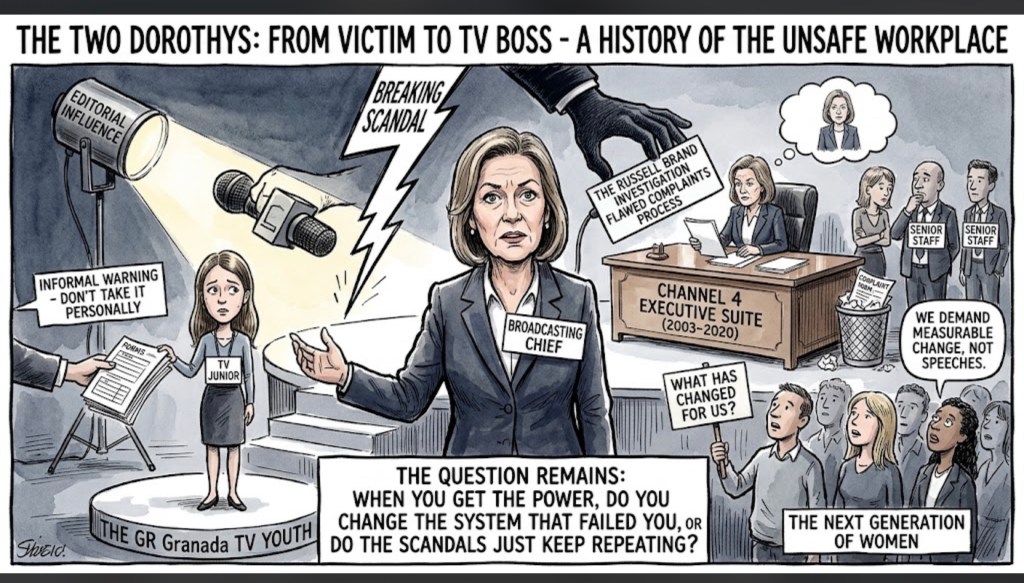
In British television, everyone knows how to produce a scandal, commission an investigation, and deliver a moving speech about workplace culture. But preventing the scandal in the first place? That seems to be an entirely different production.
What happens when someone who once experienced the industry’s failure eventually becomes one of its most influential executives?
Dorothy Byrne has spoken courageously about being sexually assaulted early in her career. But she later spent 17 years as Channel 4’s Head of News and Current Affairs (2003–2020). During that period, serious failures in handling complaints elsewhere within Channel 4 and its commissioned productions occurred.
So here’s the uncomfortable question: When you finally get a seat at the top table, how do you make sure the next generation doesn’t suffer what you suffered?
🎭 From Powerless Employee to Powerful Executive
Let’s rewind to Granada Television in the 1980s. According to Byrne’s 2019 Edinburgh Television Festival lecture, a female superior warned her that a director would sexually assault her. She was reportedly told not to take it personally because he behaved that way toward other women.
The safeguarding procedure seemed to consist of a warning and a shrug.
Now fast-forward to 2003. Byrne becomes Channel 4’s Head of News and Current Affairs. She is no longer the young employee wondering who will listen. She is an award-winning executive with substantial editorial influence and a platform to challenge the industry’s culture.
🚨 The Russell Brand Investigation: When the Complaints System Lost the Plot
In 2024, a Channel 4 investigation into Russell Brand revealed a troubling finding: a staff member made a serious allegation in 2009 that was neither properly investigated nor escalated. A separate investigation by Banijay UK found that informal concerns on Endemol productions reached senior staff but were not adequately addressed.
The TV industry can organize a twelve-camera spectacular, but apparently, making sure a serious workplace complaint reached the right people was sometimes beyond its production capabilities. 📋💥
Institutional accountability isn’t limited to asking who personally knew what. It also means asking whether those with influence helped build a culture in which people could report misconduct without fear, confusion, or professional consequences.
🏆 Awards, Speeches, and Standing Ovations
Byrne has challenged sexism and advocated for women publicly. Channel 4’s announcement of her departure highlighted her commitment to mentoring staff, particularly women.
But a stirring speech is not a safeguarding policy. An award-winning documentary is not a functioning complaints procedure.
What has not been established is which specific harassment-reporting protections or whistleblowing reforms she personally introduced during her leadership. That is a gap in the public evidence, not proof she did nothing. But it is exactly the sort of gap a serious journalist should want to fill.
⚖️ The Question Dorothy Byrne Deserves the Opportunity to Answer
Dorothy Byrne, you have described how powerless you felt when sexually assaulted as a young woman in television. You then became one of the most influential figures in British news.
What specific measures did you personally introduce, advocate, or help strengthen to ensure that younger women could report sexual harassment safely and without damaging their careers?
And looking back at the failures subsequently documented within Channel 4 during those years, what lessons would you draw about the effectiveness of the industry’s safeguards?
That’s not an accusation. It’s a question about leadership, measurable change, and institutional accountability. The ultimate test of progress is whether the next young employee can speak up without fearing that the organisation will look the other way.
🔥 Challenges: Who Watches the People Who Watch Everyone Else? 🔥
If an industry can investigate everyone else’s scandals, why has it struggled to address complaints within its own walls? Was broadcasting genuinely transformed, or did some organisations simply get better at writing policies and polishing reputations?
We want to hear from you. 💬
Have you worked in an industry where everyone knew about inappropriate behaviour but nobody was prepared to challenge it? Join the discussion.


Leave a Reply