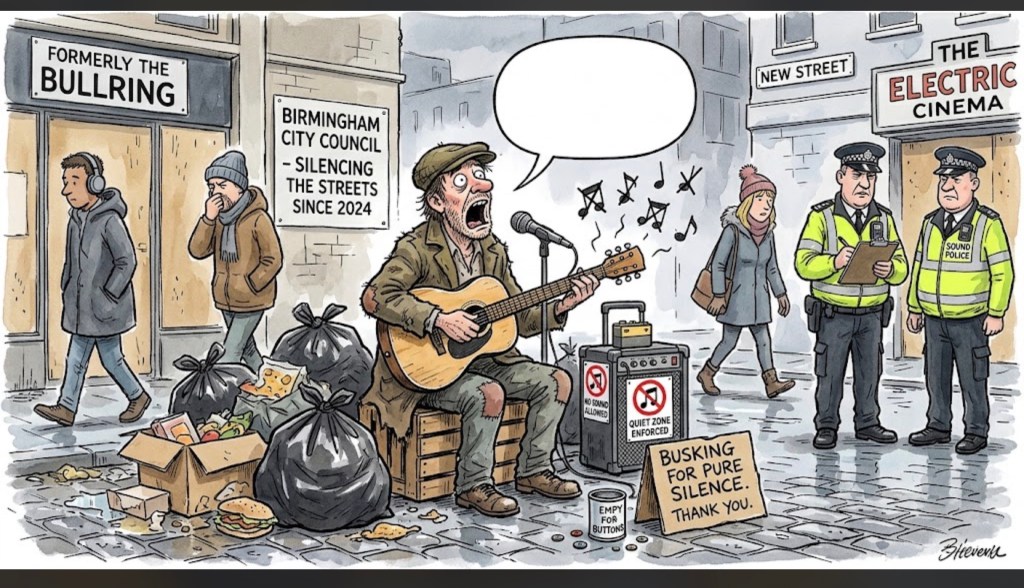
The rat on the corner of New Street is not, strictly speaking, a municipal employee, but it is currently doing far more for the local economy than the council’s cabinet member for public spaces. It is sleek, remarkably well-nourished on a three-week-old rotting doner kebab, and possesses a sharp, unobstructed view of the high street.
On any given afternoon, this rat can dodge broken paving slabs, weave through towering ramparts of uncollected black bin bags, and feast on the discarded remains of a civilization that appears to have given up around mid-August. What the rat cannot do, however—and what Birmingham City Council has very wisely determined to stamp out with the full, terrifying majesty of local government authority—is play an acoustic guitar without a permit.
Thank goodness. For a moment there, the citizens of Europe’s youngest major city were in grave danger of hearing an acoustic rendition of Wonderwall while wading through knee-deep domestic refuse.
Prioritization as a High Art Form
There is a precise, breathtaking genius to the logistical hierarchy of modern civic governance.
When a city finds itself burdened with a balance sheet that looks like it was calculated on a wet napkin by a drunken gambler, and when the simple, humble task of moving trash from the pavement to a landfill becomes an insurmountable puzzle on par with splitting the atom, a council must ask itself one fundamental question: What is truly destroying the fabric of our society?
Is it the waist-high piles of decomposing household waste harboring new species of antibiotic-resistant bacteria? No.
Is it the structural collapse of basic public services under the weight of historic financial incompetence? Far from it.
It is the brass section of the Salvation Army. It is a lonely teenager playing an out-of-tune violin near the Bullring. It is the existential, intolerable threat of someone singing O Come, All Ye Faithful without having first submitted a 40-page environmental impact assessment regarding decibel limits in a pedestrianized zone.
The Acoustic Threat to Public Decency
One must admire the official bravery required to look at a street that smells like a forgotten crisper drawer in an abandoned fridge and decide that the primary hazard to public health is an unplugged amplifier.
The official line, naturally, is “noise management.” The city center, we are told, must be a place of tranquil, peaceful reflection—a quiet sanctuary where residents can hear the gentle rustle of wind blowing plastic bags across the concourse, uninterrupted by the vulgarity of human joy.
Of course, the quiet compliance of the modern council cabinet raises more fascinating questions. In a city celebrated for its dynamic, rapidly shifting cultural tapestry, one has to wonder whose sensibilities are being protected here. Is the acoustic guitar inherently discriminatory? Does a festive carol threaten the delicate geopolitical equilibrium of the West Midlands?
When a local authority refuses to clearly explain who complained, what was said, or why a simple “turn it down” warning was deemed insufficient, it invites the public to fill in the blanks. And the blanks are rich with irony. In an effort to avoid offending anyone, the council has achieved the ultimate dream of modern administrative bureaucracy: offending everyone while rendering the city center as silent, sterile, and bleak as a post-apocalyptic sorting office.
The New Sounds of Birmingham
Since live music is now categorized somewhere between fly-tipping and petty arson, the council has effectively updated the local soundscape for the modern era. Visitors to the city center can now look forward to a rich, curated audio experience consisting exclusively of three core sounds:
Bullet The Crunching of Debris: The crisp, satisfying sound of stepping on uncollected takeaway containers with every single stride.
Bullet Aggressive Seagull Disputes: Nature’s own choir, battling over a discarded crust in front of shuttered storefronts.
Bullet The Silent Stare of Enforcement Officers: Who may not have the resources to empty your bin, but possess an infinite supply of clipboards to measure the output of a xylophone.
The Freedom to Rot in Silence
There is a profound philosophical lesson here for the rest of the nation. We used to believe that public spaces belonged to the public—that streets were living places meant for trade, conversation, art, and the occasional questionable brass band.
Birmingham has pioneered a bolder vision for the 21st century: the street as a sterile transit corridor where citizens move quickly, breathe through their sleeves to filter the stench of uncollected rubbish, and keep their mouths shut lest they emit an unauthorized melody.
So as the festive season approaches, do not despair when you walk down New Street and hear nothing but the low, rhythmic hum of a diesel generator power-washing a spot where a busker once stood. Rejoice! The trash may be rotting, the council may be broke, and the services may be dead—but at least nobody is playing the banjo.


Leave a Reply