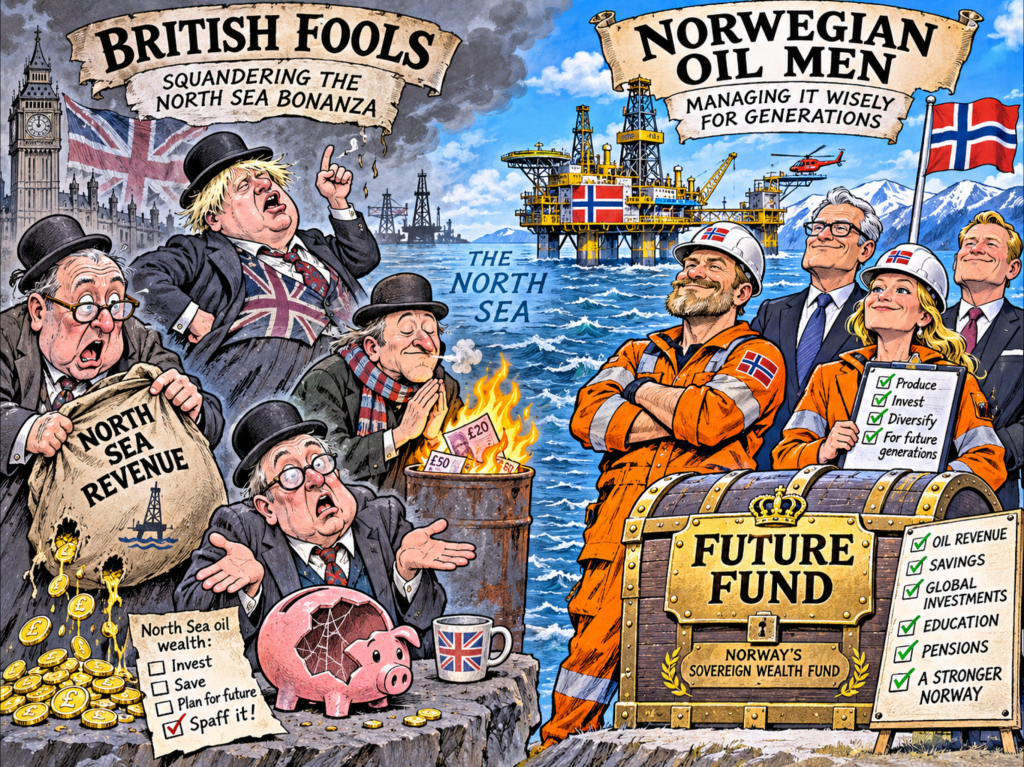
Two countries. One North Sea. Billions of barrels of oil and gas. A once-in-a-generation opportunity to turn a finite natural resource into lasting national wealth.
Norway looked at its oil reserves and thought: “How do we make this money work for our children, grandchildren and generations yet to come?”
Britain took a rather different approach: “Excellent! That should help with this year’s Budget.”
Fast-forward several decades and Norway has accumulated a sovereign wealth fund worth an eye-watering NOK 21.27 trillion — roughly £1.5 trillion at the end of 2025.
Britain? No equivalent UK-wide petroleum wealth fund. Not a trillion-pound investment pot. Not even a modest North Sea nest egg tucked away for a rainy day.
Just decades of petroleum tax revenues absorbed into the Treasury’s general finances, accompanied by the familiar Westminster soundtrack of spending arguments, borrowing debates and promises that the next government will sort everything out.
One country turned oil into investments. The other turned oil into annual Budget arithmetic.
And Scotland, sitting beside much of the resource that made this possible, has every reason to ask an awkward question:
Where is our equivalent of Norway’s oil fund? 🤔
🤡 Westminster’s Oil Economics: Why Build a Nest Egg When You Can Balance Another Budget?
Imagine two neighbours discovering gold beneath their gardens.
The first neighbour, Norway, carefully extracts it, secures a substantial public share, invests the proceeds and builds a financial portfolio designed to benefit the family for generations.
The second neighbour, Britain, sells the gold, puts the money into the household account and uses it to help cover the bills.
Years later, Norway has a magnificent investment portfolio.
Britain has a familiar explanation: “Well, you see, the money was needed at the time.”
Technically, that’s a perfectly legitimate answer.
Politically, it’s rather less satisfying when the gold has largely been extracted and there’s no dedicated national investment fund to show for it.
And this is where the British approach becomes such irresistible material for satire.
Westminster governments have spent decades talking about fiscal responsibility, long-term economic planning and protecting future generations.
Meanwhile, Norway actually created a mechanism to do precisely that.
Apparently, long-term thinking was available in Scandinavia but had difficulty getting through customs at Dover. 🚢
💰 The Numbers That Make Westminster’s Explanations Rather Uncomfortable
🇬🇧 United Kingdom
£4.3bn
Net UK oil and gas production tax receipts, 2025–26
🇳🇴 Norway
NOK 664bn
Government petroleum cash flow, 2025
Sources: HMRC, October 2026; Statistics Norway. These are different measures and periods: British production taxes versus broader Norwegian petroleum receipts, including state ownership income. They are not directly comparable. GOV.UK +1
But the truly astonishing number is sitting in Norway’s investment accounts.
Norway’s sovereign wealth fund · 31 December 2025
NOK 21.27 trillion
Approximately £1.5–£1.6 trillion at illustrative exchange rates.
Source: Norges Bank Investment Management, 2025 annual report. Norges Bank Investment Management +1
That isn’t money sitting under a Norwegian mattress next to a tin of emergency biscuits.
It’s invested internationally in shares, bonds, property and renewable-energy infrastructure.
By the end of 2025, Norway’s fund had generated approximately NOK 13.46 trillion in cumulative investment returns before management costs since its first investment.
In other words, the wealth generated by the petroleum resource has helped produce more wealth.
Imagine explaining that concept at Westminster.
“Minister, what if we invested some of the proceeds so they could generate returns for decades?”
“Interesting proposal. But have you considered spending the money now and announcing another review in five years?”
🏦 Norway Didn’t Just Save More — It Captured More
Here’s the part of the comparison that deserves particular attention.
The difference wasn’t simply that Britain spent its petroleum revenue while Norway invested a substantial portion of its own.
Norway also developed a system that included substantial taxation, direct state participation in petroleum production and public ownership interests.
Historical research comparing government petroleum revenue per barrel of oil equivalent between 1971 and 2014 estimated that Norway collected approximately 2.7 times as much public revenue per barrel as Britain, adjusted to 2014 US dollars.
That historical estimate reflects several differences, including field economics, oil prices, tax systems and state ownership. It isn’t evidence that every Norwegian barrel was identical to every British barrel.
But it does raise a rather uncomfortable question.
Why did the two countries design such different systems for capturing the public value of their natural resources?
Norway treated petroleum as an asset belonging to society, with a long-term financial strategy.
Successive British governments treated petroleum taxation primarily as part of ordinary government revenue.
The money helped finance services, reduce borrowing requirements and support public spending. That’s not the same thing as throwing it into the North Sea.
But nor is it the same thing as accumulating a giant portfolio of financial assets.
And no amount of ministerial jargon can magically turn one into the other.
🛢️ Britain’s Great North Sea Magic Trick
Britain’s oil and gas industry generated substantial revenue over the decades.
A September 2026 estimate from the Intergenerational Foundation put inflation-adjusted UK petroleum revenues through 2024–25 at around £483 billion.
That’s an extraordinary amount of money.
Money that entered the public finances over successive governments, through economic booms, recessions, tax changes and shifting political priorities.
Norway, meanwhile, established its petroleum fund in 1990 and began transferring money into it in 1996.
It didn’t simply lock away every penny. Norway has used fund transfers to finance government expenditure, operating under a fiscal framework intended to preserve the fund’s long-term value.
The contrast isn’t between a country that spent nothing and one that spent everything.
It’s between a country that deliberately built a permanent investment institution from its petroleum wealth and one that never established an equivalent UK-wide system.
Britain’s political class may offer perfectly serious arguments about the need to fund services, manage debt and respond to the economic pressures of the day.
The awkward question remains: why wasn’t building a lasting investment fund also part of the plan?
After all, oil is finite.
A properly managed portfolio of investments can continue generating income after the oil stops flowing.
That isn’t revolutionary economics.
It’s the basic principle behind saving and investing, dressed up in a suit and given a Treasury briefing paper.
🏴 Scotland: All That Oil, and Where’s the Family Fortune?
Now we arrive at the Scottish dimension.
Scotland has been central to North Sea petroleum production for decades. Aberdeen became a major offshore energy centre. Workers, engineering firms, ports and supply chains developed around one of Europe’s most significant petroleum industries.
For 2025–26, the Scottish Government estimated that Scotland’s geographical share of North Sea revenue was approximately £3.15 billion, out of a UK total of around £3.93 billion including licence fees.
That is a geographical statistical allocation, not money paid directly into the Scottish Government’s bank account.
Nevertheless, it illustrates why the future of these resources matters so much to Scotland.
The comparison with Norway raises questions about how revenues should be governed, what should be invested and how offshore communities should benefit from the economic transition.
Imagine a dedicated long-term investment strategy linked to the remaining resource, supporting engineering, renewable energy, industrial innovation, skills and future public services.
There would be difficult choices. Production has declined considerably from its peak, and money invested for tomorrow cannot simultaneously be spent on today’s hospitals, schools or debt repayments.
But those trade-offs are precisely what long-term national planning is supposed to address.
The oil won’t last forever. The consequences of decisions about its proceeds will last considerably longer.
And here’s another sting in the tale.
HMRC’s October 2026 estimates put future petroleum decommissioning-related costs to the Exchequer at approximately £11.8 billion in present-value terms, through tax repayments and forgone revenue. GOV.UK
So even as production declines, the public finances face costs associated with closing down parts of the industry.
Britain’s North Sea story, it seems, isn’t quite finished with the Treasury.
🎪 Decades of Revenue. Decades of Decisions. And One Enormous Question.
The British and Norwegian stories were never identical. Their populations, petroleum fields, production histories, public finances and political choices differed.
Norway also benefited from the timing of its production and investment growth. It would be misleading to claim that Britain could simply have copied Norway and automatically ended up with the same trillion-pound fund.
But differences in circumstances don’t make differences in policy irrelevant.
Norway’s experience demonstrates that governments can combine petroleum revenues, public ownership interests, long-term investment and controlled public spending in a single institutional framework.
Britain demonstrates a different model: allowing petroleum revenues to flow into the broader public finances, meeting the priorities and pressures of successive governments.
One model leaves a highly visible national financial portfolio.
The other leaves a historical record of revenue, expenditure and tax decisions.
And perhaps the most biting satire of all is that Westminster politicians have spent generations delivering speeches about prudence and protecting the interests of future generations.
Norway put that principle into an investment fund. Britain put it into speeches. 🎤
🔥 Challenges: Was Britain’s North Sea Wealth a Missed Opportunity?
Here’s a question capable of making a Treasury official choke on their morning coffee:
If Norway could establish a national petroleum investment fund, why did successive British governments never create an equivalent?
Was financing immediate public expenditure the right priority? Could a meaningful proportion of North Sea revenue have been invested without sacrificing essential services? Or did the absence of a long-term fund mean Britain missed an opportunity to build enduring financial wealth?
And for Scotland, the question is even more pointed.
Who should control the economic benefits of the remaining North Sea resources, and how should those benefits be protected for future generations?
These aren’t questions to bury beneath party slogans or another 400-page government consultation.
They’re questions about public wealth, economic choices and what one generation owes the next.
We want to hear your answer — whether you defend Britain’s approach, admire Norway’s model or think both countries could have done things differently.
👇 💬 Join the argument in the blog comments, hit LIKE if this got you thinking, and SHARE it with someone who believes North Sea wealth deserves a serious public debate.
The sharpest, funniest and most thought-provoking comments will be featured in the next issue of Chameleon News Magazine. 🦎📝
Key official sources: HMRC, October 2026 · Norway’s sovereign wealth fund annual report · Statistics Norway. Historical figures attributed to the Intergenerational Foundation and Natural Resource Governance Institute are retained from the supplied research.


Leave a Reply