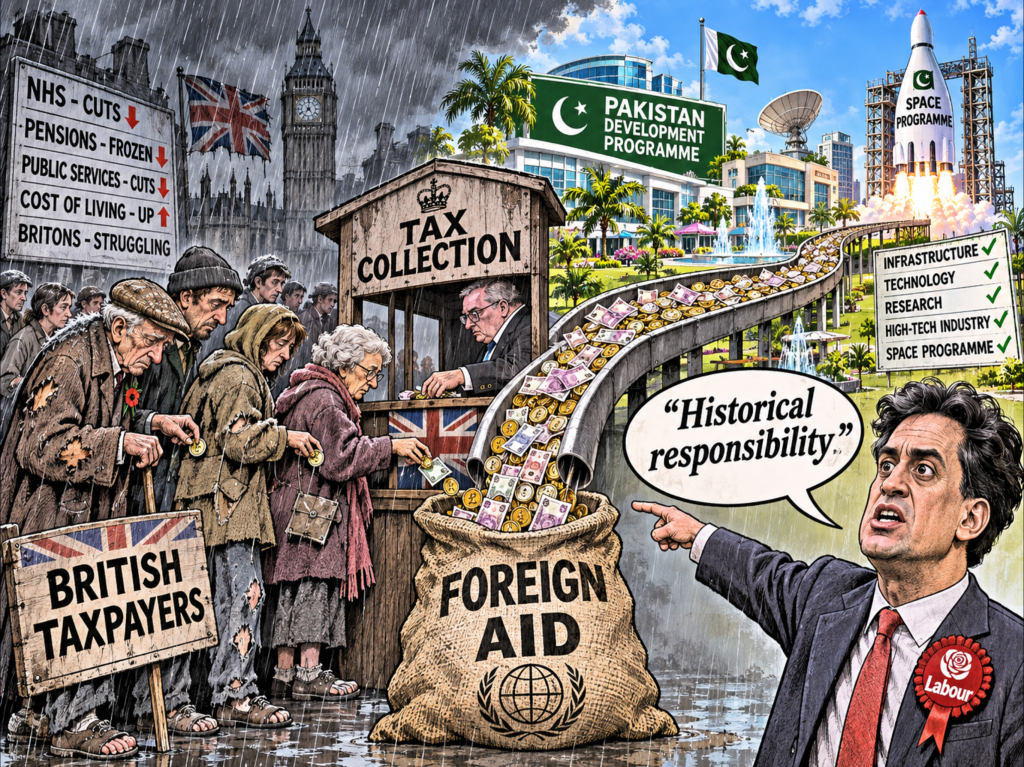
Labour’s Ed Miliband has argued that Britain bears historical responsibility for climate change and has a moral obligation to help countries such as Pakistan financially.
But there is a rather large problem with that argument.
Climate change does not stop at Pakistan’s border.
If Britain is historically responsible for climate damage in Pakistan, surely the same reasoning extends to Bangladesh, India, countries across Africa, South America and every other part of the world suffering its consequences.
So where does Britain’s financial responsibility end?
And who is expected to pay?
The British taxpayer, of course.
The Labour government has committed around £6 billion in overseas climate aid between 2026 and 2029, alongside £6.7 billion in additional UK-backed public finance.
That is a substantial commitment when Britain’s NHS, social care, public services and household finances are already under enormous pressure.
But What About Pakistan’s Own Wealth?
Here is another question British taxpayers might reasonably ask.
Pakistan is not a country without resources, economic activity or technological ambitions.
According to Pakistan’s own official statistics, its economy was worth approximately $450 billion in the 2025–26 financial year.
The World Inequality Report 2026 estimates that Pakistan’s richest 10% hold approximately 59% of the country’s wealth, while its richest 1% hold around 24%.
And Pakistan has a space programme.
Its national space agency, SUPARCO, is developing a lunar rover intended to travel to the Moon in 2028 as part of China’s Chang’e-8 mission.
That is a remarkable technological ambition for a country receiving substantial international development assistance.
It does not mean Pakistan is wealthy on a per-person basis. Millions of Pakistanis live in poverty, and a space programme does not mean the country can simply pay for every flood disaster itself.
But it raises a legitimate question about national spending priorities.
If Pakistan can invest in space exploration, how much responsibility should its own government and wealthiest citizens take for protecting its population against climate disasters before asking British taxpayers to contribute?
And What About Britain’s Own Workers?
Britain’s industrial revolution helped create the modern economy, but today’s workers did not make the decisions of the eighteenth and nineteenth centuries.
Yet they are being asked to finance the historical responsibilities attributed to those generations.
Every pound of public money committed overseas is a pound that cannot simultaneously be spent on British services, reducing borrowing or lowering taxes.
That does not mean every overseas commitment automatically causes a tax increase or a service cut. But it does mean there are financial choices and consequences.
Miliband argues that helping vulnerable countries is morally right and serves Britain’s interests.
But surely it is equally reasonable to ask how much Britain should contribute, how long these commitments should continue and whether recipient countries are making sufficient contributions themselves.
Where Does the Responsibility End?
If Pakistan qualifies for financial assistance because of Britain’s historical emissions, the argument cannot simply stop there.
Other countries also face climate damage.
Does Britain accept the same moral responsibility towards all of them?
And if so, who decides the amount Britain should pay?
The question for Ed Miliband and the Labour government is straightforward:
How much of Britain’s future wealth are you prepared to commit overseas, and how much responsibility are you prepared to place on British workers already struggling with the cost of living?
Helping people after disasters is one thing.
But asking British taxpayers to accept an ever-expanding historical financial responsibility, while recipient countries pursue their own national ambitions, deserves much greater scrutiny.
Before sending another bill to British workers, the government should explain exactly what Britain is paying for, what the recipient countries are contributing and where the financial responsibility ends.


Leave a Reply