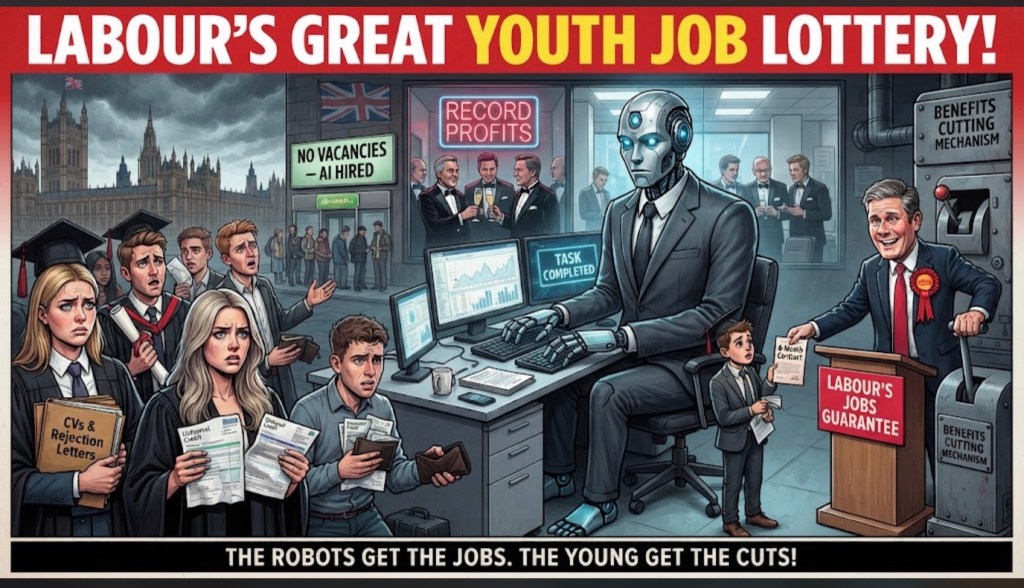
💷🔥Welcome to modern Britain, where Labour wants artificial intelligence to revolutionise the economy while telling young people to get off benefits and find jobs that could soon be performed by computers.
With nearly a million young people outside education, employment or training, Labour is promising investment, apprenticeships, digital skills and subsidised jobs.
Sounds marvellous. But where are the secure, properly paid careers — and will they still exist when the robots finish their training?
🎪 Labour’s Employment Circus: Plenty of Promises, But Where’s the Future?
Imagine being 22, applying for 150 jobs and receiving 149 rejections — many delivered by recruitment software before a human even reads your CV.
Then the government arrives, waving a shiny employment initiative.
Congratulations! You’ve won six months of subsidised work! 🎉
And afterwards?
That’s where the fairy tale gets complicated.
Temporary placements can provide valuable experience, but they don’t automatically create lasting employment. Without progression, Labour risks moving youngsters from benefits into short-term jobs and straight back into uncertainty.
🤖 Artificial Intelligence: Your Replacement Has Already Applied
Here’s Britain’s economic contradiction.
The government celebrates AI, automation and digital transformation while urging young people into a labour market where technology is already changing entry-level work.
Customer service, administration, research and even coding increasingly involve AI.
Yes, technology can create opportunities. But teaching youngsters to use a chatbot isn’t a substitute for building sustainable careers.
Britain risks training a generation for jobs that technology is already transforming — then blaming them when employment proves difficult to find.
💊 Feeling Unwell? Have You Tried Being Poorer?
Many young people face mental health difficulties, chronic illness, disability and financial insecurity.
Yet welfare reform can make the problem sound like an epidemic of laziness.
Depression doesn’t disappear because benefits become harder to claim. Chronic illness isn’t cured by a ministerial speech about productivity.
And poverty is hardly a recognised treatment for anxiety.
Removing someone from the benefits register without improving their future isn’t necessarily economic progress. Sometimes it’s poverty disguised as a successful statistic. 📉
✊ Where Have All the Young Rebels Gone?
Previous generations marched against unemployment, inequality and governments they believed had abandoned them.
Today’s youngsters face insecure employment, unaffordable housing, mounting financial pressures and an increasingly digital existence.
Perhaps the revolution hasn’t been cancelled.
Perhaps it’s simply stuck on a waiting list.
Young people still protest, but it’s difficult to fight the establishment when you’re struggling to pay rent and receiving automated rejection emails for minimum-wage jobs.
💷 More Wealth for Britain, Less Security for Its Young?
Labour’s apprenticeships, training programmes and employment support could genuinely change lives.
But announcing opportunities isn’t the same as delivering secure careers.
The real questions are simple: Are youngsters still employed after their subsidised placements finish? Can they afford independent lives? Are those with health problems receiving meaningful support?
And if AI makes Britain richer, shouldn’t the next generation share in that prosperity?
Otherwise, Britain could become a country where machines grow smarter, companies become wealthier and young people remain too poor to leave their parents’ spare bedrooms.
The robots get the productivity. The shareholders get the profits. The government gets the headlines. And Britain’s youngsters get told to update their CVs. 🤡
🔥 Challenges: A Jobs Revolution or Another Westminster Illusion?
Is Labour creating genuine careers or simply moving young people between benefits, temporary jobs and unemployment?
And if artificial intelligence promises greater national prosperity, why is Britain discussing reducing financial support for the generation expected to inherit it?
💬 Tell us what you think in the Chameleon News blog comments. Is Labour offering a lifeline or another expensive political numbers game?
👇 COMMENT, LIKE and SHARE — because Britain’s young people deserve a future, not just a place on a government spreadsheet! 🔥
🏆 The best comments will be featured in the next issue of Chameleon News magazine.


Leave a Reply