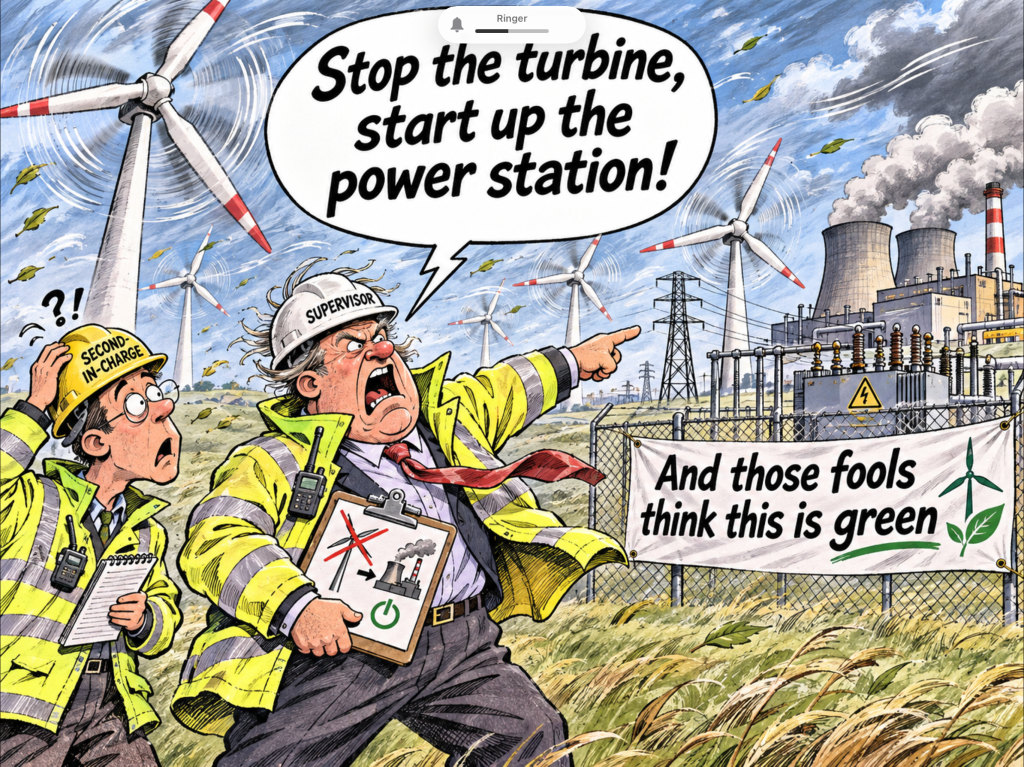
Welcome to Britain, where the wind blows for free, the electricity costs a fortune, and apparently the most profitable thing a wind turbine can sometimes do is absolutely nothing!
Only in the wonderful world of British energy policy could we build wind farms, celebrate the arrival of cheap renewable electricity, then discover we haven’t got enough transmission capacity to deliver it where it’s needed.
And what’s the brilliant solution?
Pay some wind farms to switch off, pay other power stations to switch on, and let British households and businesses pick up the bill.
You couldn’t make it up. Unfortunately, the National Energy System Operator (NESO) has published the figures. National Energy System Operator +1
🎪 The Great British Electricity Circus: Where Even Switching Off Comes at a Price!
Imagine running a restaurant where the chef gets paid to cook dinner, then receives compensation because the kitchen cannot deliver the food to the tables.
Naturally, you then pay another chef to cook a replacement meal.
And when the customer complains about being charged for the whole ridiculous performance, you explain that it’s all part of your exciting new Sustainable Dining Strategy.
Welcome to Britain’s electricity system. 🍽️⚡
The wind farms aren’t necessarily doing anything wrong. They’re operating within the market arrangements that have been established.
The bigger question is: who designed a system where producing electricity and getting it to customers appear to have been planned by two departments that have never met?
And just when you think it couldn’t become more absurd, along come the numbers.
NESO REPORTED GRID CONSTRAINT COSTS
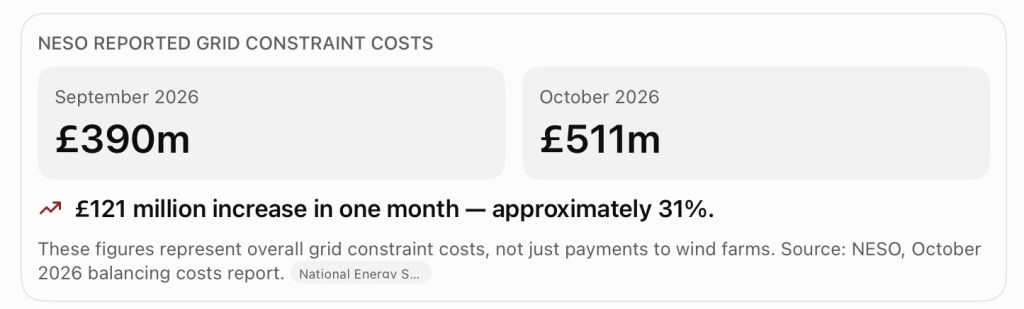
£121 million increase in one month — approximately 31%.
These figures represent overall grid constraint costs, not just payments to wind farms. Source: NESO, October 2026 balancing costs report. National Energy System Operator (NESO)
That’s £121 million extra in a single month.
At this rate, perhaps the next government energy-saving campaign should be called “Turn Off Your Lights So We Can Afford to Turn Off the Wind Farms.” 💡💸
And there’s more.
According to NESO, balancing the electricity system cost £3.1 billion during 2025–26, with just under £500 million paid directly to wind farms to reduce generation.
That’s nearly half a billion pounds in compensation for electricity that wasn’t produced. National Energy System Operator +1
Before someone starts screaming that every penny is pure profit, it isn’t. These payments operate through electricity-market balancing arrangements and can replace revenue generators would otherwise have earned.
But that doesn’t make the underlying problem disappear.
We’re paying to manage an expensive mismatch between where electricity is generated and where the network can deliver it.
🏗️ Build the Wind Farms First, Worry About the Wires Later!
Somewhere in Britain, you can almost imagine the following government planning meeting.
“Minister, we’ve approved another enormous collection of wind turbines in Scotland.”
“Splendid! Can we get the electricity to the people who need it?”
“Well, Minister, there is a slight issue with the transmission network.”
“How slight?”
“Approximately several hundred million pounds’ worth of slight.”
“Excellent! Put it under infrastructure challenges and announce another green success story!” 🌱🥂
Of course, the real problem is more complicated than a minister signing one absurd contract. Generation projects, network investment, market rules and planning decisions involve multiple organisations and successive governments.
But that complexity is precisely why somebody should be accountable for coordinating them.
NESO itself identifies the transmission bottlenecks between Scotland and England as a major contributor to these costs. It also reports that replacement generation, predominantly gas, represents a substantial part of thermal constraint spending. National Energy System Operator +1
So Britain can find itself paying to reduce wind generation in one location while paying gas-fired stations to produce electricity somewhere else.
It’s the energy equivalent of buying a brand-new electric car, forgetting to build the road, and then hiring a diesel taxi to complete the journey. 🚕⚡
💷 The Taxpayer and Billpayer: Britain’s Most Reliable Renewable Resource
Here’s the extraordinary part.
Politicians can spend years arguing about whether wind power is cheaper than gas, whether renewables are essential for energy security, and whether Britain should become a clean-energy superpower.
Meanwhile, the ordinary person opening an electricity bill has a rather simpler question:
“If the wind is free, why am I paying for someone to stop using it?”
The answer involves grid limitations, wholesale markets, compensation mechanisms and balancing charges.
Try explaining all that to a pensioner choosing how long to put the heating on.
Or a small business struggling with energy costs.
Or a family watching another direct debit disappear from their bank account.
The system costs are principally recovered through electricity charges, eventually affecting households and businesses. They aren’t simply a direct payment from general taxation.
But whether you call someone a taxpayer, a billpayer or the poor unfortunate soul at the end of the direct debit, the public is still carrying the cost.
And let’s not pretend that this is an argument against wind energy.
Cheap electricity is no bargain if the system repeatedly has to pay to throw some of it away and purchase replacement power.
Britain doesn’t just need more generation.
It needs transmission networks, storage, sensible market incentives and proper coordination so that the electricity we generate can actually reach the people paying for it.
Otherwise, we’re not building an energy revolution.
We’re building the world’s most expensive collection of industrial-sized garden ornaments. 🌬️🏆
🔥 Challenges: Who Signed Us Up for This Expensive Game of Musical Turbines?
Here’s the question that deserves to be asked in Parliament, in boardrooms and around every kitchen table in Britain:
Who thought it was intelligent to create an electricity system where consumers can end up paying generators to stop producing power, then paying other generators to replace it?
Was it poor planning? Political ambition racing ahead of infrastructure? Flawed market incentives? Or decades of governments announcing impressive energy targets without ensuring that the network could deliver?


Leave a Reply