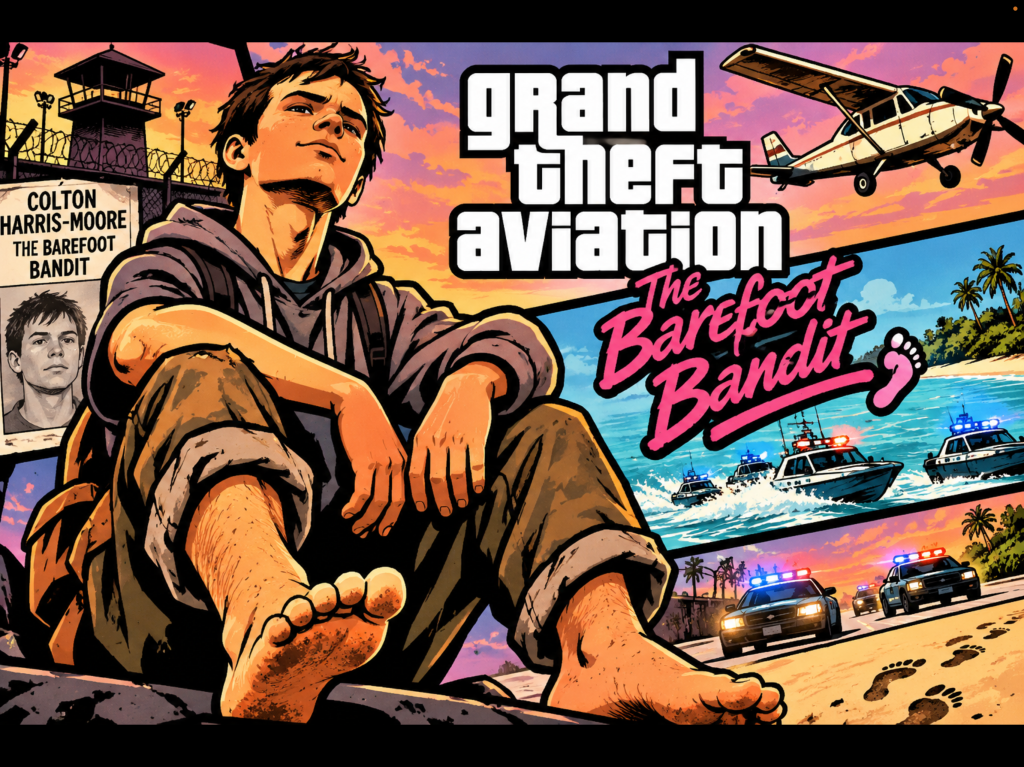
First, they failed to protect him. Then they imprisoned him. And when Hollywood came calling, they made sure he couldn’t keep the money from his own extraordinary story.
The story of Colton Harris-Moore, America’s infamous Barefoot Bandit, isn’t simply about a teenager who stole aeroplanes, escaped police and embarrassed the authorities.
It’s about something far more disturbing: a child who reportedly endured years of abuse, neglect and poverty, only to discover that the system was considerably better at punishing him than protecting him.
Growing up in Washington state, Harris-Moore experienced a childhood that most people would struggle to imagine. Court evidence described parental alcoholism, violence, neglect and desperate poverty. His lawyers said he began breaking into homes as a young teenager simply to obtain food and clothing. Los Angeles Times +1
And where was the protection? Where were the adults who should have intervened? Where was the safety net supposedly designed to stop vulnerable children from falling through the cracks?
Apparently, the cracks were large enough to accommodate an entire aeroplane. ✈️
⚖️ From Childhood Neglect to Prison: What an Extraordinary Achievement for the System!
Here’s a young man who reportedly had to fend for himself, yet somehow managed to teach himself the fundamentals of flying aircraft.
Think about that.
A teenager without a conventional aviation education developed enough knowledge to operate stolen planes, travel enormous distances and evade experienced investigators.
Not because someone recognised his potential and helped develop it.
Not because a teacher spotted an exceptional talent.
But because he was resourceful, determined and, by then, operating far outside the law.
Imagine what that determination could have achieved if someone had invested in him instead of allowing his childhood to descend into chaos.
He might have become a pilot, an engineer or an aviation entrepreneur.
Instead, he became an international fugitive.
And when the authorities finally caught him in the Bahamas in July 2010, the machinery of criminal justice sprang into action with an efficiency that makes you wonder where all that determination had been when he was a vulnerable child.
Prison sentences followed, including six and a half years at federal level and more than seven years at state level, ordered to run concurrently. Los Angeles Times +2
Suddenly, there were resources, legal proceedings, investigators, prosecutors and institutions ready to take charge of his future.
Funny how the system can find the money to lock someone up after failing to provide the protection they desperately needed growing up. 💰🚔
Of course, his crimes caused real damage. Innocent people lost property, suffered financial losses and deserved compensation.
But acknowledging his victims doesn’t require us to ignore the child who was himself a victim long before he became an offender.
🎬 Hollywood Wanted His Story — But He Wasn’t Allowed to Profit From It! 💵
And just when you think this story couldn’t become more outrageous, along came Hollywood.
In 2011, Harris-Moore agreed to a film-rights deal with 20th Century Fox, reportedly worth as much as $1.3 million.
Finally, an opportunity for a young man whose life had been dominated by hardship, criminality and imprisonment to turn his remarkable experiences into something financially valuable.
Except there was a catch.
Under his plea agreement, he couldn’t personally profit from selling the rights to his story. The proceeds were directed towards compensating his victims. The authorities did not actually block the film-rights deal; they supported using it for restitution. UPI +2
Compensating victims is understandable and important.
But here’s the uncomfortable question.
If society failed to protect this boy from abuse and neglect, should rehabilitation really mean denying him every financial benefit from telling his own story?
He wasn’t asking to steal another aircraft. He had secured an opportunity to make money through a legitimate agreement.
Yet he couldn’t keep the proceeds.
And the irony gets worse.
After leaving prison, Harris-Moore tried to raise money for legitimate flight training. That effort was also stopped by his supervision authorities, who said the money should instead go towards outstanding restitution. Seattle Red
So, consider the absurdity.
As a teenager, he taught himself enough to fly stolen aeroplanes.
As a convicted adult trying to pursue flying legally, he encountered another financial and legal obstacle.
Apparently, escaping a troubled childhood and stealing an aeroplane was easier than escaping the shadow of his criminal record. 🛫🤦♂️
💔 The Real Scandal Isn’t That He Broke the Law — It’s What Happened Before He Did
Let’s ask the question that ought to make every social worker, policymaker and child protection authority uncomfortable.
Who takes responsibility when a vulnerable child is failed so badly that criminality becomes part of his survival?
Colton Harris-Moore didn’t arrive in the world knowing how to steal planes.
He was once an ordinary child who needed security, food, encouragement, protection and somebody willing to believe he had a future.
According to evidence presented in court, his childhood provided precious little of that.
Yet when his behaviour became a problem for society, the institutions responsible for enforcing the law were suddenly impossible to escape.
A judge sentencing him on state charges acknowledged the extraordinary bleakness of his upbringing and took his remorse and background into account. CBS News
Even the courtroom recognised that this wasn’t an ordinary story of greed or criminal ambition.
It was also a story of profound childhood disadvantage.
That doesn’t erase his responsibility.
But it raises an equally important responsibility for society.
Why are we so efficient at calculating the financial cost of someone’s crimes, yet so reluctant to calculate the human cost of failing them as children?
We know how much his victims were owed.
We know how many years he was sentenced to serve.
We know what the Hollywood rights were reportedly worth.
But what was the price of the childhood he never properly had?
And who was ever held accountable for that?
🔥 Challenges: Who Really Failed the Barefoot Bandit?
Here’s something worth arguing about.
Should a young man who survived serious childhood neglect be punished without society also examining its own failures?
Was it right to divert his film-deal money entirely towards restitution, or should there have been some way to compensate victims while also helping him build a legitimate future?
And if a teenager can teach himself to fly aeroplanes despite such a troubled upbringing, how many other gifted children are being overlooked because they happen to be poor, neglected or labelled troublemakers?
Perhaps the greatest tragedy isn’t that Colton Harris-Moore became the Barefoot Bandit.
Perhaps it’s that we’ll never know who he might have become if somebody had given him a proper chance.
💬 Tell us what YOU think in the comments on the Chameleon News blog — not just on Facebook!
Was the punishment justified? Did society abandon him first? Or can both things be true?
👇 COMMENT, LIKE AND SHARE! Give us your verdict. Challenge the system, question the punishment and make your voice heard! 🔥⚖️🦶
🏆 The best comments will be featured in the next issue of Chameleon News Magazine! 📰


Leave a Reply