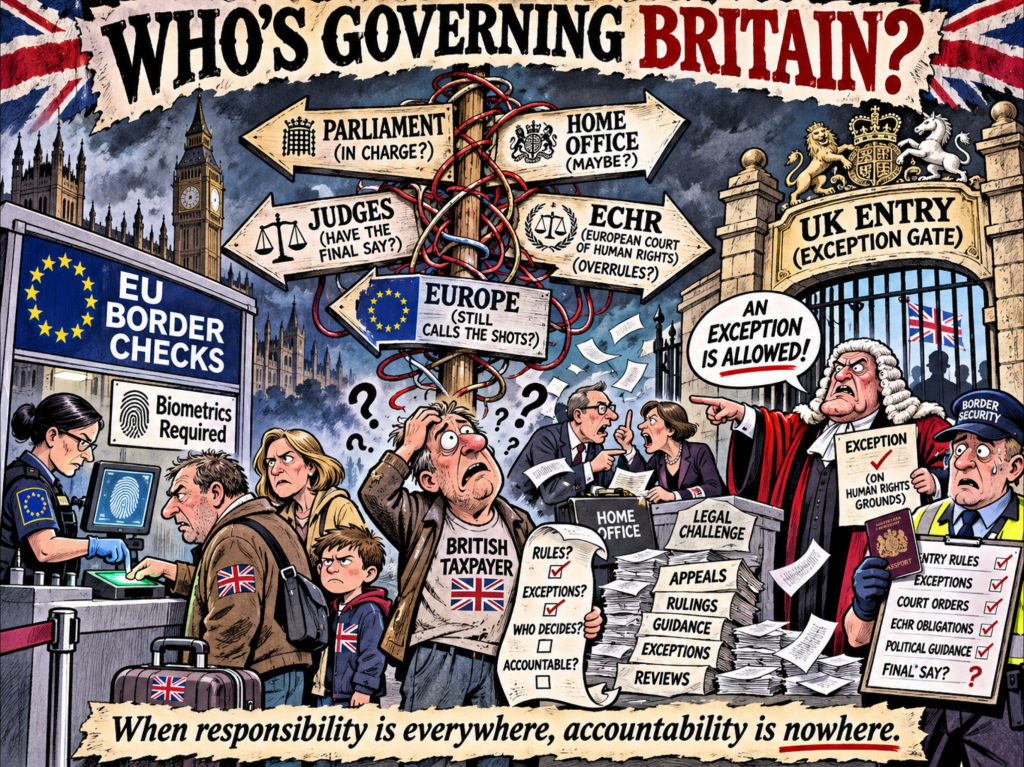
British citizens travelling to Europe are expected to provide fingerprints and facial recognition data as part of European border controls. Yet here in Britain, a judge has ruled that exceptional circumstances can justify allowing a family from Gaza to proceed without first completing the normal biometric requirements.
So here is the question: Why are British citizens expected to comply with strict European border controls while British courts can permit exceptions to our own?
The justification involves the European Convention on Human Rights, an international agreement that Britain signed and incorporated into domestic law.
But when did we reach the point where Britain needs an international agreement to keep its own elected government under control? Are we no longer capable of writing our own laws, protecting our own citizens and holding our own politicians accountable?
And this brings us to the bigger problem.
When citizens no longer understand who makes the laws, who interprets them and who can change them, confidence in justice begins to erode.
A legal system can be technically correct and still appear profoundly unfair to the people living under it.
When different rules apply to different circumstances, there must be a clear explanation of why. Otherwise, exceptions begin to look like preferential treatment.
And when elected governments blame judges, judges point to legislation, and politicians point to international treaties, the British public is left wondering who the hell is actually running the country.
Fairness requires more than laws being followed. It requires laws people can understand, decisions they can challenge and institutions they can hold accountable.
Because when the law becomes confusing, responsibility becomes invisible.
And when responsibility becomes invisible, democracy begins to lose its meaning.
The question is no longer simply whether Britain makes its own laws. It is whether the British people can still identify who is responsible for them.


Leave a Reply