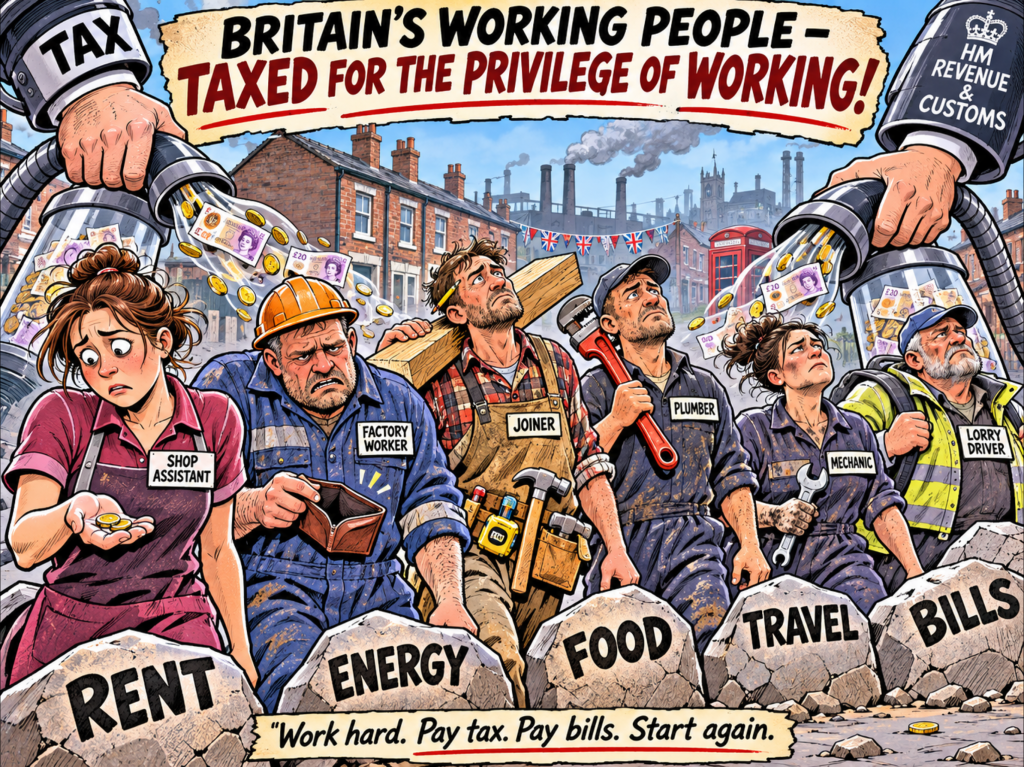
💷🇬🇧The joiner builds your home. The plumber keeps your water running. The mechanic keeps your car moving. The lorry driver keeps the shelves stocked.
Yet, according to our Total Working Household Burden Index, the very people keeping Britain’s commercial economy functioning could be left with remarkably little after taxation and essential living costs.
Our assessment calculates the following combined financial burdens as a percentage of employment value:
- Shop assistant — 99.6%
- Factory worker — 97.4%
- Warehouse worker — 92.5%
- Joiner — 82.7%
- Welder — 81.2%
- Plumber — 79.8%
- Mechanic — 79.7%
- Lorry driver — 75.9%
Under this assessment, a shop assistant is left with just £11 a month and a factory worker £65.
Financial freedom? Perhaps in the reduced-to-clear aisle. 🛒
💸 Congratulations! You’ve Earned Enough to Exist!
Welcome to the monthly obstacle course otherwise known as payday.
Your wages arrive, the bills assemble like a hungry pack of wolves, and whatever survives is expected to fund your ambitions, emergencies and retirement.
Fancy a holiday? Open Google Maps and use Street View.
Planning for retirement? Try not to age.
Need a new washing machine? Start negotiating with the laundry basket.
Meanwhile, economic growth is discussed in percentages, forecasts and impressive-looking graphs. But a rising GDP figure doesn’t necessarily mean a rising household bank balance.
Taxation funds essential public services, but affordability, wages, housing costs and taxation all deserve scrutiny when assessing whether employment delivers a reasonable standard of living.
Perhaps the most meaningful economic question isn’t simply how much wealth Britain generates, but how much financial security its working households actually enjoy.
After all, a joiner can build somebody else’s dream home while struggling to finance their own future.
There’s a rather uncomfortable irony in that. 🔨
🔥Challenges🔥
What does a full week’s work actually buy you anymore?
Is the problem taxation, inadequate wages, soaring living costs — or a combination of all three?
Does your own household experience reflect our findings? What would you change, and how would you balance household affordability with funding essential public services?
Join the debate directly in our blog comments. Don’t leave the conversation buried in Facebook’s comment section.
👇 COMMENT. LIKE. SHARE. Tell us what working life in Britain really costs you.
The best comments will be featured in the next issue of Chameleon News Magazine. 🎯


Leave a Reply