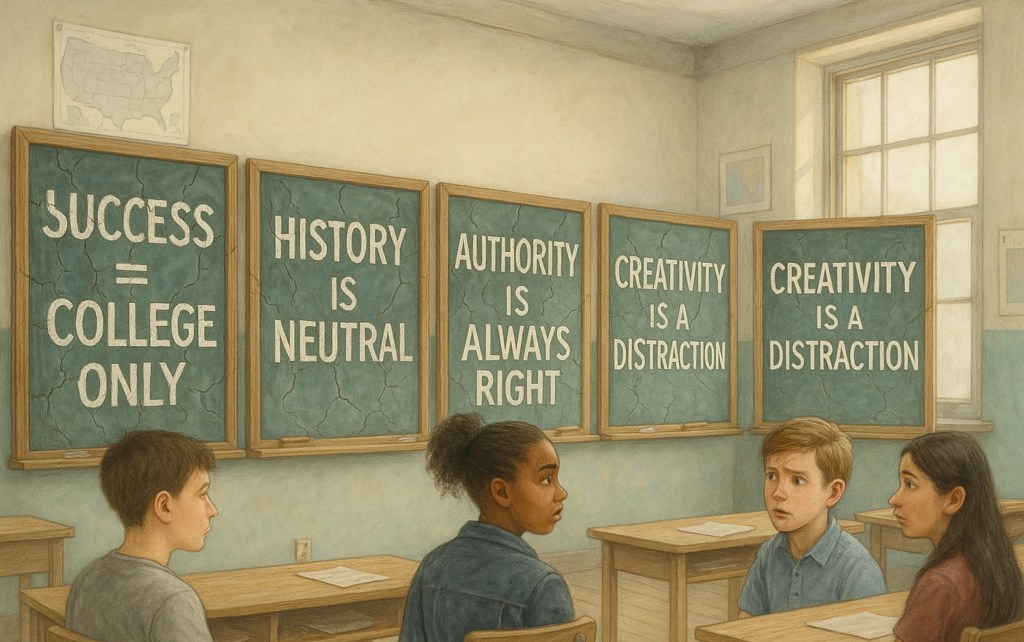
Inspired by Rachel Dvorak’s article, “The 5 Most Destructive Lies American Public Schools Have Taught Us to Believe,” this piece takes a distinctly British tilt on the same themes. While Dvorak’s reflections focus on the American education system, the underlying absurdities are just as present in British classrooms — albeit served with more uniforms, less air conditioning, and a stronger sense of quiet, repressed despair. In the grand halls of British schooling — where the scent of dry-marker ink mingles with existential dread — we were spoon-fed a buffet of well-meaning nonsense dressed up as wisdom. And like obedient little scholars, we swallowed it all with a side of square pizza and a 10-minute break. Here are five of the most gloriously destructive lies schools have taught us — now served with a generous helping of sarcasm, disappointment, and dry wit.
1. “You have to go to university to be successful.”
Ah yes, the sacred rite of passage: take out a small mortgage at 18, study something like “Medieval Gender Studies and Subtextual Papyrus Analysis,” then graduate into a job market that rewards charisma over Chaucer. Meanwhile, Dave from Form 2 who flunked his GCSEs now owns three vans and a heating business — and your radiator. But never mind! You have knowledge. And £60,000 of “character-building” debt.
2. “Getting good grades means you’re smart.”
Welcome to the British grading system, where an ‘A’ means you’re clever, a ‘C’ means you’re average, and an ‘E’ means you should probably try acting. Intelligence? No time for that. We’re measuring your ability to memorise what Mr. Jenkins said in Year 10 while desperately trying not to blink during the two-hour exam on Hamlet’s emotional constipation. Heaven forbid you actually understand something. Just regurgitate, my child — like an anxious academic seagull.
3. “There’s one right answer.”
Unless you’re applying for a civil service job or trying to cross a British road at a zebra crossing, this is a myth. In school, however, there’s only The Answer. Not your answer. Not an answer. The Answer. Usually located in the back of a textbook or inside Mrs. Ellington’s fraying binder from 1984. Heaven help the child who says, “What if it’s more complex than that?” Because now you’re a ‘disruption,’ which is code for “future podcaster.”
4. “You’re only valuable if you’re productive.”
Ah, the old Protestant work ethic wrapped in a high-vis vest and flogged to children before they’ve even hit puberty. Break time? What is this, France? No, Timmy, we’ve got targets to hit, league tables to climb, and mental health to ignore. In Britain, if you’re not busy, you’re lazy. And if you’re enjoying yourself while being productive, you’re obviously cheating.
5. “Authority is always right.”
Of course it is. That’s why we still wear ties in schools where the windows don’t open and you’re not allowed to go to the loo without written permission from the Archbishop of Canterbury. Authority in British education is infallible — just like the Head of Year who insists calculators are the devil’s abacus or the PE teacher who thinks the Battle of Hastings happened in 1065. But question them, and you’re labelled “difficult.” Or worse — “not a team player.”
Closing Thought:
Maybe it’s time we stop asking whether kids can recite oxbow lake formation diagrams from memory and start asking what kind of adults we’re creating. Because the true test of education isn’t the grade — it’s the aftermath.


 Chameleon Magazine
Leave a comment