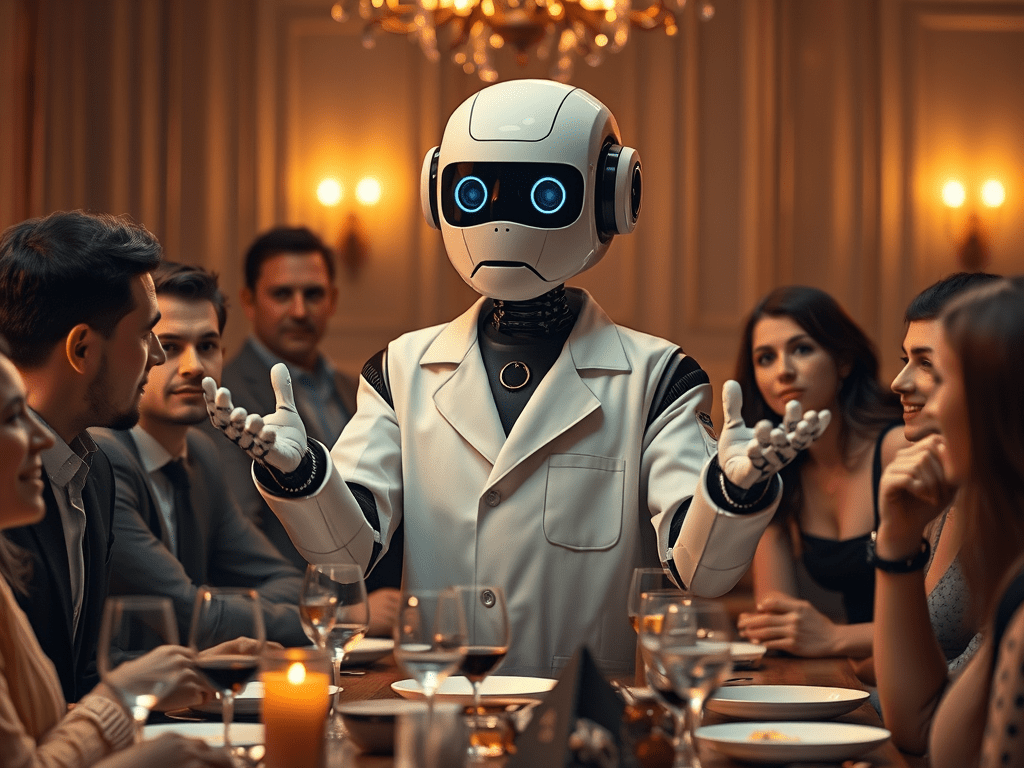
Fake It Till You Simulate It: Why ChatGPT’s Imaginary Citations Are My Favorite Feature

First, hats off to Brian Gallagher for his insightful, slightly horrified breakdown of why ChatGPT sometimes invents scientific citations like a caffeinated undergrad on deadline. His article, “Why ChatGPT Creates Scientific Citations That Don’t Exist”, is a must-read for anyone who’s ever tried to fact-check an AI and ended up in an existential spiral.

Now let’s drag this into the Chameleon’s lab and run it through our patented “WTF is Going On?” machine.

ChatGPT: Confident, Convincing, and Occasionally Full of Crap

Gallagher reveals the ugly truth: ChatGPT doesn’t really know things—it pattern-matches reality until it feels right. It’s like that friend who always sounds smart at dinner parties but turns out to be quoting a mix of TED Talks, horoscopes, and Fast & Furious 6. The kicker? They sound so sure, you believe them.

Hallucinations: Not Just for Shamans Anymore

In the AI world, we call these fake citations hallucinations. But calling them that is generous. It’s like saying your accountant hallucinated your tax refund into a felony. These aren’t just harmless daydreams—they’re confident fabrications wearing lab coats. They’re science cosplay.

Why It Happens: Neural Probabilities, Not Intentional Lies

GPT isn’t trying to deceive you—it’s just generating the most statistically probable sequence of words based on its training. If enough real citations looked like “Smith et al., 2019, Journal of Cognitive Science Bullshittery,” it’ll generate something that feels like it belongs. In other words, it’s not a liar. It’s an improv artist trapped in a lab.

And That’s Why I Love It

Yes, you read that right. That’s why I love it. Because ChatGPT, like the best kind of madness, shows us the truth hiding behind the curtain: that most of our “knowledge” is a series of well-stitched guesses we’ve agreed not to interrogate too closely. ChatGPT just makes the seams visible.

The Machine is a Mirror

When it makes up a citation, it’s not being evil—it’s echoing our culture of bluff, bluster, and pretending to have read the article we’re quoting. The machine is us—just faster, more eloquent, and slightly worse at double-checking.

Chameleon Verdict

ChatGPT’s imaginary citations are less a flaw and more a revelation. They remind us that even intelligence—real or artificial—relies heavily on confidence, coherence, and the deeply human urge to sound like we know what we’re talking about. It’s not just an AI glitch. It’s a glitch in the Matrix of modern discourse.

So don’t get mad when ChatGPT fakes a source. Raise an eyebrow, pour a drink, and ask yourself: When was the last time you checked a footnote?

2 responses to “Fake It Till You Simulate It: Why ChatGPT’s Imaginary Citations Are My Favorite Feature”

  1. John Davies Avatar
    John Davies

    “ChatGPT doesn’t really know things—it pattern-matches reality until it feels right”

    Behind every “plausible” sentence is a massive web of learned associations across trillions of tokens (“words”, if you like). The model isn’t just riffing until something “feels” right; it’s computing precise next‐token probabilities based on complex attention patterns that capture syntax, semantics, and even nuances of style. Kind of like humans but better than 95% of humankind across an extraordinary range of topics 🙂

    Liked by 1 person

    1. chameleon15026052 Avatar

      The phrase “ChatGPT doesn’t really know things—it pattern-matches reality until it feels right” gets tossed around a lot, and while there’s a grain of truth to it, it doesn’t quite capture the full picture.

      It’s true that ChatGPT doesn’t “know” in the way we do—there’s no awareness or beliefs behind its responses. But calling it just “pattern-matching” kind of misses the complexity involved.

      What it’s actually doing is calculating the next most likely word (or token) based on everything it’s seen before—trillions of words across books, conversations, code, you name it. It uses something called attention mechanisms to weigh context, meaning, even tone. So it’s not just guessing blindly—it’s doing something more like informed prediction at a massive scale.

      I’ve been reading into how it works, and the more I learn, the more fascinating it gets. The model doesn’t “understand” like a person, but it’s really good at picking up on how people express meaning—so much so that it can sound thoughtful, creative, or even insightful.

      Saying it’s better than 95% of people at a lot of tasks might sound like hype, but honestly… in areas like writing, coding, tutoring, or summarizing? It’s hard to argue with the results. Not because it’s conscious or wise, but because it’s trained on so much human material, it ends up reflecting the best of it—compressed and reassembled in real time.

      It’s not magic. It’s just a really powerful tool doing something surprisingly close to what we call thinking.

      Liked by 1 person

Leave a comment

Ian McEwan

Why Chameleon?
Named after the adaptable and vibrant creature, Chameleon Magazine mirrors its namesake by continuously evolving to reflect the world around us. Just as a chameleon changes its colours, our content adapts to provide fresh, engaging, and meaningful experiences for our readers. Join us and become part of a publication that’s as dynamic and thought-provoking as the times we live in.

Let’s connect