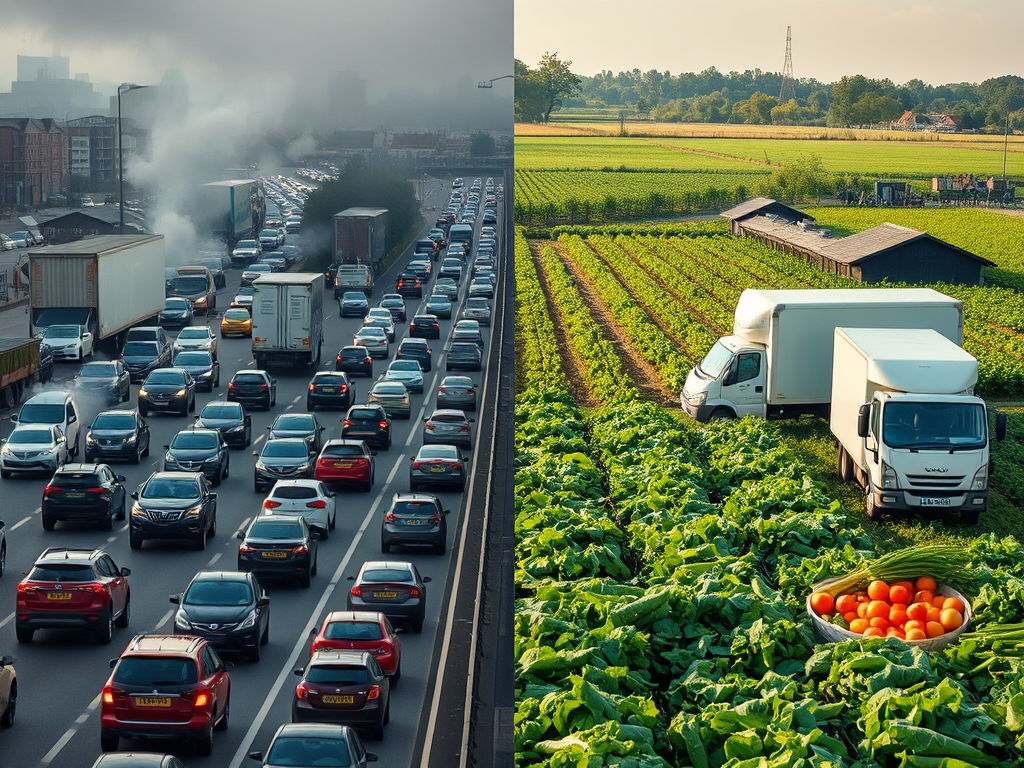
We were told ULEZ was about health.
Not tax, not politics—just clean air. Children coughing. Asthma rates. Diesel particles swirling invisibly around our lungs. And fair enough: no one wants to live in a petrol-perfumed smog bath. So we accepted it, reluctantly or not.
But here’s the uncomfortable question:
If pollution is serious enough to fine your nan for driving a 2009 Fiesta,
why are we still importing beef from Brazil, apples from New Zealand, and fish that passed more airports than you did last year?
Where’s the ULEZ for farming, fishing, and livestock?
🚛 Food Miles Are Emission Miles
Every avocado flown in from Peru. Every cow reared in Argentina. Every fishing trawler vacuuming the ocean 3,000 miles from our table.
They don’t just emit carbon—they waltz through policy loopholes like smoke through a cracked window.
We tell drivers they’re the problem, yet let supermarkets sell “fresh” food with a frequent flyer record.
🥩 The Inconsistency Is Rotten
ULEZ tells us:
“For the good of your lungs, your liberty is restricted.”
Fine. But then let’s be consistent. Let’s say to the food industry:
“For the good of the planet—and the soil beneath your feet—you must take what’s grown, caught, or raised nearby before importing anything else.”
No cherry-picking. No lettuce from Spain while Kent’s fields sit idle. No diesel fines for the delivery driver while the chicken came from Thailand.
🌱 The Fix Is Obvious. We Just Don’t Want to Say It.
You want clean air?
Then start with what’s on the shelf as well as what’s on the road.
Mandate local produce first. Make food sellers show their sourcing.
Give them import limits like you gave us emission zones.
Because otherwise, ULEZ isn’t a health policy—it’s a hypocrisy tax.
Either we’re serious about pollution, or we’re not.
If the diesel driver’s a villain, the global food system is an unindicted co-conspirator.
Let’s stop pretending you can clean the air without cleaning up the supply chain.


 Chameleon Magazine
Leave a comment