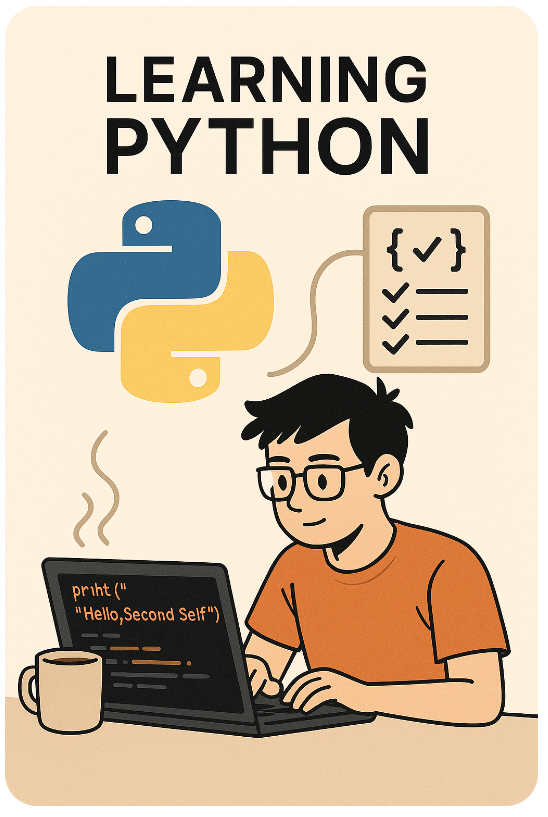
Over the next few weeks, I’m diving into something new: Python programming.
Not because I want to become a coder-for-hire or build the next TikTok (though who knows…), but because I want to give life to a project that’s been taking shape in my mind for months — Second Self.
Second Self is my vision of a lifelong companion system — part journal, part memory engine, part personal assistant — that grows alongside its user. To bring this from idea to reality, I need a toolset that’s flexible, practical, and powerful. Python fits that perfectly.
The Learning Path
I didn’t just want to dive in randomly. Instead, I’ve lined up a sequence of courses that will take me from absolute basics to a strong foundation, all while applying each lesson directly to the Second Self prototype. Here’s the order I’ll be tackling them:
- Python for Non-Programmers – A gentle introduction for people like me who want to learn programming logic from the ground up.
- Python Quick Start – A hands-on crash course that gets me coding small scripts right away.
- Python Essential Training – A deeper dive into the real mechanics of Python: data types, functions, error handling, and everything that makes the language so versatile.
- Learning Python (2021) – A reinforcement stage, where I’ll revisit the core concepts with a fresh perspective and newer examples.
By pacing myself this way, I’m not just “watching videos” — I’m layering my knowledge step by step, making sure I can actually use it.
Why This Matters for Second Self
Second Self isn’t going to build itself. It needs:
- Journaling functions (to store daily entries and reflections).
- A continuity core (a lightweight memory layer that tracks themes and emotions).
- Database skills (so nothing gets lost — SQLite is my chosen tool).
- Modular thinking (splitting the system into clear, functional pieces).
Every Python lesson I complete will be turned into a building block of Second Self. Lists become memory logs. Dictionaries become structured data. File handling becomes journaling. It’s all connected.
The Road Ahead
I expect this to take several weeks of steady learning. By the end, I don’t just want a certificate on my profile — I want a working prototype I can touch, test, and grow.
This is going to be equal parts experiment, education, and adventure. I’ll share updates as I go, along with any breakthroughs (and probably some spectacular mistakes) along the way.
And yes, it does mean you might see a few fewer blogs from me for a while. But don’t worry — they’re not stopping, just stripped back a little so I can give this learning curve the attention it deserves.
Second Self is about continuity — so in many ways, this is me putting that philosophy into practice. Step by step, code by code, lesson by lesson.
Stay tuned.


 Chameleon Magazine
Leave a reply to Mike Cancel reply