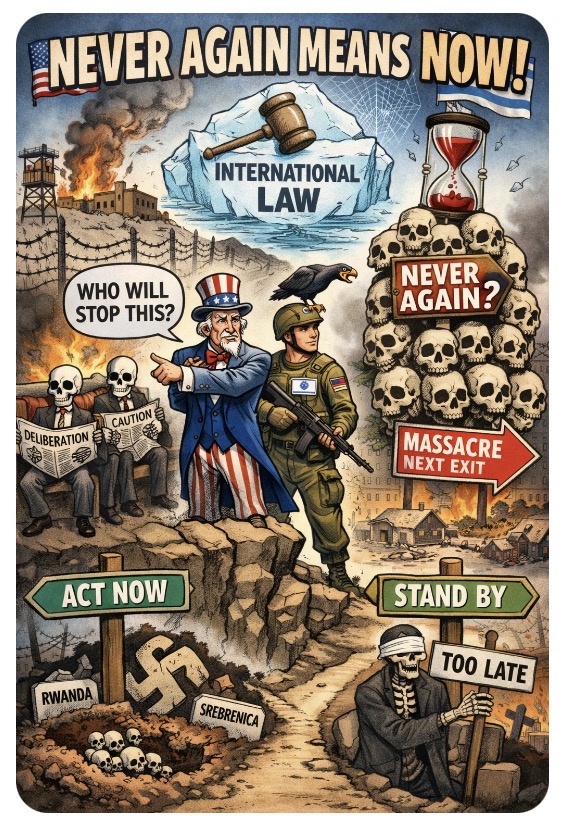
We carved the words into stone. We whispered them at memorials. We printed them in textbooks and posted them every January with black-and-white photos and trembling captions.
“Never Again.”
But here’s the inconvenient twist: “Never Again” only works if it applies when it’s uncomfortable.
If genocide is only condemnable when it’s geopolitically tidy… then it’s not a principle. It’s a vibe. 😬
And vibes don’t stop mass graves.
🔥 The Age of Outrage — Until It’s Inconvenient
We love a moral stance — provided it fits neatly inside international procedure, unanimous votes, and diplomatic choreography.
But atrocity doesn’t wait for paperwork.
If credible evidence shows a regime is systematically exterminating its own people, sovereignty doesn’t become sacred. It becomes a shield for slaughter. 🚫🛡️
Critics ask, “How dare America and Israel intervene?”
Fair question.
But here’s the sharper one:
Who else is stepping in?
Because history has receipts.
Rwanda.
Srebrenica.
In both cases, the world debated. The world assessed. The world urged restraint.
The killing did not pause for reflection. ⚰️
Yes, intervention carries risk.
Yes, escalation is possible.
Yes, mistakes happen.
But inaction has a body count too.
Supporting decisive action in such moments isn’t cheering for war. It’s acknowledging that sometimes force is the last thin line between a regime and annihilation.
And if the global system freezes while blood flows, what exactly are we preserving? Procedure? Optics? Plausible deniability?
⚖️ Morality Isn’t a Committee Vote
The Holocaust didn’t end because strongly worded letters were drafted. It ended because a regime was defeated.
If a genocidal state stays within its borders while exterminating millions, does neutrality become noble — or obscene?
We know the answer.
“Never Again” isn’t ceremonial language for memorial candles. It’s a standard. And standards cost something.
Standing with America and Israel in a scenario where mass slaughter is credibly unfolding means standing for:
• The idea that extermination voids moral legitimacy.
• The belief that deterrence matters.
• The recognition that preventing catastrophe is not colonialism dressed in camouflage.
It means saying sovereignty ends where systematic murder begins.
And no — support doesn’t mean blind allegiance. It means applying a hard filter:
Is the evidence real?
Are non-military paths exhausted?
Is the response proportional?
Is there a plan beyond the first strike?
If those thresholds are met, then hesitation can become complicity.
History rarely condemns those who stopped slaughter.
It often condemns those who watched.
🔥 Challenges 🔥
So let’s get uncomfortable.
Is “Never Again” a living principle — or a memorial slogan we dust off once a year?
If intervention risks escalation but inaction guarantees graves, where do you stand? Would you rather be criticized for acting too soon… or remembered for acting too late?
Take it to the blog comments — not just the algorithm. Bring your facts. Bring your fury. Bring your counterarguments. 💬🔥
👇 Comment. Like. Share.
The sharpest, smartest responses will be featured in the next issue of the magazine. 📰🎯


 Chameleon Magazine
Leave a comment