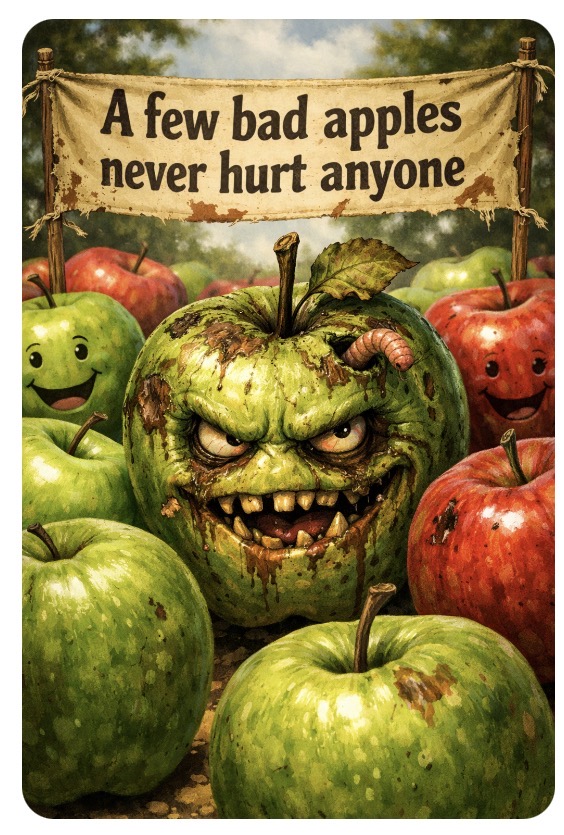
A mysterious wave of apple-related fatalities hits the nation… and somehow the biggest concern isn’t the deaths—it’s the feelings of the apples. Specifically, the green ones. What began as a simple observation (“Hey, these green apples seem to be killing people”) has spiraled into a full-blown campaign to protect the reputation of fruit, rather than the lives of those eating it.
🍏 The Great Apple Identity Crisis
First came the obvious: people noticed a pattern. Green apples. Not red. Not golden. Not the ones in your nan’s crumble. Green ones.
Naturally, someone suggested—brace yourself—removing the green apples.
Cue outrage.
Suddenly, orchard spokespeople, amateur philosophers, and part-time fruit activists emerged from the bushes yelling:
“NOT ALL GREEN APPLES!” 🍏😡
“IT’S JUST A FEW BAD APPLES!”
“STOP FRUIT SHAMING!”
And just like that, the conversation pivoted from “Why are people dying?” to “Why are you being so mean to apples?”
The government, always ready to solve the wrong problem with maximum efficiency, stepped in with a groundbreaking policy:
👉 All apples are equal.
👉 Stop identifying apple colours in reports.
👉 Please continue eating apples as normal.
Ah yes. Nothing says “public safety” like aggressively ignoring patterns.
Meanwhile, people are still dropping like overripe produce, but at least the apples’ self-esteem remains intact. Priorities. 🍎✨
Let’s be clear: this isn’t about apples anymore. It’s about the bizarre idea that identifying a problem is somehow worse than the problem itself.
Apparently, if you just repeat “a few bad apples never hurt anyone” enough times… reality politely nods and stops existing.
Spoiler: it doesn’t.
If pointing out what’s killing people is now “the real issue,” where does that leave us? Blindfolded in a supermarket of denial, hoping we don’t bite into the next PR-approved poison?
Go on—say it louder: when did noticing danger become more controversial than the danger itself? Drop your take directly on the blog. Stir the pot. Shake the tree. 🍏💥
👇 Comment. Like. Share. Tag someone who still trusts the “few bad apples” logic.
The sharpest takes (and juiciest rants) will be featured in the next issue. 📝🔥


Leave a comment