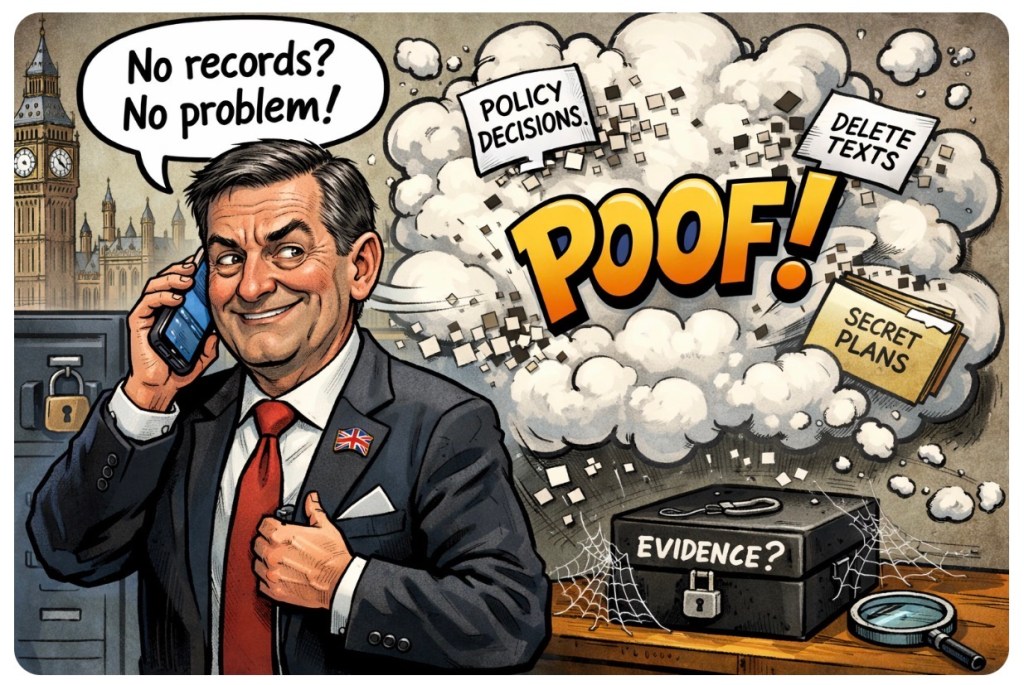
📱💨In a world where your nan can’t delete a Facebook post from 2012 without accidentally live-streaming herself, government ministers are somehow mastering the dark art of disappearing messages. Convenient, isn’t it? Policies that shape millions of lives—discussed in chats that vanish faster than accountability at a press conference. Magic trick or modern governance? 🎩✨
🕵️♂️ The Great Digital Houdini Act
Let’s get this straight: if you’re making decisions that affect healthcare, education, taxes, and whether Dave from Croydon can afford his heating bill—those messages aren’t “private chats.” They’re digital paper trails. Or at least… they should be.
Instead, we’ve got ministers treating encrypted apps like a lads’ group chat:
“Should we pass this policy?”
“Yeah lol 👍”
Message deleted
Gone. Poof. Democracy by Snapchat. 📸💀
Now—before anyone starts clutching their pearls about “Big Brother reading everything”—let’s clarify something important. This isn’t about turning every ministerial message into public reading material for bored insomniacs and amateur sleuths. No one needs access to their lunch plans or passive-aggressive emoji use.
This is about accountability with a memory.
Messages related to official work shouldn’t vanish into the digital abyss—they should be securely stored and accessible when things go wrong. Think less “public broadcast,” more “locked vault.” 🔐
Because when a policy collapses, a contract explodes, or a scandal crawls out of the woodwork, investigators shouldn’t be met with:
“Sorry, all evidence self-destructed after 24 hours 😌”
Failure to retain those records? That shouldn’t be a minor oversight—it should be a breach of duty. If you’re trusted to run a country, you’re trusted to keep receipts. 🧾
And the “black box” idea? Still standing. Planes have them. Why not politicians? If your decisions can nosedive public trust instead of an aircraft, maybe we should have a way to rewind the tape. 🎙️📉
Because here’s the uncomfortable truth: transparency isn’t about exposing everything—it’s about ensuring that when it matters, nothing important can be quietly erased.
🔥 Challenges 🔥
So where’s the line—privacy or plausible deniability? 🤨
Should ministers be allowed to “oops-delete” the very conversations that shape your life?
Jump into the blog comments and tell us: secure archive for accountability… or let it vanish and hope for the best? 💬🔥
👇 Hit comment, like, and share—drag this debate into the daylight.
The sharpest, spiciest takes will be featured in the magazine. 📝🎯


Leave a comment