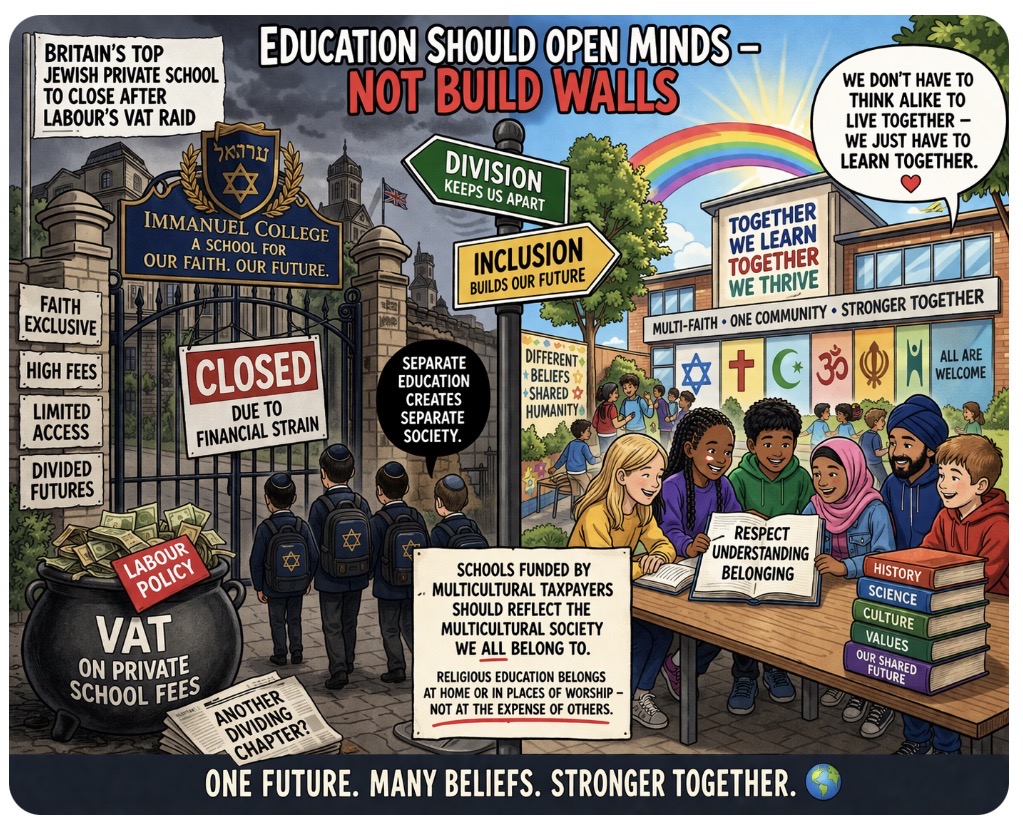
🏫⚖️The closure of Immanuel College has reignited a debate far bigger than tax policy. It cuts right to the heart of what education is meant to do—and whether publicly influenced systems should ever allow one belief system to dominate the formative minds of children.
🌍 One Classroom, Many Beliefs—Or None at All
Let’s strip this down to basics. Schools funded—directly or indirectly—by multicultural taxpayers should not become pipelines for a single religious worldview. That’s not education, that’s ideological branding with a uniform.
Because here’s the uncomfortable truth: when one religion dominates a school environment, it doesn’t just “teach values”—it filters reality. It shapes who belongs, who doesn’t, and what ideas are acceptable before kids are even old enough to question them.
And in a society that prides itself on diversity, that’s a contradiction dressed up as tradition. 🎭
What we should be building instead? Multi-faith, inclusive schools—places where children learn early that people believe different things… or nothing at all—and that coexistence isn’t something to fear, but something to practice daily.
Imagine classrooms where a child understands Ramadan, Christmas, Diwali, and atheism before they’ve even hit secondary school—not through doctrine, but through exposure and shared experience. That’s not dilution of culture—that’s expansion of perspective. 🌈
⛪ Keep the Faith—But Move It Out of the Classroom
Religious education absolutely has a place—but let’s be honest about where.
Homes. Churches. Mosques. Synagogues. Temples.
These are spaces designed for belief, tradition, and spiritual guidance. Schools, on the other hand, should be spaces for critical thinking, shared knowledge, and social integration.
Because when non-believing families—or those of different faiths—are effectively subsidising environments that prioritise a single doctrine, it stops being about choice and starts being about imbalance.
And that’s where resentment quietly brews. ☕
This isn’t about attacking religion—it’s about protecting fairness. About ensuring no child grows up thinking their worldview is the default setting while others are optional extras.
🎓 Education or Indoctrination? Pick a Lane
We can’t keep pretending the line isn’t blurry.
If education is about preparing children for a shared society, then segregating them—intellectually or culturally—undermines that goal from day one.
Multi-faith schools don’t erase identity—they contextualise it. They teach kids not just who they are, but how to live alongside people who aren’t the same. And in today’s world, that’s not a luxury—it’s a necessity.
🔥 Challenges 🔥
Are faith-based schools preserving culture—or quietly dividing the next generation? Should taxpayers support institutions that don’t reflect the full spectrum of society? And are we brave enough to rethink education before division becomes the norm? 👀🔥
👇 Drop your thoughts in the blog comments—this one’s guaranteed to spark debate.
Like it, share it, challenge it—bring your strongest arguments.
🏆 The best comments will be featured in the next issue of the magazine.


 Chameleon Magazine
Leave a comment