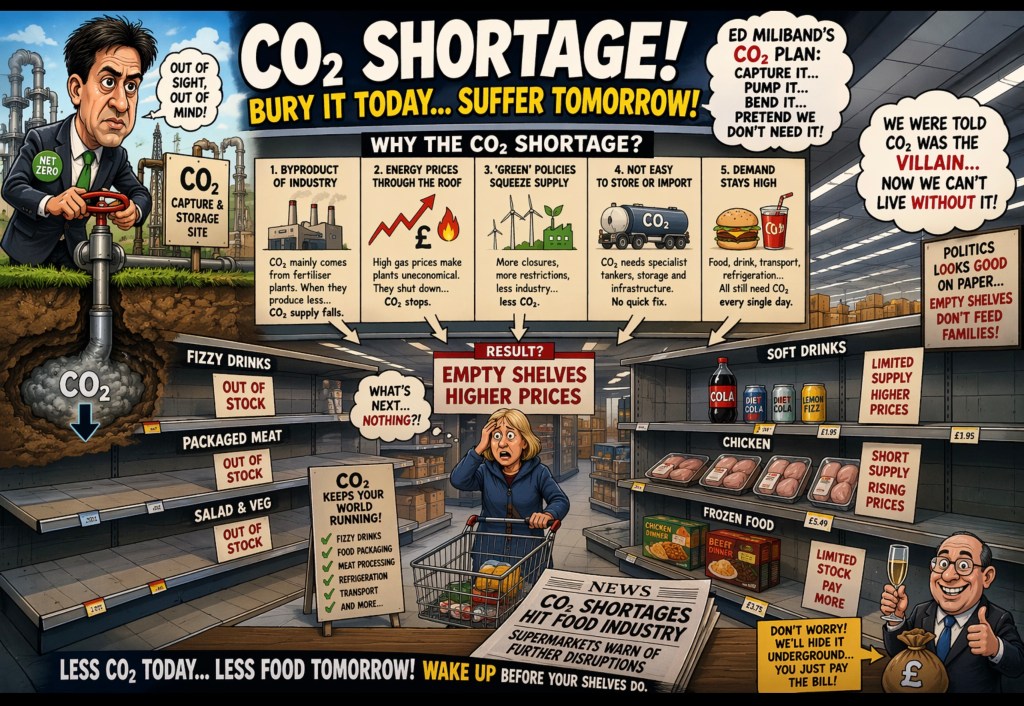
🫧🚨Yes, that CO₂. The same gas Ed Miliband wants pumped underground to “save the planet” is now creeping back into your life in a far more inconvenient form: shortages hitting the food chain.
Because here’s the twist nobody shouts about—CO₂ isn’t just an emissions villain. It’s also the quiet enabler of modern life. And when supply dries up? So does your weekly shop.
🥤 No Bubbles, No Burgers, No Chicken? Welcome to the Carbon Chaos
CO₂ keeps the wheels turning:
- Fizzy drinks stay fizzy 🍾
- Meat processing runs smoothly 🐔
- Packaged food lasts longer 🥩
- Cold storage works efficiently ❄️
Take it away, and suddenly:
- Drinks go flat
- Meat production slows or stops
- Supermarkets start looking… patchy
Not dramatic overnight collapse—but a creeping, frustrating squeeze that shows up as missing items and higher prices.
⚙️ So Why Is There a Shortage? Here’s Where It Gets Messy
This isn’t one single failure—it’s a perfect storm brewing behind the scenes:
1. CO₂ is a byproduct (not the main event)
Most of the UK’s CO₂ supply comes from fertiliser plants. When those plants slow down or shut (often due to high energy costs), CO₂ production drops with them. No fertiliser output = no CO₂. Simple as that.
2. Energy prices have wrecked production
When gas prices spike, running those plants becomes uneconomical. So they switch off. And when they switch off, the CO₂ tap gets turned off too.
3. “Green” shifts are squeezing supply further
As heavy industry gets scaled back or restructured in the name of cutting emissions, you lose more of those industrial byproducts—including CO₂. The system wasn’t redesigned to replace that supply.
4. Storage and imports aren’t a magic fix
CO₂ isn’t something you can easily stockpile like tins of beans. It requires infrastructure, transport, and timing. When supply dips, there’s no giant backup tank waiting to save the day.
5. Demand hasn’t gone anywhere
Food, drink, logistics—they still need CO₂ at the same levels. So you’ve got shrinking supply… and steady demand. That gap? That’s where shortages are born.
🤹 The Absurd Balancing Act
So here we are:
- Trying to get rid of CO₂ on one hand
- While desperately needing it to keep the food system running on the other
It’s not just ironic—it’s a logistical headache nobody seems keen to solve properly.
Because while policy talks big about the future, the present is quietly asking:
“Where’s the gas that keeps everything working?”
If CO₂ is so dangerous we must bury it… why does the system fall apart when we don’t have enough? Are we planning ahead—or just reacting after the shelves start thinning?
Drop your take in the blog comments—this one’s got contradiction written all over it. 💬🔥
👇 Like, comment, and share if you’d prefer your drinks fizzy and your shelves full.
The boldest and sharpest responses will be featured in the next issue. 🎯📝


Leave a Reply