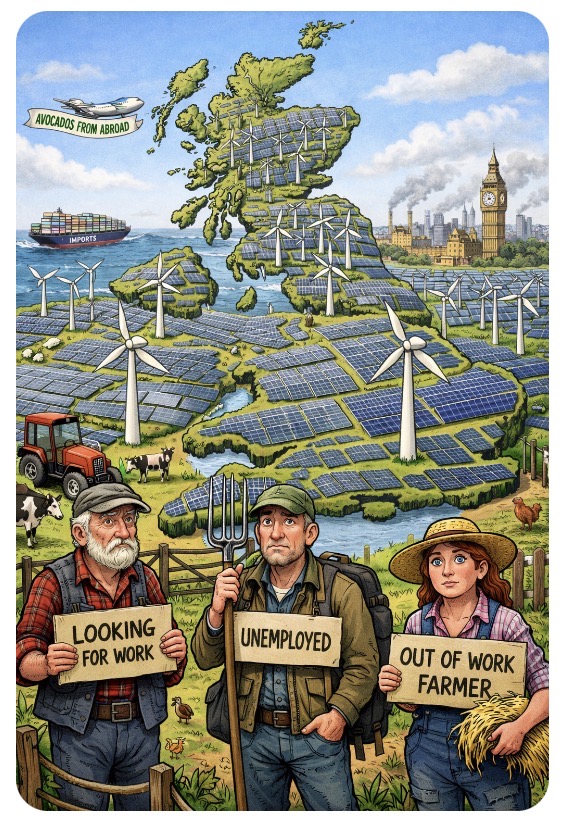
The UK’s food system looks stable—until you realise we’re increasingly swapping farmland for solar farms… and then importing the food we used to grow. Because nothing says “strategic resilience” like covering your fields in panels and hoping Peru’s harvest goes smoothly. What could possibly go wrong?
🌱 Fields of Gold… or Fields of Glass?
Somewhere along the line, we decided that prime agricultural land had a higher calling: becoming an energy spreadsheet’s dream. Solar panels stretch across fields that once grew food, wind turbines rise where livestock grazed—and the weekly shop quietly becomes more dependent on ships, fuel costs, and global stability.
Now, let’s be clear—renewables matter. Massively. But the execution? That’s where things get… chef’s kiss chaotic.
Because while we’re busy decarbonising our countryside, we’re also increasing reliance on imports for basics—and luxuries. British soil replaced by silicon, British produce replaced by… avocados flown in from 5,000 miles away. 🥑✈️
It’s a strange trade:
- Less domestic food production
- More exposure to global shocks
- And a nice green glow to make it all feel virtuous
Until, of course, energy prices spike and supply chains wobble—and suddenly we’re short on both power and peppers. Efficiency meets irony.
Meanwhile, farmers are stuck in the middle of a policy tug-of-war: grow food, host energy infrastructure, or just sell up and let someone else figure it out. Spoiler: the margins often make the decision for them.
So we end up with a system that’s greener on paper, but shakier in practice—where resilience is quietly sacrificed for optimisation.
🔥Challenges🔥
Would you trade local food security for cheaper, greener energy? Or is this a false choice we’ve lazily accepted? And how comfortable are you relying on global imports while standing in a field that used to grow your dinner?
Take it to the blog—this one’s ripe for debate. 🍽️🔥
👇 Comment, like, and share—defend the panels, defend the farmers, or just vent about £2.50 avocados.
The boldest takes will be featured in the next magazine issue. 🎯📝


Leave a Reply