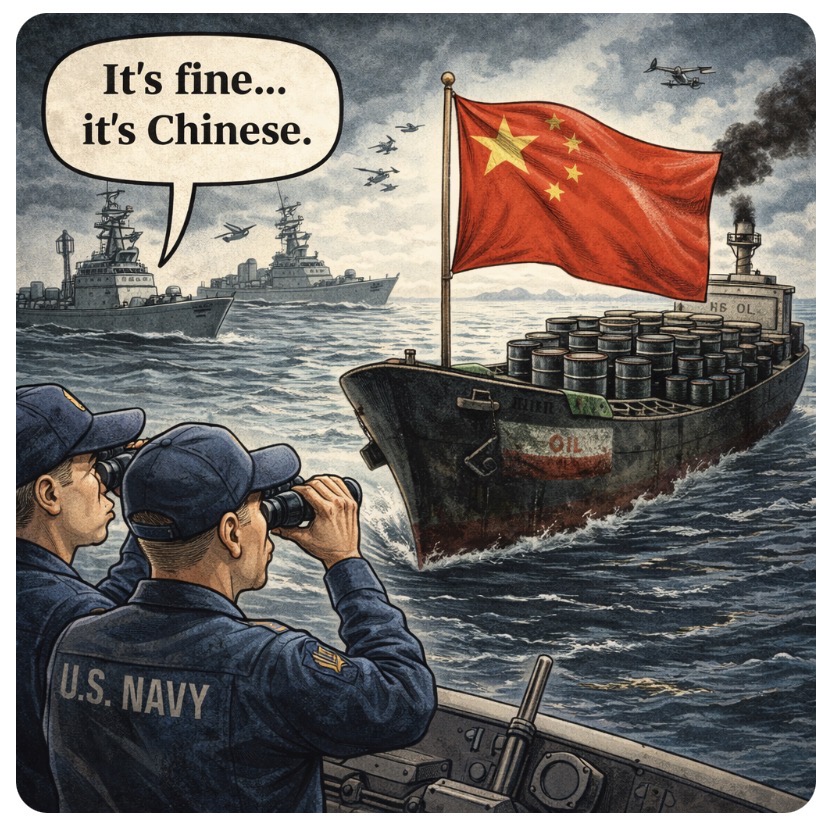
🏴☠️🇨🇳Somewhere between global trade and geopolitical brinkmanship, a strange new legend is forming on the high seas: pirate ships—not with skull-and-crossbones—but flying the Chinese flag to glide through the Strait of Hormuz untouched.
Because in 2026, even piracy apparently comes with… strategic alignment.
🏴☠️ Modern Pirates, Updated Branding
Forget eye patches and parrots. Today’s “pirates” are far more sophisticated—steel hulls, GPS navigation, and a keen understanding of geopolitics.
Why risk interception when you can simply rebrand mid-journey?
Swap the flag. Change the signal. Suddenly, you’re not a rogue vessel—you’re someone else’s problem.
And when China signals “hands off,” that flag becomes less decoration and more deterrent. 🚢⚠️
⚓ Power Plays in a Narrow Strait
The Strait of Hormuz has always been tense—but now it’s layered with something new: implied protection through association.
If vessels—legitimate or otherwise—can pass more safely under certain flags, then the rules of the game have quietly changed.
It’s no longer just about naval presence.
It’s about whose shadow you sail under.
Meanwhile, the idea of a US-enforced maritime order starts to look… negotiable.
🛢️ Trade, Tension, and Tactical Identity
This isn’t really about piracy alone. It’s about how fragile the concept of neutral trade has become.
When ships can alter identity for safety, it suggests:
- Authority at sea is no longer singular
- Power is being contested in real time
- Commercial and grey-zone actors are adapting faster than policy
And perhaps most importantly—control of trade routes is no longer just about ships and weapons, but about influence and perception.
🎭 The Disappearing Line
Where does legitimate shipping end and opportunistic behaviour begin?
If changing flags can mean the difference between safe passage and confrontation, then the line between compliance and exploitation gets dangerously thin.
Today it’s defensive strategy.
Tomorrow? It could be standard practice.
🔥Challenges🔥
If ships can effectively “choose” protection by changing identity, what does that mean for international law at sea?
Are we watching a clever workaround—or the early stages of maritime rules breaking down altogether?
👇 Drop your take in the blog comments—analysis, skepticism, or sharp critique welcome.
The strongest insights will be featured in the next issue of the magazine. 📝🔥


Leave a Reply