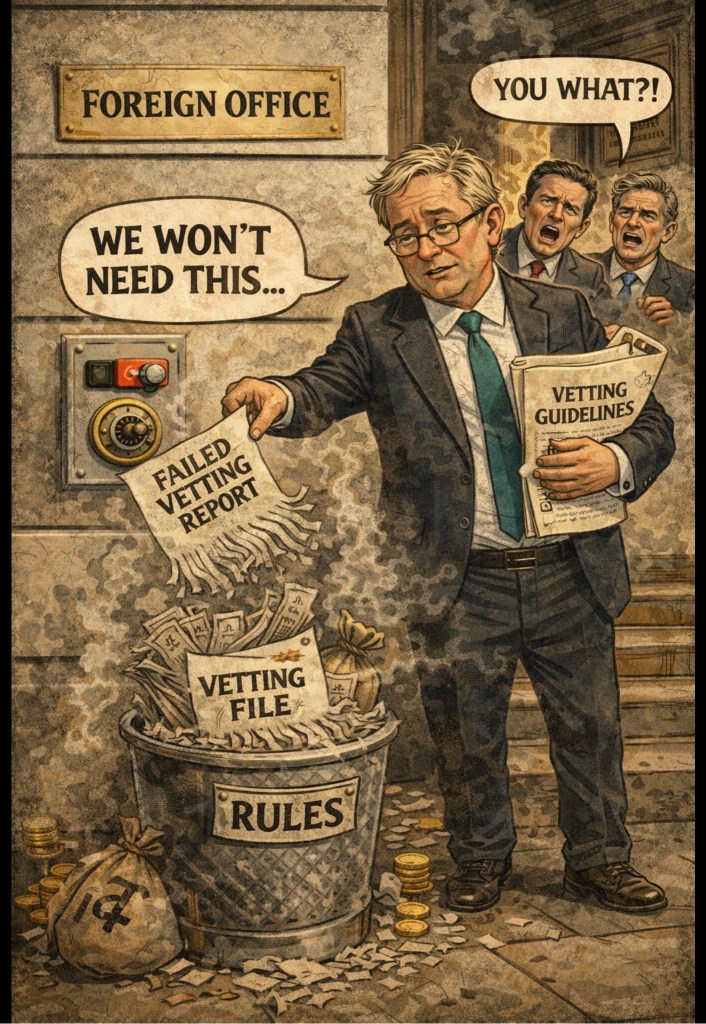
You’d hope the person running the Foreign Office knows the rules of their own game.
So when the suggestion emerges that those at the top were unaware that vetting decisions can be overridden… it lands somewhere between baffling and deeply uncomfortable.
🤔 Ignorance… or Optics?
Let’s be straight: there are only a few realistic possibilities here—none of them particularly flattering.
- They genuinely didn’t know
- Which raises serious competence questions
- Because this isn’t a minor procedural footnote—it’s a core safeguard mechanism
- They knew, but weren’t informed it was used in this case
- Which points to a breakdown in internal communication
- Or a system where critical decisions don’t reliably reach ministers
- They knew, and are now distancing themselves
- Which turns this into classic political damage control
Whichever version you pick, it doesn’t exactly scream “tight grip on the controls.” 🎛️
🎭 The Real Issue Isn’t Just Knowledge
This isn’t just about whether Sir Keir Starmer or his team knew the rule existed.
It’s about this:
👉 A major safeguard was bypassed
👉 The escalation chain failed (or wasn’t used)
👉 And afterward, no one clearly owns the decision
That’s the kind of setup that erodes trust fast—because it suggests the system can make high-risk calls without clear, accountable oversight.
⚠️ Why This Feels So Off
People expect two basic things from government:
- That safeguards mean something
- That leaders know what’s going on
When both are in doubt—even temporarily—it creates a vacuum.
And into that vacuum rush:
- Critics
- Speculation
- And yes… comments like those from Donald Trump
Because from the outside, it doesn’t look like nuance.
It looks like confusion.
🔥 Challenges 🔥
If leaders don’t know when safeguards are overridden… who’s actually in control? 🤨
And if they do know but say they don’t—what does that say about accountability?
Drop your take on the blog—cut through the spin and say what you really think. 💬🔥
👇 Like, share, and call it as you see it: incompetence, miscommunication, or something more calculated?
The sharpest responses will be featured in the next issue. 🎯📝


Leave a Reply