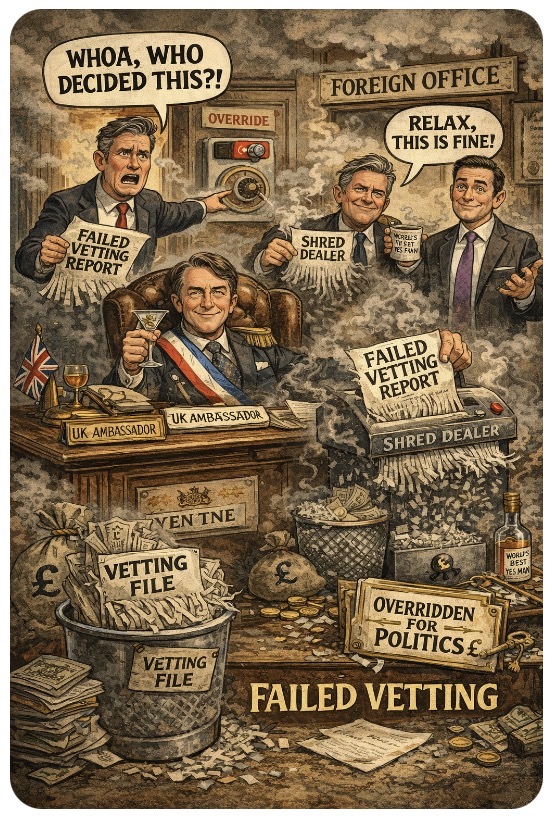
Let’s strip this right back—no spin, no polite Westminster wording, just the mechanics of what you’re describing:
A formal vetting process flags that Peter Mandelson should not be appointed.
That process exists specifically to stop risk—security, judgment, influence—from entering sensitive positions.
And then… the Foreign Office overrides it.
Not quietly bending a rule—
Flat-out stepping over the system designed to say “no.”
⚠️ The Moment the System Stops Meaning Anything
Here’s the uncomfortable reality:
If vetting can be overridden without:
- Clear accountability
- Transparent justification
- Ministerial awareness
Then it stops being a safeguard…
And starts becoming a suggestion box. 📥
That’s the part people are reacting to—not just the decision itself, but what it implies:
👉 The safeguard exists
👉 The safeguard fails
👉 The failure is allowed anyway
At that point, the question isn’t “was this legal?”
It’s:
What’s the actual purpose of the vetting system if its conclusions can be ignored?
🧠 “It’s Fine” vs “It’s Functional”
Now bring in Darren Jones suggesting this is acceptable.
There is a technical defence of that position:
- Vetting isn’t always absolute
- Governments sometimes override for political or strategic reasons
- Flexibility exists by design
But here’s where that argument hits a wall:
If overrides are normal, then the system relies entirely on trust in the people overriding it.
And right now, trust is exactly what’s in short supply.
Because from the outside, it looks less like:
“Carefully considered exception”
And more like:
“Rules for show, decisions elsewhere.” 🎪
🎭 The Bigger Problem No One Wants to Say Out Loud
This isn’t just about one appointment.
It’s about a structural contradiction:
- We’re told safeguards protect the public
- We’re told leaders are accountable
- But when safeguards are bypassed, accountability becomes… selective
And that’s how you end up with:
- Sir Olly Robbins out the door
- Ministers claiming they weren’t informed
- And the actual decision still sitting in the shadows
🔥 Challenges 🔥
If a system designed to say “no” gets overridden—should we still trust it to protect anything? 🤔
Or is this just security theatre with better paperwork?
And here’s the real pressure point:
If you’re okay with this override… where do you draw the line next time? ⚠️
Drop your raw, unfiltered take on the blog—not the safe version, the real one. 💬🔥
👇 Like, share, and call it what you think it is—necessary flexibility or a broken safeguard?
The sharpest, boldest comments will be featured in the next issue. 🎯📝


Leave a Reply