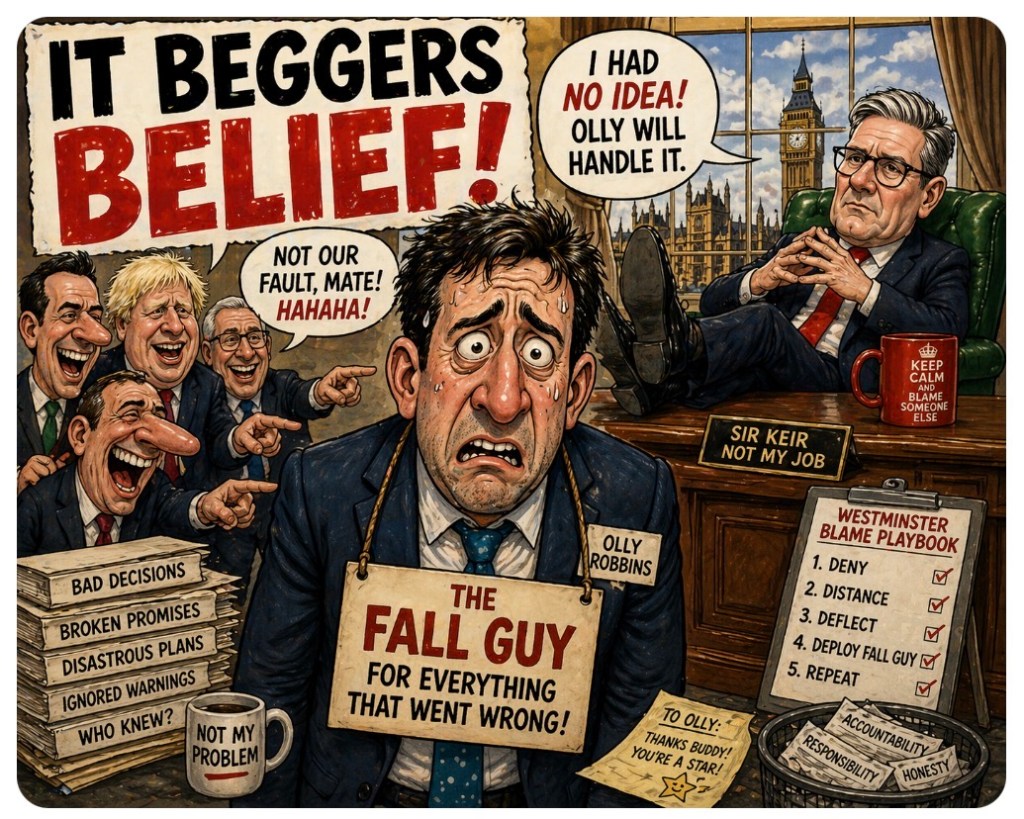
When the dust settles and the headlines start circling like vultures, somehow it’s always the same story—someone, somewhere, is left holding the entire mess like a political hot potato. And this time, the spotlight drifts straight toward Olly Robbins, as if he just wandered into the storm without a clue what was coming.
Really? Nobody saw this coming? Not a whisper, not a hint, not even a raised eyebrow in a corridor somewhere in Whitehall? Pull the other one. 🎭
🎩 The Fall Guy Factory of Westminster
This isn’t an accident—it’s practically an institution. Decisions get made at the top, polished for public consumption, and when reality inevitably crashes the party, the search begins for a suitable “responsible party.”
And who fits the bill perfectly?
Not the people giving the speeches.
Not the ones setting the direction.
No—someone just close enough to the action to take the hit, but not powerful enough to push back.
Enter the fall guy. Stage left. 👏
Hovering in the background, of course, is Keir Starmer—steady, composed, and remarkably untouched by the incoming splash damage. Because in modern politics, accountability is less about who made the call and more about who can be seen to absorb it.
🧾 “Lessons Will Be Learned” (Translation: See You Next Time)
The script writes itself:
- Things go wrong 📉
- Shock is expressed 😮
- Responsibility is “clarified” 🔍
- Someone carries the can 🥤
And just like that, the cycle resets—ready for the next crisis, the next scapegoat, the next round of “how could this possibly have happened?”
It doesn’t just beggar belief—it practically shakes it down for loose change.
🔥Challenges🔥
Do you really think these situations are surprises—or are fall guys quietly factored in from the very beginning? And if so, what does that say about how decisions are actually made?
Drop your take in the blog comments—no filters, no spin. 💬🔥
👇 Comment, like, share—call out the blame game loud enough that it can’t be ignored.
The sharpest, boldest responses will be featured in the next issue of the magazine. 🎯📝


 Chameleon Magazine
Leave a comment