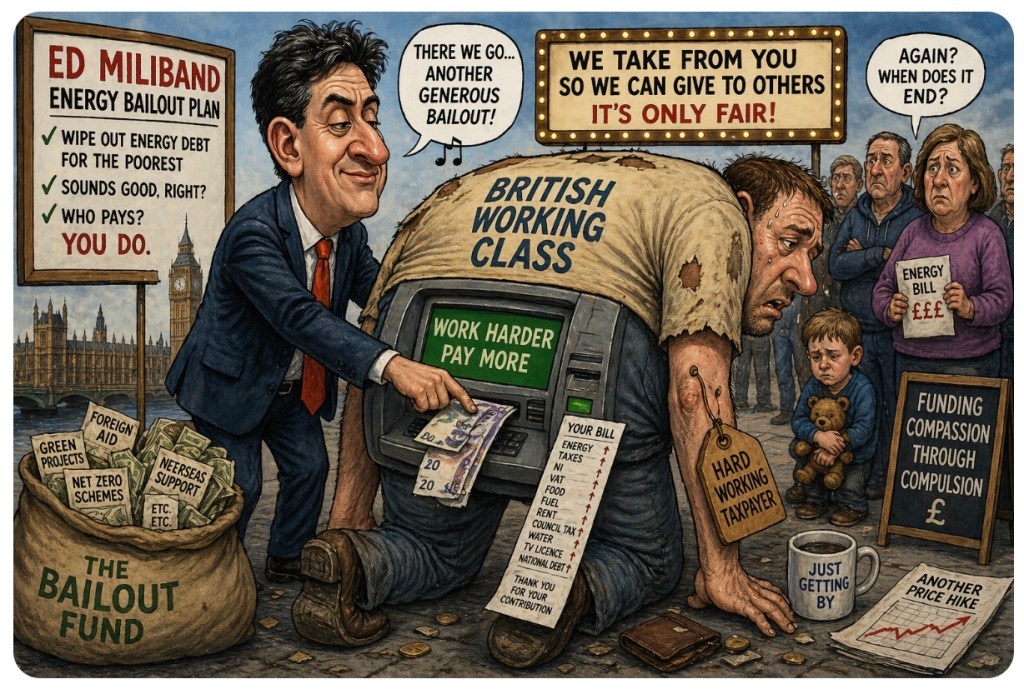
Another day, another grand political “rescue plan”—and somehow, like clockwork, the invoice lands squarely on the doormat of ordinary working people. This time, it’s Ed Miliband stepping up with a proposal to wipe energy debt for the poorest households. Sounds compassionate. Sounds necessary. Sounds… expensive. And not in a way that disappears into thin air.
🔄 The Magic Trick: Now You See the Debt, Now You Pay It
Debt doesn’t just vanish—it migrates. One minute it’s sitting with struggling households, the next it’s been politely redistributed across the rest of the population like an unwanted group bill nobody agreed to. 🍽️
Call it “targeted support,” call it “relief,” call it whatever makes the press release glow—but the mechanics stay the same. The cost gets absorbed elsewhere, and more often than not, that “elsewhere” is the already stretched working majority.
Because governments don’t generate money out of thin air—they reroute it. And when the rerouting starts, it rarely flows uphill.
🏦 Britain’s Most Reliable Revenue Stream: You
There’s a growing sense of déjà vu here:
Crisis hits → Solution announced → Applause → Bill quietly reappears under a different name.
Energy crisis? Working households absorb it.
Inflation spike? Working households juggle it.
New “support” package? Well… you see where this is going.
And while helping vulnerable people is broadly supported, the frustration kicks in when the same group keeps being tapped to fund every fix, with little say in how it’s structured.
🔥Challenges🔥
Is this the fairest way to handle a crisis—or just the easiest way to move costs without calling it what it is? And how many more “solutions” can the working class bankroll before patience runs out?
Drop your take in the blog comments—no filters, no fluff. 💬🔥
👇 Comment, like, share—say the quiet part out loud.
The sharpest and most brutally honest responses will be featured in the next issue of the magazine. 🎯📝


 Chameleon Magazine
Leave a comment