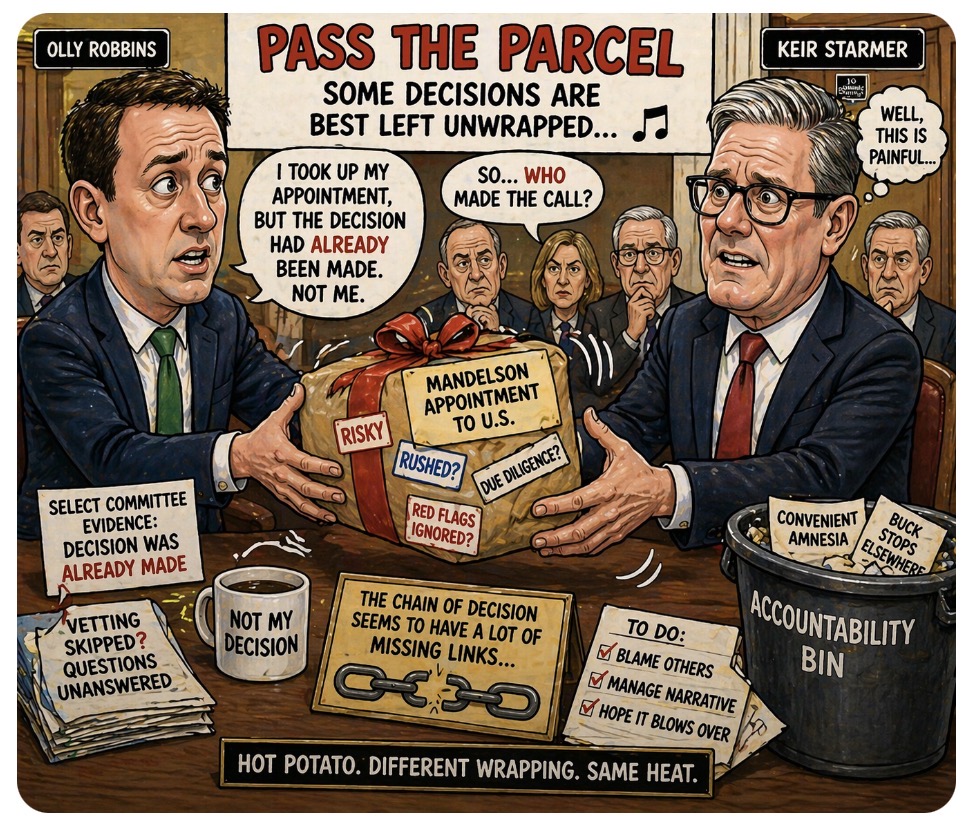
Well, that didn’t take long. Just when it looked like the fallout might be neatly contained, Olly Robbins steps into a select committee and effectively says: “Not my call—it was already done when I arrived.”
And just like that, the spotlight swings straight back toward the top—where Keir Starmer is now standing, blinking under it.
🎯 The “Not Me, Gov” Defence
This isn’t subtle. It’s the political equivalent of handing the parcel back with a note attached: “You signed for this.”
If Robbins is accurate, the timeline matters—a lot:
- Decision made before he took the role
- Vetting either rushed, skipped, or sidelined
- Responsibility drifting upward at speed
Which raises an awkward question: who actually signed this off—and why the rush? 🤨
✂️ Corners Cut or Questions Avoided?
Your point cuts to the core of it. If due diligence wasn’t fully carried out before pushing someone like Peter Mandelson into a sensitive international role, that’s not a minor oversight—that’s a gamble.
And not the fun kind.
Because in high-level appointments, especially involving international relationships (hello, Washington 🇺🇸), the vetting isn’t optional—it’s the whole point. Miss steps there, and you’re not just risking headlines… you’re risking credibility.
🧾 The Chain of Accountability (Now Reversed)
What makes this explosive isn’t just the claim—it’s the implication:
👉 The decision didn’t originate with the person now closest to the fallout
👉 The process may have been accelerated or bypassed
👉 The political leadership can’t easily distance itself anymore
In short, the “fall guy” script just got flipped. 🔄
🔥Challenges🔥
Is this a genuine case of corners being cut—or a carefully timed shift of blame as things unravel? And more importantly, should decisions like this ever be rushed at all?
Drop your take in the blog comments—who owns this mess now? 💬🔥
👇 Comment, like, share—because when the timeline changes, so does the truth.
The sharpest, boldest responses will be featured in the next issue of the magazine. 🎯📝


 Chameleon Magazine
Leave a comment