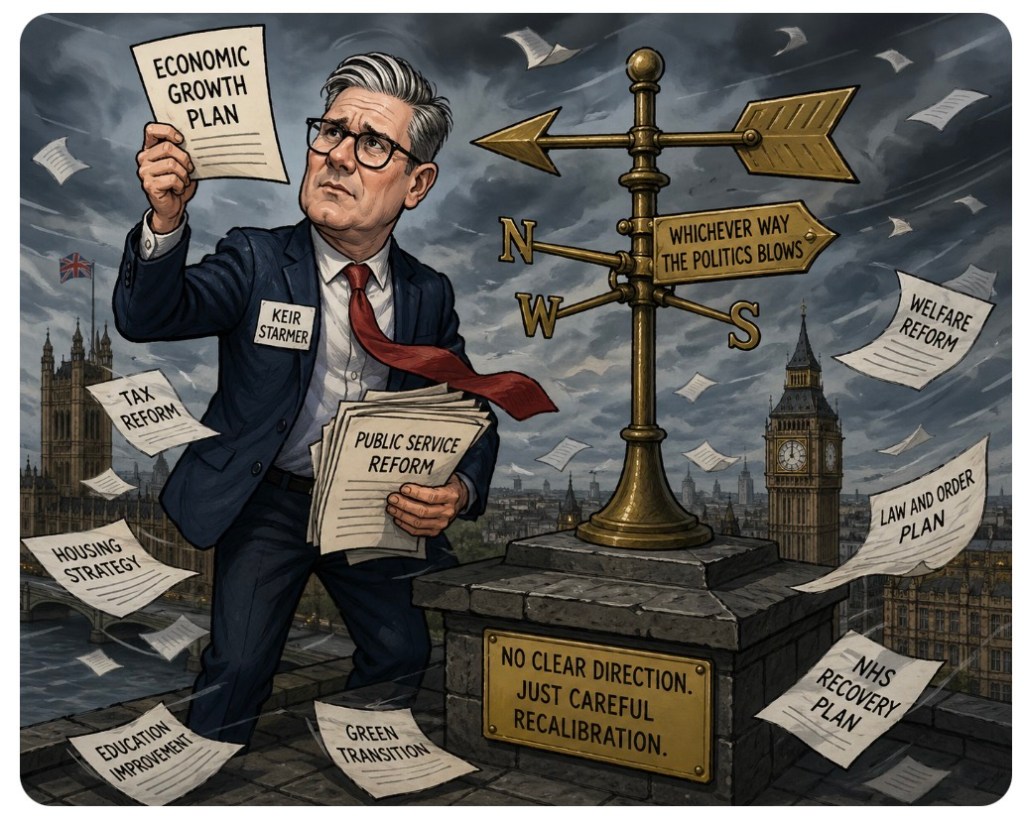
A nation adrift doesn’t always notice the drift at first. It feels like calm. Like caution. Like measured leadership. But at some point, the stillness stops looking strategic and starts looking suspiciously like… nothing at all. Welcome to the curious case of Keir Starmer — a leader who seems less like a navigator and more like a man politely asking the wind which way it fancies blowing today.
🎯 The Art of Going Nowhere—With Impressive Efficiency
There’s a fine line between steady leadership and political limbo, and right now, this government is doing Olympic-level balance work on it.
Policies appear. Then soften. Then vanish like a magician’s assistant who never signed up for the second act. One minute it’s bold ambition, the next it’s “well, let’s not rush into anything rash,” followed closely by a quiet policy retreat that tiptoes offstage hoping nobody noticed.
Spoiler: everyone noticed. 👀
But let’s go deeper, because this isn’t just about optics—it’s about structure.
A government without a visible through-line starts to feel like a playlist on shuffle. One track is fiscal restraint, the next is growth-at-all-costs, followed by a remix of “long-term reform” with no release date. The problem isn’t that any one of these ideas is wrong—it’s that they don’t seem to belong to the same album.
Take economic policy. We’re told to expect discipline—tight spending, careful budgeting, seriousness. Fine. Necessary, even. But then comes the parallel promise of rapid growth, investment surges, transformation. Ambition without a mechanism is just wishful thinking in a suit. Where’s the bridge between restraint and expansion? Right now, it looks less like a bridge and more like a polite suggestion that one might appear later.
And then there’s public service reform—the political equivalent of saying “we should really get in shape” while sitting on the sofa. Everyone agrees something must change. But what does “better” actually look like? Faster access? Cheaper delivery? Structural overhaul? Without a defined destination, reform becomes a permanent conversation rather than an achievable outcome.
Meanwhile, when pressure hits—and it always does—the response pattern is becoming predictable:
Confidence → recalibration → quiet retreat.
It’s not the recalibration that’s the problem. Good leadership adapts. But adaptation without explanation creates a vacuum. And in politics, vacuums don’t stay empty—they fill with doubt.
So instead of “we changed course because of X,” the public hears a softer, more ambiguous version: “we’re refining our approach.” Translation? Even we’re not entirely sure what the approach is anymore.
🎭 And that’s where credibility starts to wobble—not collapse, not implode, just… wobble. Persistently.
There’s also the international dimension. A Prime Minister isn’t just a domestic operator; global engagement is part of the job. But perception is everything. When voters at home feel unresolved pressures—cost of living, strained services, economic uncertainty—frequent appearances on the world stage can start to look less like leadership and more like strategic absence.
Fair or not, politics runs on perception, not footnotes.
If international meetings don’t translate into visible, tangible outcomes back home, they risk feeling like theatre: important conversations, impressive rooms, very little immediate relevance to everyday life.
And then we arrive at the core issue: consistency.
Changing your mind isn’t weakness. Failing to explain why you’ve changed it is. Repeated shifts without a clear narrative thread don’t signal flexibility—they signal instability. Over time, that creates a strange political atmosphere where every policy feels temporary, every announcement provisional, every promise quietly pencilled in rather than written in ink.
And if nothing feels solid, nothing feels trustworthy.
Which leads to the unavoidable question: what is the plan?
Not the next speech. Not the next policy tweak. Not the next carefully worded clarification.
The plan.
Where is the country going? What does success actually look like? And how do today’s decisions build toward that outcome in a way people can see, understand, and believe in?
Because right now, the overriding impression isn’t of a government making difficult, deliberate choices in pursuit of a clear goal. It’s of one managing events as they arise—competently, perhaps, but without a visible destination.
And managing is not the same as leading. 🧭
🔥Challenges🔥
Here’s the uncomfortable challenge: are we mistaking activity for progress? 🚨
Does a constant stream of announcements make you feel reassured—or just distracted? And if you had to explain the government’s long-term plan in one sentence… could you actually do it?
No dodging. No vague answers. Go to the blog and spell it out. Is this steady leadership in uncertain times—or a slow-motion drift with good lighting? 💬🔥
👇 Hit comment, hit like, hit share. Call it out, defend it, or dismantle it—we want the sharpest takes.
The best responses will be featured in the next issue of the magazine. 🎯📝


 Chameleon Magazine
Leave a comment